Industry
Why New York Needs a Cannabis-Infused Restaurant — And Why the First Chef to Build It Could Become a Billionaire


Across New York State — and especially in the 518 — cannabis culture is exploding. Dispensaries are opening, consumers are becoming more educated, and infused products are growing more sophisticated every year. Yet amid all this progress, one golden opportunity remains untouched: the cannabis-infused restaurant.
This is not just a trend waiting to happen. It is a billion-dollar idea hiding in plain sight.
A Culinary Revolution That Hasn’t Arrived in New York… Yet
Imagine a sit-down restaurant with a full infused menu:
• Breakfast plates with eggs fried in cannabis-infused oil
• Crispy “hash” browns with a double meaning
• Tender infused chicken dinners
• Gourmet sauces, butters, and glazes infused with carefully measured cannabinoids
Not edibles from a sealed package.
Not a pop-up dinner that lasts one night.
A full-scale, legal, culinary experience.
This concept has gained traction in other states. California’s Original Cannabis Café became a national headline when it opened as the first licensed, public cannabis dining venue in America. In Colorado, Detroit, and Las Vegas, cannabis-friendly lounges, private dinners, and chef-led infused events have sold out repeatedly.
The appetite is there. The demand is proven. The industry is ready.
Yet in New York State, not a single fully licensed cannabis restaurant exists. Not one. For entrepreneurs in the 518, that means the opportunity is still wide open.
Why Consumers Would Line Up Around the Block
The modern cannabis consumer doesn’t just want to get high — they want an experience. They want culinary creativity, atmosphere, and innovation. An infused restaurant would immediately appeal to:
• Cannabis connoisseurs hungry for something more than gummies
• Foodies and brunch lovers looking for a new twist
• Tourists seeking a unique NY attraction
• Non-smokers who prefer controlled edible effects over inhalation
• Wellness-oriented adults who use low-dose infused meals for relaxation
A chef who can combine real culinary artistry with responsible dosing would have the kind of competitive advantage most entrepreneurs can only dream of. This isn’t a niche. This is mainstream potential with a cannabis twist.
The Legal Landscape: Tough, But Not Impossible
New York’s Office of Cannabis Management has strict rules about where cannabis can be consumed. Currently, infused food served and consumed inside a restaurant is not permitted — a detail that explains why no one has opened such a venue yet. Legalization is evolving, regulations continue to change, and lawmakers are beginning to acknowledge the dining-with-cannabis market.
In states where cannabis dining has been allowed — even temporarily or through special licensing — the success has been immediate. This indicates one thing: the instant the law shifts in New York, the race begins.
The entrepreneur who prepares early, studies the regulations, works with attorneys, and builds a compliant business model now will be the one who dominates the market later.
A Billion-Dollar Concept Waiting for Its First Pioneer
The first true cannabis restaurant in New York wouldn’t just be a local success — it would become a destination. Think about it:
• Media coverage statewide
• Viral social media exposure
• Celebrity interest
• Cannabis tourism influx
• Investors waiting in line
• The potential for franchising
New York is a global food capital. A cannabis-infused dining experience here would attract attention far beyond the 518. The chef or team who creates the blueprint will define the industry for the next decade.
A Call to the Chefs, Innovators, and Dreamers of New York
New York is filled with talented chefs, creative thinkers, and entrepreneurs looking for the next big wave. Here it is. The concept has already succeeded elsewhere. Consumers already want it. The market is underserved. And the first person who can bring this vision to life — legally, responsibly, and with culinary excellence — stands to make history.
If you’re a chef reading this: the world is waiting for you.
If you’re an investor: the blueprint is right in front of you.
If you’re a supporter of cannabis innovation: share this idea far and wide.
Because the truth is simple:
This is the next billion-dollar restaurant movement — and New York is the perfect place to start it.



Industry
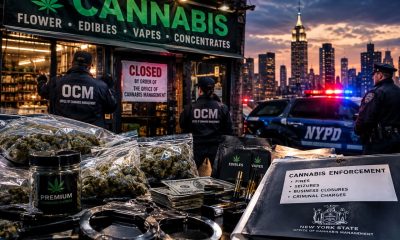
THE BLACK MARKET GAMBLE: Can Playing by Some of the Rules Keep New York Cannabis Businesses Safe?

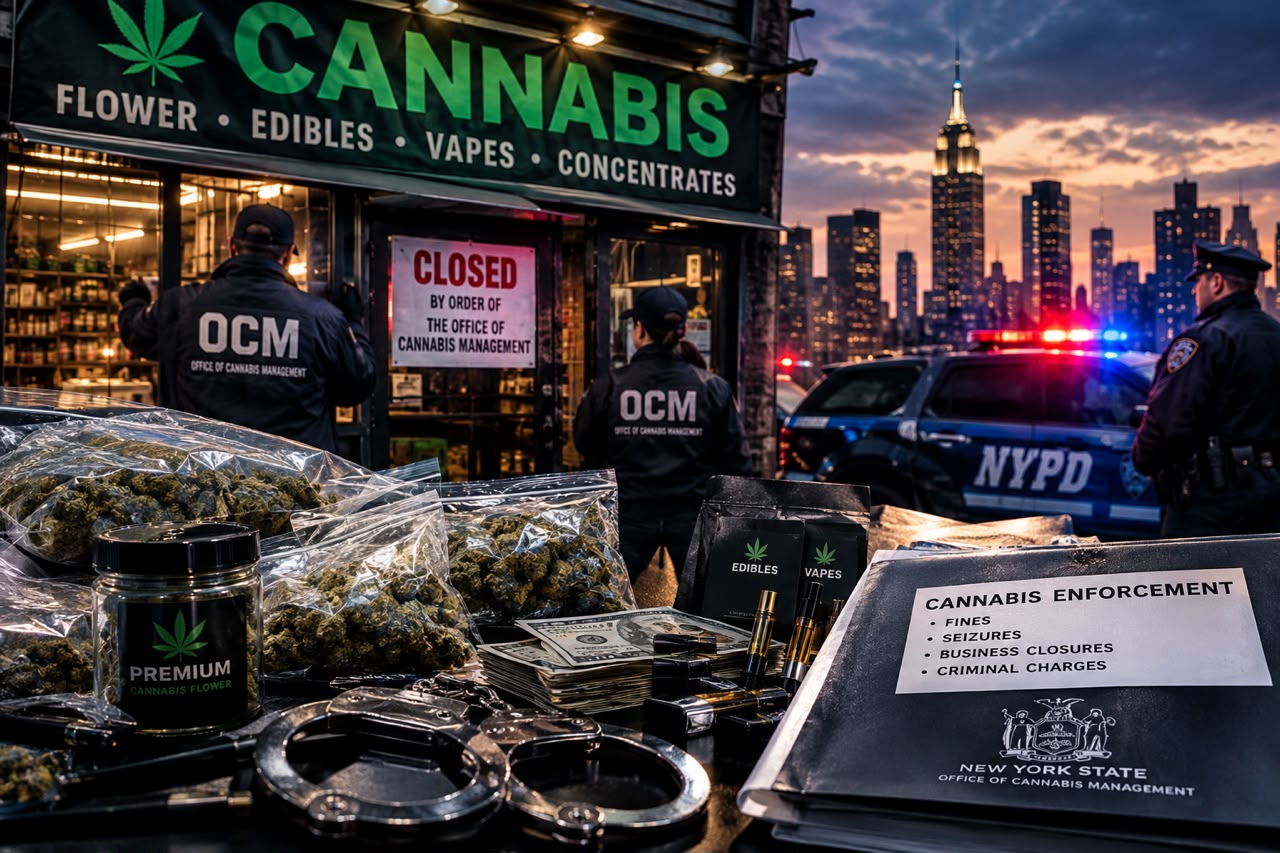
New York legalized recreational cannabis, but that doesn’t mean everybody selling it is operating legally. From pop-up vendors and cannabis events to unlicensed storefronts and businesses operating in regulatory gray areas, plenty of people are participating in an industry where the rules can be confusing—and the consequences of breaking them can be far more expensive than expected.
Some operators believe that if they sell quality products, label everything properly, avoid selling to minors, and follow as many safety rules as possible, they can reduce their chances of attracting unwanted attention from regulators. Others assume that getting caught simply means losing some inventory, paying a fine, and getting back to business.
But how much protection does following some of the rules actually provide? And what happens when the Office of Cannabis Management comes knocking?
Let’s break it down.
WHAT EXACTLY IS OCM?
The New York State Office of Cannabis Management, commonly known as OCM, regulates the state’s legal cannabis industry. It oversees licensing, compliance, product safety requirements, and enforcement against businesses operating outside the law.
Adults 21 and older can legally possess up to three ounces of cannabis flower and 24 grams of concentrated cannabis under New York law. However, the right to possess cannabis does not give someone the right to sell it commercially without the required authorization.
Having an LLC, a tax identification number, a business registration, or paperwork for a different cannabis-related activity does not automatically authorize commercial cannabis sales. A business may be legitimate in certain respects while still violating cannabis licensing requirements.
That distinction matters to pop-up vendors, event operators, smoke shops, brands, and anyone else selling cannabis products outside New York’s licensed system.
WHAT HAPPENS WHEN OCM COMES KNOCKING?
The consequences depend on the type of operation, the violations involved, the amount of product, and whether the operator continues selling after being ordered to stop.
Possible consequences include:
Fines: Civil penalties can reach thousands of dollars per day under applicable enforcement provisions.
Inventory seizures: Cannabis products may be confiscated.
Business closures: Certain unlicensed storefronts can be padlocked under the state’s enforcement procedures.
Major financial judgments: Operators who continue unlawful sales despite enforcement orders can face substantial penalties.
Criminal charges: Certain unlawful commercial cannabis sales can constitute criminal offenses.
New York Cannabis Law § 132 authorizes civil penalties of up to $10,000 for each day certain unlicensed commercial activity continues, plus additional penalties potentially tied to revenue or projected product revenue. Continued sales after an applicable cease order can expose an operator to penalties of up to $20,000 per day under that provision.
These are statutory maximums, not automatic fines imposed in every case. The actual outcome depends on the circumstances and applicable legal provisions.
A shutdown isn’t necessarily limited to two weeks, either. When the requirements for an emergency sealing order are met, a premises can be padlocked for an extended period.
REAL-WORLD ENFORCEMENT: THIS ISN’T JUST A WARNING
New York’s enforcement actions demonstrate that the consequences can go well beyond a small fine.
Brooklyn — January 2026
In an enforcement action announced by OCM on February 17, investigators recovered more than 220 pounds of cannabis flower, along with edibles, concentrates, and pre-rolls, at a Brooklyn location near a child-care center. The products had an estimated street value exceeding $1.4 million. The business received a notice of violation and was padlocked.
Previous major financial judgments
New York Attorney General Letitia James announced a $9.5 million judgment against the operator of the unlicensed Jaydega 7.0 dispensary in Ontario County. The judgment included penalties associated with continued unlawful sales after an order to stop.
In another case, the operator of seven unlicensed dispensaries associated with I’m Stuck and Weed Warehouse faced a $15.2 million judgment.
These were not ordinary first-offense cases. They involved commercial operations and serious enforcement proceedings. Nevertheless, they demonstrate the financial exposure that can arise when businesses continue operating unlawfully.
DOES FOLLOWING THE RULES HELP IF YOU’RE STILL UNLICENSED?
This is where things get interesting.
Imagine two operators. One sells products with no meaningful safety information, questionable packaging, and no reliable way to establish what’s actually inside them. The other takes product quality seriously, uses child-resistant packaging, provides accurate ingredient and potency information, and takes steps to protect consumers.
From a consumer-safety standpoint, the second operator is taking more responsible precautions.
But there is a major difference between reducing product-safety risks and complying with the law.
New York’s cannabis packaging and labeling regulations include requirements for licensed businesses involving potency, ingredients, warnings, packaging, and product documentation. The state also requires applicable cannabis products to undergo testing through permitted laboratories.
Simply putting a label on a product does not establish that it has been properly tested. Nor does a professional-looking package establish that the seller is authorized to distribute its contents.
Following some safety standards does not replace a required cannabis license.
An unlicensed business can still face enforcement even if its products appear well packaged, its customers are satisfied, and no one has reported a safety problem. Unpaid taxes and missing business authorization can create separate legal and financial exposure, depending on the circumstances.
Conversely, a licensed business can face penalties for failing to meet safety and labeling requirements. Licensing and product compliance are separate responsibilities.
IF YOU’RE OPERATING IN A GRAY AREA, WHAT SHOULD YOU DO?
There is no reliable checklist that guarantees an unlicensed cannabis business will avoid OCM enforcement. Rather than assuming that following selected rules makes an operation safe, operators should understand the legal status of their business and take steps to address any violations.
Here are the most meaningful precautions:
- Confirm what your paperwork actually authorizes. A business registration, event permit, or agreement with another company may not authorize cannabis sales. Verify the applicable license requirements with OCM or a qualified New York cannabis attorney.
- Take product safety seriously. Accurate labeling, appropriate packaging, reliable product documentation, and legitimate laboratory testing are important consumer-protection measures. They do not legalize unlicensed sales, but they address risks that can harm customers.
- Understand your tax obligations. Cannabis sales can involve state and local tax requirements. Operating outside the licensed system does not automatically eliminate tax obligations, and tax violations can create additional legal exposure.
- Do not ignore an enforcement order. Continuing prohibited sales after an official cease order can significantly increase potential civil penalties and lead to further legal action.
- Explore a lawful route forward. If your current operation is not authorized, seek legal advice about whether your activities can be brought into compliance, whether an appropriate license is available, and what obligations must be addressed before resuming sales.
The goal isn’t to make an unlawful business harder to find. It’s to understand the risks, protect consumers, and determine whether the operation can legally continue.
COULD YOU ACTUALLY GO TO JAIL?
Yes, in certain circumstances—but an OCM inspection or civil violation does not automatically mean jail time.
New York Penal Law § 222.50 makes certain unlawful commercial cannabis sales a Class A misdemeanor. For example, knowingly and unlawfully selling more than three ounces of cannabis or more than 24 grams of concentrated cannabis can qualify as criminal sale of cannabis in the third degree. The statute also covers certain unlawful sales to people under 21.
A Class A misdemeanor carries a maximum potential jail sentence of one year. More serious quantities or circumstances can lead to felony charges.
That doesn’t mean every pop-up vendor or small seller caught by OCM will be arrested. The facts, quantity, applicable offense, and evidence determine the outcome. Civil penalties, inventory seizures, and business closures are distinct from criminal prosecution.
But anyone who assumes that cannabis legalization eliminated criminal consequences for unlawful commercial sales should understand that it did not.
THE BOTTOM LINE: IS THE GAMBLE WORTH IT?
For some operators, the risk may seem manageable. They may believe that an occasional fine or loss of inventory is simply part of doing business. Others may decide that the possibility of losing their products, being locked out of their premises, facing a major financial judgment, or dealing with criminal charges makes the gamble unacceptable.
And there is no universal outcome. A small operation, a large storefront, a first inspection, and a business that repeatedly ignores enforcement orders are not interchangeable situations.
Following safety practices is responsible, but it isn’t a shield against licensing enforcement. Good packaging won’t replace a license, and a professional-looking business isn’t necessarily a legal one.
Maybe you believe getting busted is just part of the game. Maybe you think the potential profits justify the risk. Or maybe one enforcement action could take away everything you’ve worked to build.
So, is it worth it?
Is it worth risking your inventory, your business, your savings, and potentially your freedom for the chance to make money outside the licensed market? Or is getting caught even once a risk you simply can’t afford?
That’s a decision every operator has to make for themselves. But before taking that chance, make sure you understand what you’re actually risking.
This article is for general informational purposes and is not legal advice. Penalties depend on the applicable law and facts of each case.
There are few things more frustrating than discovering that two laws can exist at the same time, point in completely different directions, and somehow both be important to you.
New York says cannabis is legal for adults 21 and older.
The Second Amendment protects the right to keep and bear arms.
And then there is the complicated world of federal controlled-substance and firearms law sitting right in the middle of those two rights.
But in June 2026, something happened that changed the conversation.
The United States Supreme Court decided United States v. Hemani, a case involving a Texas man who regularly used marijuana and possessed a firearm in his home. The federal government prosecuted him under 18 U.S.C. §922(g)(3), the federal law that generally prohibits an “unlawful user of or addicted to” a controlled substance from possessing a firearm.
The Supreme Court unanimously rejected the government’s attempt to prosecute Hemani based solely on his marijuana use, holding that the government’s application of the law to him violated the Second Amendment. The Court emphasized that the government had not shown that Hemani’s marijuana use made him dangerous or otherwise supplied the individualized justification necessary to disarm him.
That is a BIG deal.
But here’s where New York gets complicated.
Because Hemani did not simply declare that every marijuana consumer in America now automatically qualifies for every firearm license in every state.
And that distinction matters.
THE TEXAS CASE THAT CHANGED THE CONVERSATION
Ali Hemani lived in Texas and admitted that he used marijuana about every other day. Federal agents found marijuana and a firearm at his home during an investigation unrelated to the firearm charge.
The government later prosecuted him under §922(g)(3), relying on his marijuana use.
The Supreme Court’s question wasn’t whether marijuana was legal under Texas law.
It was whether the federal government could take away Hemani’s Second Amendment right and prosecute him merely because he regularly used marijuana, without additional evidence showing that his drug use made him dangerous.
The Court said no.
The decision was an as-applied decision, meaning the Court decided the constitutionality of the federal prohibition as it was applied to Hemani’s circumstances. The Court did not declare every possible application of §922(g)(3) unconstitutional. It specifically left questions involving addiction, present intoxication, other controlled substances, and individualized evidence of dangerousness unresolved.
That is why headlines saying “marijuana users can now own guns” can be misleading if they leave out the details.
The decision opened a door.
It did not erase every law standing behind that door.
SO WHAT ABOUT NEW YORK?
New York has its own pistol-licensing system.
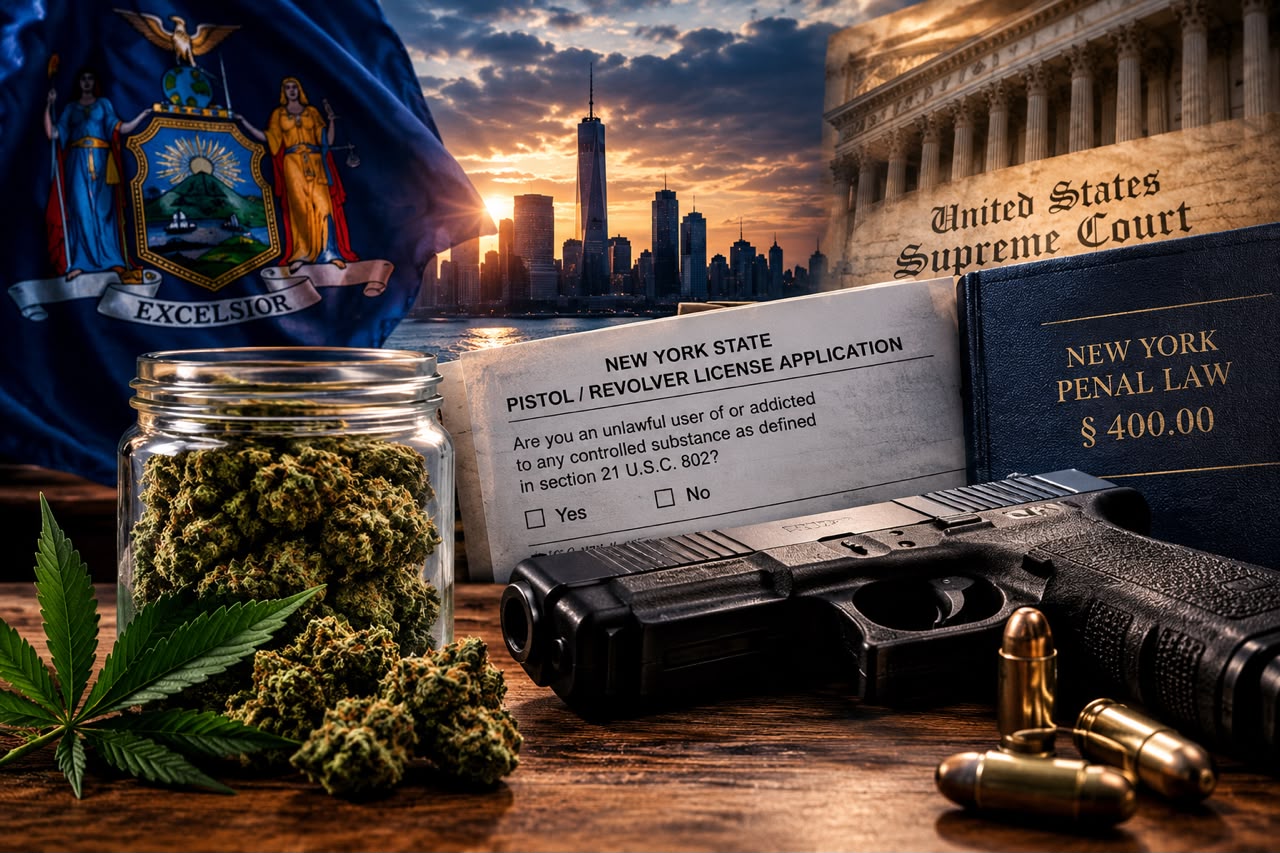
Under New York Penal Law §400.00, an applicant cannot be issued or renewed a pistol license if the applicant is an “unlawful user of or addicted to any controlled substance” as defined by federal law. The statute also requires the licensing officer to investigate the application and make findings concerning the applicant’s eligibility and character.
And the current New York State pistol/revolver license application asks applicants directly:
“Are you an unlawful user of or addicted to any controlled substance as defined in section 21 U.S.C. 802?”
So New York has not simply removed marijuana from the firearm-license equation because cannabis became legal under New York law.
New York legalized adult-use cannabis for adults 21 and older, including possession and consumption within the limits established by state law.
But federal law has historically treated marijuana as a controlled substance.
That creates the collision:
New York cannabis law says lawful.
New York pistol law still uses federal controlled-substance terminology.
The Supreme Court has now said that the federal government cannot automatically disarm a marijuana user based solely on marijuana use in circumstances like Hemani’s.
Welcome to the legal gray area.
WHAT IF YOU USED TO SMOKE BUT DON’T ANYMORE?
This is one of the most important distinctions.
There is a huge difference between saying:
“I used marijuana years ago.”
and:
“I currently use marijuana.”
New York’s statutory disqualification is written in the present tense. It says an applicant must not “be” an unlawful user of or addicted to a controlled substance.
That means past marijuana use is not automatically the same thing as current unlawful use.
In fact, the current New York application asks the applicant whether they are an unlawful user or addicted—not simply whether they have ever consumed cannabis.
That doesn’t mean an applicant should hide past drug use.
Quite the opposite.
New York’s application separately asks applicants about arrests, charges and indictments, including matters that may be relevant to their background investigation.
And New York courts have repeatedly emphasized that applicants must provide truthful information and that licensing officers have substantial authority to investigate an applicant’s eligibility based on character.
So if somebody smoked marijuana years ago, stopped, and otherwise meets the requirements, past use by itself is not the same statutory condition as being a current unlawful user.
That is an important distinction.
WHAT IF YOU CURRENTLY USE CANNABIS IN NEW YORK?
This is where the answer becomes much less comfortable.
Under the literal language of New York Penal Law §400.00, a person who is an “unlawful user” of a controlled substance is disqualified from receiving a pistol license.
Because New York’s statute incorporates the federal controlled-substance definition, marijuana’s continued federal status matters.
That is why New York’s Office of Cannabis Management warned in 2026 that cannabis users should understand the continuing tension between state cannabis legalization and federal firearm rules. Its published guidance specifically described cannabis—including medical cannabis—as remaining federally illegal and warned that disclosure on firearm applications could have licensing consequences.
But then came Hemani.
And Hemani creates a serious constitutional question about whether New York—or anyone acting under federal law—can simply say:
“You use marijuana, therefore you are automatically too dangerous to possess a firearm.”
The Supreme Court rejected that kind of automatic conclusion in Hemani’s case.
The Court found that marijuana use alone, without additional evidence establishing the kind of danger that historically justified disarmament, was insufficient to support the federal prosecution against Hemani.
But—and this is the part people need to understand—the Supreme Court did not issue a ruling specifically ordering New York licensing officers to issue pistol permits to current marijuana users.
That question remains open.
NEW YORK VS. TEXAS: WHAT’S ACTUALLY DIFFERENT?
The biggest misconception is that Texas somehow received a special marijuana-and-guns exemption.
It didn’t.
Hemani happened to be a Texas resident.
The Supreme Court was deciding a federal constitutional question, not creating a Texas-only marijuana firearm law.
The federal constitutional holding therefore matters in New York too.
But New York has its own pistol-license statute and licensing process.
That’s the critical difference.
Think of it as two separate layers:
FEDERAL LAYER:
The Supreme Court has limited the government’s ability to use federal §922(g)(3) to automatically disarm a marijuana user solely because that person uses marijuana, at least under circumstances like Hemani’s.
NEW YORK LAYER:
New York Penal Law §400.00 still contains an eligibility requirement excluding an applicant who is an unlawful user of or addicted to a controlled substance.
Those two things now have to be reconciled.
And that reconciliation has not yet been definitively answered by the Supreme Court or, as of this writing, by a controlling New York appellate decision specifically holding that ordinary current marijuana use alone can no longer disqualify a New York pistol-permit applicant.
That is the legal question sitting on the table.
marijuana in the past but stopped
Past use alone is not the same as being a current unlawful user. It is not an automatic marijuana-based disqualification under the wording of §400.00.
You currently use cannabis in New York
New York’s statute still contains a controlled-substance disqualification, so current cannabis use can create a pistol-license eligibility problem.
You currently use cannabis and possess a firearm
Hemani significantly changed the federal constitutional analysis, but it did not automatically invalidate every state firearm restriction involving marijuana.
You are addicted to a controlled substance
Hemani expressly did not resolve the constitutionality of every application involving addiction.
There is additional evidence of dangerous conduct connected to drug use
That can present a materially different constitutional and licensing question from marijuana use alone.
You were denied a NY permit because of cannabis
The precise reason for the denial matters. A denial can potentially be challenged through the appropriate legal process, including judicial review under Article 78, depending on the circumstances.
The table is the short version.
The real story is much bigger.
IS THE BATTLE OVER?
No one should honestly tell New York cannabis consumers that the Supreme Court’s decision automatically solved the problem.
It didn’t.
But nobody should honestly tell them that the issue is hopeless, either.
The legal landscape has changed dramatically.
Before Hemani, the federal government had a much stronger argument that regular marijuana use alone could trigger §922(g)(3).
After Hemani, the Supreme Court has said that the government cannot simply assume that a marijuana user is dangerous and strip that person of firearm rights without the constitutionally required justification.
That creates an important foundation for future litigation, legislation and regulatory changes.
And that’s where the next chapter begins.
WHAT CAN PEOPLE DO NOW?
There are several lawful ways citizens can participate in the ongoing legal and policy debate.
First: know exactly what happened if a permit is denied.
A denial based on current cannabis use is different from a denial based on an undisclosed arrest, criminal conviction, false statement, or an independent finding concerning character or eligibility.
New York courts have recently emphasized that applicants must be truthful and that licensing officers have significant discretion in evaluating applications.
Second: talk to an attorney who understands both firearms law and cannabis law.
This is not an area where internet comments should replace individualized legal advice. The interaction between federal constitutional law, New York Penal Law §400.00 and local licensing procedures is complicated.
Third: watch the courts.
If a New York applicant is denied specifically because of marijuana use, that individual may have an opportunity to challenge the determination through the appropriate judicial process. New York law provides for judicial review of adverse licensing determinations, and recent cases demonstrate that firearm-license disputes continue to reach New York.
Fourth: watch Albany.
New York’s firearm laws are made and changed through legislation. Citizens can contact their state legislators, submit testimony, participate in public legislative processes and support or oppose proposed legislation according to their own views.
There are also national organizations on different sides of the Second Amendment and cannabis-law debate that are participating in litigation and public-policy discussions surrounding Hemani. The Supreme Court case itself attracted participation from organizations including the ACLU, NORML, the NRA and others.
And perhaps most importantly:
Pay attention to what the courts actually say—not just what social media says they said.
THE QUESTION NEW YORK HAS TO ANSWER
There is something almost surreal about the current situation.
New York can tell an adult:
“You are legally permitted under New York law to possess and consume cannabis.”
But its pistol-licensing statute still asks whether that same person is an unlawful user of a federally controlled substance.
Meanwhile, the Supreme Court has now said the federal government cannot automatically treat a marijuana user as someone who can be stripped of Second Amendment rights merely because that person uses marijuana.
That collision was inevitable.
Hemani didn’t finish the conversation.
It made the conversation impossible to ignore.
And now the question is no longer simply:
“Can a person smoke marijuana and own a gun?”
The more precise question is:
“Can the government constitutionally treat marijuana use, by itself, as sufficient evidence that an otherwise eligible person should lose the right to possess a firearm?”
The Supreme Court has already answered that question in one important federal context:
Not automatically.
But New York’s licensing system still contains language that creates a separate legal problem.
So for New Yorkers, the story isn’t finished.
The next chapter could come from the Legislature.
It could come from New York courts.
It could come from another federal case.
It could come from new regulations or guidance.
Or it could come from some combination of all of them.
For now, the most responsible conclusion is also the most intriguing one:
The Hemani decision changed the battlefield, but it did not declare the New York battle over.
For cannabis consumers who also care about their constitutional rights, that distinction matters.
Because when laws collide, knowing exactly where the law stands is the first step toward knowing where the law may go next.
- Seymour Buds

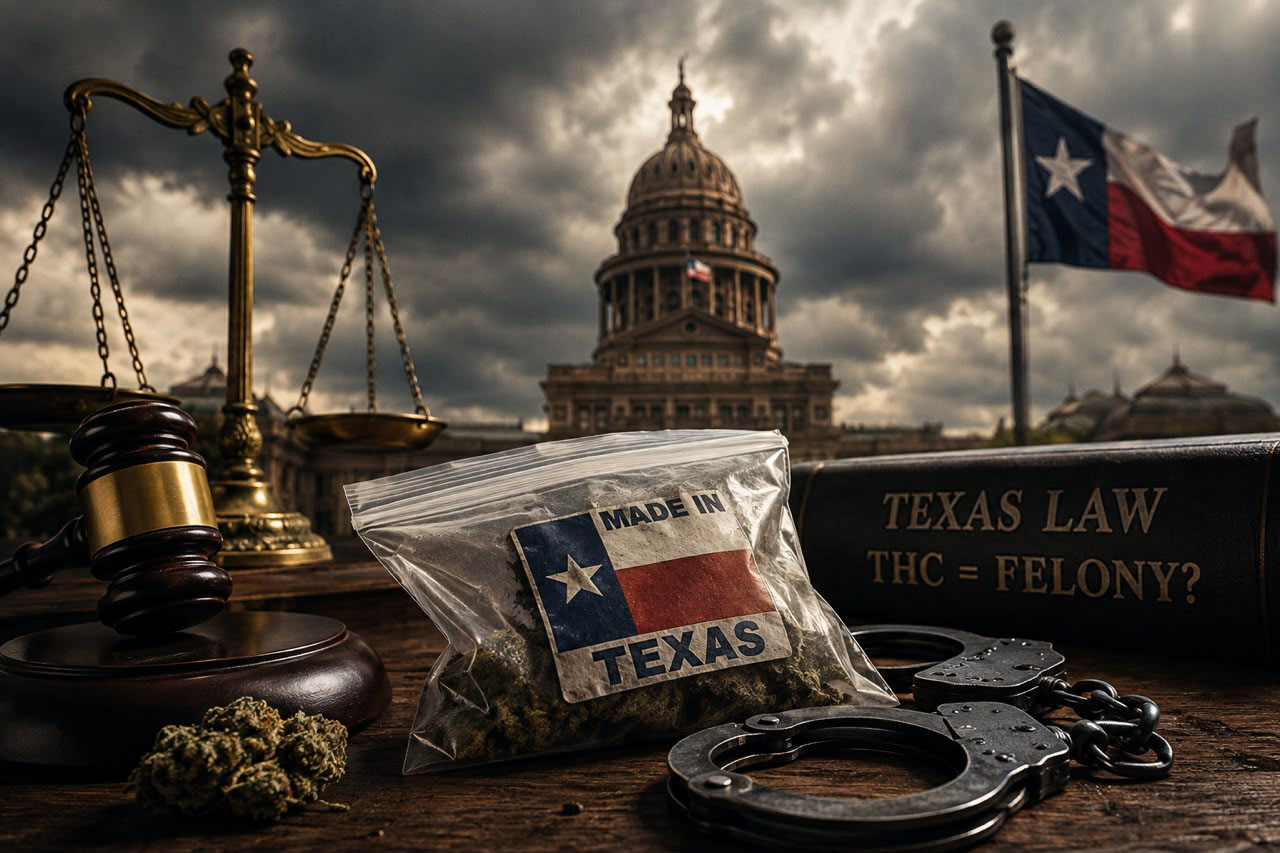
When a state turns a cannabis crackdown into a criminal-justice issue, silence isn’t an option.
There are moments in the cannabis movement when you read the news and think, “Wait…did we seriously just go backward?”
This is one of those moments.
As of July 31, 2026, Texas began enforcing a sweeping crackdown on numerous hemp-derived THC compounds, including delta-8 and delta-10. Compounds that had been legally sold in Texas—including in products such as gummies and vapes—can now fall under Texas controlled-substance laws, with possession potentially carrying felony consequences depending on exactly what the substance is and how much is involved.
And before somebody starts throwing tomatoes at me for saying this: there is an important legal distinction here.
Texas did not suddenly rewrite its marijuana-possession statute to make one gram of ordinary marijuana a felony. Under the current statute, possession of two ounces or less of marijuana remains a Class B misdemeanor.
But don’t let that technical distinction distract from the bigger picture.
Texas has just taken a giant step backward on cannabis freedom.
And that’s what this article is about.
WE’VE BEEN HERE BEFORE
For decades, cannabis consumers were treated like criminals.
People lost jobs. People lost opportunities. People lost years of their lives. Families were torn apart. And people went to prison over a plant that millions of Americans now openly consume.
Then something started changing.
States began recognizing that prohibition wasn’t working.
Cannabis legalization and reform movements began spreading across the country. Medical programs appeared. Adult-use markets followed. Communities began expunging old convictions. And in some places, people who had been criminalized for participating in the cannabis industry were finally being given opportunities to participate in the legal industry.
That was more than a business transition.
It was an acknowledgment that we got something wrong.
America had spent decades telling people cannabis was so dangerous that possessing it could destroy their lives.
Then America slowly began admitting:
Maybe the people weren’t the problem.
Maybe the policy was.
Texas appears determined to take a different road.
THE GOVERNOR’S ROLE MATTERS
If we’re going to criticize government policy, we need to identify who actually has responsibility for it.
Governor Greg Abbott is central to the story.
In September 2025, Abbott issued Executive Order GA-56 directing Texas agencies to tighten regulation of hemp-derived products. The order called for changes involving age restrictions, testing, labeling, fees and enforcement.
Abbott had previously vetoed Senate Bill 3, a sweeping hemp prohibition passed by the Texas Legislature in 2025. In his veto statement, he argued that an outright prohibition could create serious constitutional and federal-law problems and called instead for a regulatory framework.
But Texas didn’t stop there.
In 2026, Texas restored controlled-substance treatment for several hemp-derived THC compounds. The result is a situation where products that were previously available in ordinary Texas retail stores can suddenly carry dramatically different legal consequences.
That is an enormous change.
And ordinary people need to understand it.
IMAGINE THIS
Imagine you’re visiting a friend in Texas.
You’ve got a legal-looking package of THC gummies sitting in your vehicle.
Maybe you bought them legally before the rules changed.
Maybe you didn’t even realize the law had changed.
Maybe you thought, “It’s hemp. It’s sold in stores. What’s the problem?”
Now imagine that same product is suddenly treated as a controlled substance.
That isn’t some abstract political debate.
That’s a real person’s freedom.
That’s someone’s criminal record.
That’s someone’s job.
That’s someone’s family.
And potentially, depending on the substance and circumstances, that’s someone’s liberty.
Ask yourself a simple question:
Does possessing a tiny amount of a cannabis-derived product automatically make somebody a bad person?
Of course it doesn’t.
Yet criminal law has a way of turning complicated human beings into very simple labels:
CONVICTED.
THIS IS BIGGER THAN WEED
That’s the part I really want people to understand.
This isn’t only about marijuana.
It’s about what happens when government decides that adults shouldn’t be trusted to make decisions about their own bodies.
You don’t have to smoke cannabis.
You don’t even have to like cannabis.
Hell, you can think cannabis smells like a skunk got trapped inside a gym bag.
That’s fine.
But you should still care about the principle.
Because once government gets comfortable deciding what adults are allowed to possess, consume or put into their own bodies, the argument becomes bigger than cannabis.
The cannabis movement has always been about more than getting high.
It has been about freedom, fairness, personal responsibility and ending disproportionate criminal punishment.
And that’s why this moment matters.
TEXAS, WE KNOW YOU SMOKE
Here’s the part that makes me laugh.
Texas has millions of people.
And somehow we’re supposed to believe cannabis consumers simply disappeared because somebody changed the rules?
Come on.
That’s like putting a “NO FISHING” sign next to a lake and expecting every fisherman in America to suddenly discover knitting.
People don’t stop consuming something simply because politicians decide they don’t like it.
Prohibition has taught us that lesson repeatedly.
The question is whether government chooses to regulate reality—or pretend reality doesn’t exist.
SO WHAT CAN WE ACTUALLY DO?
Here’s my answer:
Use your wallet.
If you disagree with what Texas is doing, you don’t have to sit around complaining about it while continuing to financially support everything coming out of the state.
You can make different choices.
If you see a product labeled “Made in Texas,” you have the right to decide whether you want to buy it.
If you don’t agree with Texas’ cannabis policies, consider supporting businesses and organizations in states that reflect the policies you believe in.
If you’re donating to organizations, research where that money goes.
If you’re buying products, research where they’re manufactured.
And if you disagree with Texas’ policies, say so.
Facebook.
Instagram.
TikTok.
YouTube.
Letters.
Emails.
Phone calls.
Public comments.
Every peaceful, lawful avenue available.
Don’t threaten anybody.
Don’t harass anybody.
Don’t destroy anything.
Just make your voice impossible to ignore.
Because democracy is not supposed to be quiet.
WRITE THE GOVERNOR
If you want to take your protest directly to the person whose administration initiated the regulatory crackdown, write Governor Greg Abbott.
The Governor’s official office specifically invites citizens to submit opinions and concerns.
Governor Greg Abbott
Office of the Governor
P.O. Box 12428
Austin, TX 78711-2428
You can also use the Governor’s official online opinion form through the Office of the Governor.
Tell him what you think.
Be respectful.
Be factual.
Be passionate.
And most importantly, be heard.
WE CANNOT AFFORD TO GO BACKWARD
I’ve spent years watching the cannabis movement fight for progress.
I’ve watched people who were once treated like criminals become legitimate business owners.
I’ve watched communities build cannabis industries.
I’ve watched states recognize that locking people up for possessing a plant was not exactly the greatest public-policy achievement in American history.
And I’ve watched people who were once punished for cannabis finally receive opportunities in the legal marketplace.
To me, that was America acknowledging something important:
We were wrong.
So when I see laws and policies moving in the opposite direction, it pisses me off.
Not because I think everybody should smoke weed.
Because I think adults should have freedom.
Texas can call this public safety.
Texas can call this regulation.
Texas can call this protecting children.
Those are legitimate issues worth discussing.
But when the solution creates the possibility that ordinary adults can suddenly face life-altering criminal consequences over products they previously could legally purchase, we have every right to ask whether the punishment fits the conduct.
THIS ISN’T THE END OF THE MOVEMENT
And here’s where I want to be clear:
I don’t believe the cannabis movement is going backward.
I believe Texas is choosing to go backward.
There’s a difference.
The national cannabis movement is bigger than one governor.
Bigger than one legislature.
Bigger than one state.
And certainly bigger than one political party.
Cannabis consumers exist everywhere.
Republicans smoke it.
Democrats smoke it.
Independents smoke it.
Rich people smoke it.
Poor people smoke it.
Blue-collar workers smoke it.
Professionals smoke it.
Veterans smoke it.
Artists smoke it.
Entrepreneurs smoke it.
And yes…
Texans smoke it.
That’s precisely why this fight isn’t over.
THE MESSAGE FROM OG STRAIN
I’m not calling for violence.
I’m not calling for harassment.
I’m not calling for anybody to break the law.
I’m calling for something far more powerful:
Participation.
Pay attention.
Know what your state is doing.
Know what politicians are doing.
Know what you’re buying.
Know where your money is going.
Write letters.
Make phone calls.
Speak publicly.
Vote.
Organize.
Support cannabis businesses that are fighting for sensible policy.
And when politicians forget that government is supposed to work for the people?
Remind them.
Because freedom doesn’t protect itself.
People protect it.
And if we learned anything from the last several decades of cannabis prohibition, it’s this:
Every time somebody tells us the fight is over, that’s usually when we need to start fighting harder.
Texas may have changed the rules.
But it hasn’t changed the people.
It hasn’t changed the millions of Americans who believe cannabis should be treated responsibly rather than criminalized.
And it certainly hasn’t changed me.
I’m OG Strain.
I’ve been in this movement.
I’ve watched it grow.
I’ve watched people sacrifice for it.
I’ve watched people fight for it.
And I’m not interested in watching us quietly surrender everything we’ve accomplished.
We cannot go backward.
Not for cannabis.
Not for freedom.
Not for the people who spent decades paying the price for prohibition.
And not for the next generation that deserves better than inheriting the same failed war our generation spent so long trying to end.
Texas, we’re watching.
America, we need to pay attention.
And cannabis community—don’t you dare fall asleep now.
Because this fight is bigger than weed.
It’s about freedom.


I DON’T WANT TO WASTE ANOTHER DAY: WHY I’M BUILDING MY LEGACY IN THE 518 CANNABIS COMMUNITY

THE BLACK MARKET GAMBLE: Can Playing by Some of the Rules Keep New York Cannabis Businesses Safe?

GOOD BURGER OR BAD TASTE? THE MOST CONTROVERSIAL STRAIN OF 2026 HAS SMOKERS DIVIDED!

She Didn’t Tiptoe In — OG Granny Blew the Door Off the Internet 💥🌿

Tokalotapot & Cannafae: The Couple That Made Weed Legal (Not Really, But It Feels Like It)

“Damn Sam”, The Man Who Kept the 518 Lit (and Safe) Before It Was Legal to Say “Lit”
-
 Cannabis Hall Of Fame10 months ago
She Didn’t Tiptoe In — OG Granny Blew the Door Off the Internet 💥🌿
-
 Cannabis Hall Of Fame1 year ago
Tokalotapot & Cannafae: The Couple That Made Weed Legal (Not Really, But It Feels Like It)
-
 Cannabis Hall Of Fame8 months ago
“Damn Sam”, The Man Who Kept the 518 Lit (and Safe) Before It Was Legal to Say “Lit”
-

 Cannabis Hall Of Fame1 year ago
Dope as Yola: From the Bottom to Cannabis Hall of Fame
-

 Community9 months ago
Empire State Cannabis Cup: An OG Strain Community Walkthrough
-

 Community1 year ago
🔥 HARVEST HYSTERIA: WHERE THE BUD AT, NEW YORK?!
-

 Community12 months ago
From Soil, Struggle, and Soul: Hudson Valley Green Wins Big at the Palenville Cannabis Cup”
-

 Community2 months ago
STONER MAMA NICOLE Breaking Stigma, One Laugh at a Time