Health & Wellness
“Grow Like It’s 1850: The Ancient Trick That Waters Your Plants While You Chill”

By OG Strain
Spring is in the air. Birds are chirping, the sun is shining, and my phone is blowing up like it’s tax return season.
“Yo OG, I got my seeds popping!”
“Bro, clones are ready!”
“Should I put them outside yet?!”
And I love it. This is our Super Bowl, people. Cannabis growers across the land are stretching, hydrating, and preparing for the outdoor season like athletes entering the championship game.
But while everyone’s out here buying fancy irrigation systems, timers, hoses, sprinklers, drip lines—basically building NASA launchpads for their plants—I stumbled across something that made me stop, roll one, and say:
“Wait… they were doing WHAT back in the 1800s?!”
Let me introduce you to one of the most genius, low-key magical growing techniques ever used by humans…
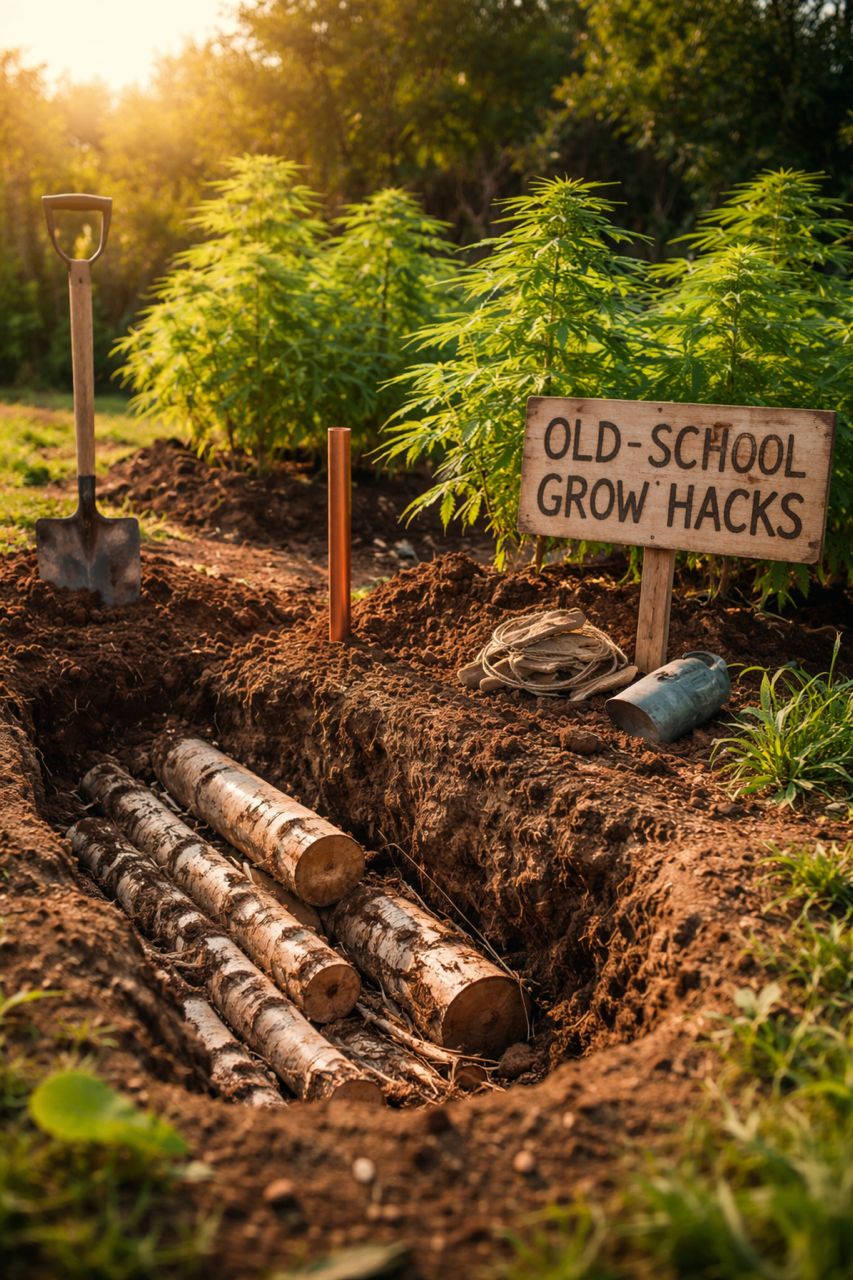
The Underground Sponge Trick (a.k.a. Hugelkultur, but we’re keeping it street)
Back in the day—I’m talking old-school farmers, mountain growers, people who didn’t have Home Depot five minutes away—they had to get creative. Especially in places where water wasn’t easy to come by.
So what did they do?
They buried wood.
Yeah. I know. Sounds like the start of a bad backyard decision. Stay with me.
Here’s how it works:
You dig a trench or a raised bed area. Then you take logs—preferably hardwood or semi-hardwood. Birch is a great option—and you lay those bad boys down in the trench. Big logs, smaller branches, sticks… layer it up like a lasagna your Italian grandma would be proud of.
Then you cover it with soil.
That’s it.
Well… not just it. Because what happens next is where the magic lives.
As that wood slowly breaks down underground, it acts like a sponge. It absorbs water when it rains, holds onto it, and then releases it slowly back into the soil as your plants need it.
That means:
• Less watering
• Healthier root systems
• Moisture regulation like nature intended
Basically, your plants are sipping on a hidden underground reservoir while you’re sitting there like, “Wow, I’m barely doing anything and these plants love me.”
It’s like setting up autopilot for your grow.
Why This Method Is Straight-Up Genius
Let’s break it down OG-style:
• Water Retention: The buried wood holds moisture like a camel holds grudges.
• Nutrient Boost: As the wood decomposes, it feeds the soil with organic matter.
• Better Soil Structure: Your dirt becomes fluffy, airy, and root-friendly—like a luxury mattress for your plants.
• Sustainability: You’re literally using natural materials to create a self-sustaining system. Mother Nature approves.
And the best part?
You don’t need some expensive setup. No timers. No apps. No Wi-Fi password required.
Just logs, dirt, and a little bit of effort upfront.
The Copper Pipe Trick: Myth, Magic, or Mad Science?
Now here’s where things get a little spicy…
I recently heard about another old-school trick: placing a copper pipe vertically into the soil to “energize” it and help draw nutrients toward the roots.
Sounds like something Nikola Tesla might’ve whispered to a farmer while high, right?
Here’s the honest breakdown:
Copper is a conductive metal, and in theory, it can interact with soil chemistry in small ways. Some growers swear it improves plant vitality or microbial activity. Others say it’s more folklore than fact.
So where do I stand?
I say this:
It’s not going to hurt if done properly, and experimenting is part of the grower’s journey. Just don’t expect your plants to start glowing or speaking English.
Think of it as a “maybe bonus,” not the main event.
Why This Matters for Cannabis Growers Right Now
We’re heading into outdoor season, and a lot of growers are about to do what they always do—dig holes, drop plants, and pray to the weed gods.
But if you take a little extra time now to build a hugelkultur-style bed?
You could:
• Cut your watering workload way down
• Grow bigger, healthier plants
• Save money
• And look like an absolute genius to your friends
Meanwhile, they’re out there dragging hoses around in July heat like it’s a CrossFit workout.
Final Thoughts from OG Strain
Listen, I’m all about working smarter, not harder. If people in the 1800s figured out how to grow thriving gardens on mountains without irrigation… and we’re out here struggling with a water bill and a YouTube tutorial… something ain’t adding up.
Sometimes the best techniques aren’t new—they’re just forgotten.
So this spring, while everyone else is overcomplicating things, maybe take a page out of history. Bury some wood. Build your soil. Let nature do what it’s been doing since before dispensaries had loyalty points.
And if your plants end up thriving while you’re doing less work?
Don’t worry… You can act like it was your idea all along.
Stay lifted, stay learning, and grow smarter.
— OG Strain



For outdoor cannabis growers across New York, September can be one of the most exciting—and stressful—times of the growing season.
The plants are getting heavy with flowers, harvest is getting closer, and months of hard work are finally starting to pay off.
Then somebody spots it.
A little white powder on a leaf.
A suspicious brown spot inside a cola.
A piece of flower that suddenly looks wet, gray, or dead.
Mold and mildew can turn a beautiful outdoor garden into a nightmare remarkably fast.
But there is good news: prevention and early intervention can make a major difference.
The key is understanding that mold and mildew are not problems that should be addressed only after they become obvious. The most effective strategy is to create conditions where these pathogens have difficulty getting established in the first place.
FIRST, KNOW WHAT YOU ARE LOOKING AT
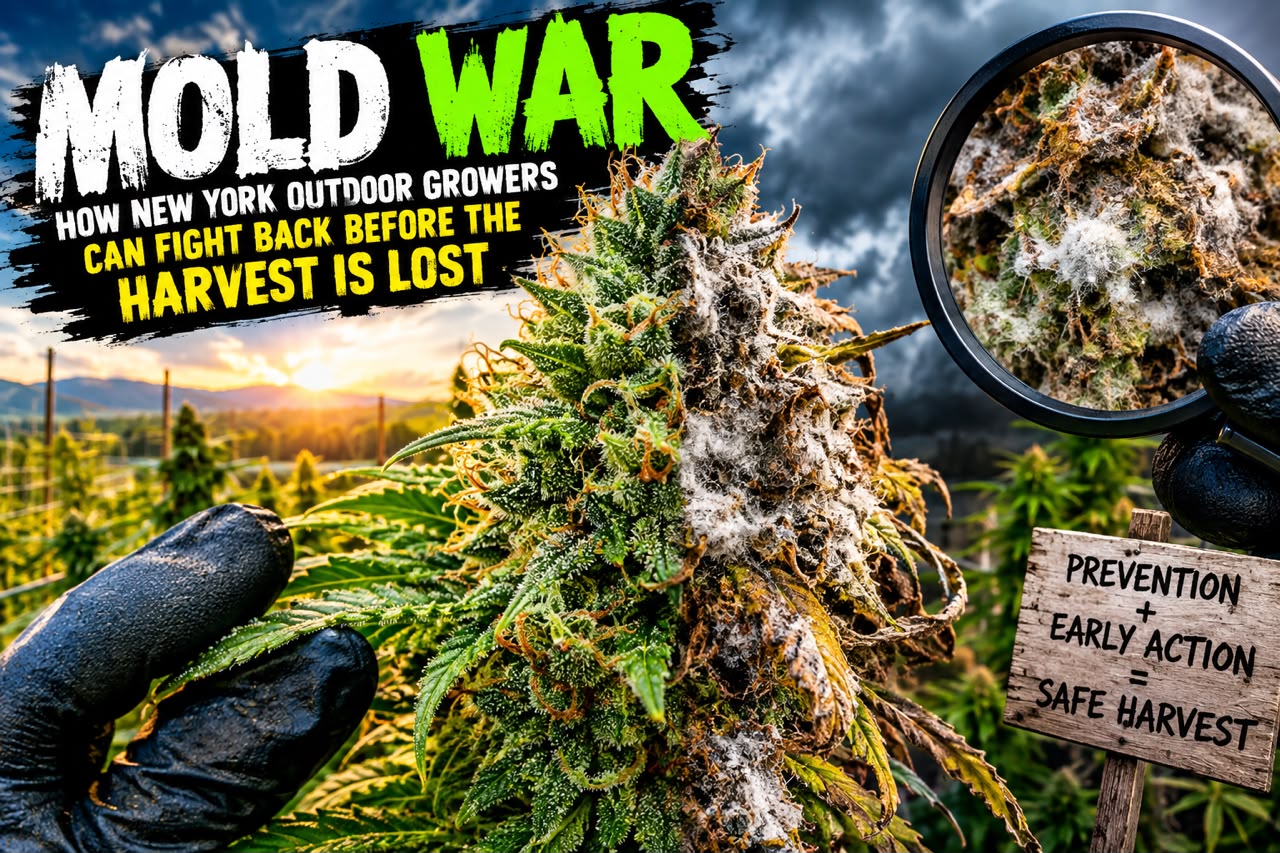
Two problems frequently discussed by cannabis growers are powdery mildew and Botrytis, commonly called bud rot or gray mold.
Powdery mildew often appears as white, powder-like growth on leaves and plant surfaces. Botrytis is different. It can begin inside dense flowers or on damaged tissue and may produce brown, water-soaked or decaying areas followed by gray fungal growth.
New York State cannabis education materials specifically identify Botrytis as a disease that can infect stems, leaves and flowers and recommend increased air circulation, avoiding work in wet plants, removing infected plants and sanitizing equipment.
That distinction matters because what works against one disease is not necessarily the answer for another.
THE BIGGEST WEAPON IS THE ENVIRONMENT
The best mold treatment is often the one you never have to use.
Outdoor growers obviously cannot control the weather, but they can control many of the conditions surrounding their plants.
Air movement matters.
Dense plants with limited airflow can trap moisture inside the canopy. After rain, dew or heavy humidity, that trapped moisture can remain around flowers and leaves much longer than it does on an open, well-ventilated plant.
Pruning and training can help open the interior of the plant. Adequate spacing between plants can also improve air movement.
Nearby vegetation matters, too. Overgrown weeds and vegetation can contribute to poor airflow and create additional moist surfaces around the garden.
UC IPM recommends improving circulation, spacing plants appropriately, pruning dense canopies and removing nearby vegetation when managing Botrytis.
DON’T WATER THE FLOWERS IF YOU DON’T HAVE TO
Overhead irrigation can increase the amount of time foliage and flowers remain wet.
Whenever practical, watering at the root zone rather than spraying the entire plant can reduce unnecessary moisture on flowers and leaves.
And after rainfall, resist the temptation to immediately start handling wet plants.
New York’s cannabis IPM training specifically recommends not working the field when plants are wet, because moisture and physical disturbance can contribute to disease spread.
INSPECTION SHOULD BECOME A DAILY HABIT
During periods of wet weather, high humidity and late-season flowering, growers should inspect their plants frequently.
Don’t just look at the outside of the buds.
Spread flowers apart and inspect the interior of large, dense colas.
Look for:
Unusual brown or dying tissue
Water-soaked areas
Gray or fuzzy growth
Sudden discoloration
Leaves dying for no obvious reason
White powdery growth on leaves
Flowers that appear to be deteriorating from the inside
Early detection is incredibly important because fungal diseases become substantially more difficult to manage once they become widespread. UC IPM notes that powdery mildew is easier to control early, while extensive infections are considerably harder to manage.
WHAT IF YOU FIND POWDERY MILDEW?
Don’t panic—but don’t ignore it either.
If the infection is limited, remove affected plant material carefully and dispose of it away from the garden. Avoid spreading spores from one plant to another.
Powdery mildew management can include cultural controls plus appropriately labeled treatments. Research-supported options used in plant disease management include materials such as potassium bicarbonate, sulfur, certain horticultural oils and biological products containing beneficial microorganisms.
However, cannabis is not just another garden crop when it comes to pesticide use.
New York’s Department of Environmental Conservation explains that there are no pesticide products registered in New York that specifically list cannabis as an application site, although some pesticide labels are broad enough to allow use on cannabis. Growers are directed to consult New York’s pesticide guidance and NYSPAD database to determine what is actually permitted.
That means growers should never assume that a product is legal to spray on cannabis simply because it is marketed as “organic,” “natural,” “safe,” or suitable for another crop.
The label matters.
POTASSIUM BICARBONATE: ONE OF THE TOOLS WORTH KNOWING
Potassium bicarbonate is one of the better-known lower-toxicity tools used in integrated powdery mildew management.
University of California IPM guidance reports that potassium bicarbonate can provide some eradicative activity against powdery mildew, particularly when applied early and with thorough coverage.
But there is an important catch:
More is not necessarily better.
Improper application can injure plant tissue, and advanced infections can become increasingly difficult to control. Growers should follow the exact product label and confirm that the specific product and use are permitted for cannabis in New York.
SULFUR: POWERFUL TOOL, WRONG TIMING CAN CREATE PROBLEMS
Sulfur has been used for powdery mildew management for generations and remains an important tool in plant disease management.
But sulfur is not something to blindly throw at flowering cannabis.
Temperature, plant sensitivity, application timing and interactions with other products all matter. UC IPM warns that sulfur can injure plants under high temperatures and that sulfur should not be combined too closely with certain oils.
Most importantly, growers should verify that the exact sulfur product is allowed for the intended cannabis use in New York before applying it.
BIOLOGICAL CONTROLS ARE PART OF THE MODERN TOOLBOX
Modern integrated pest management isn’t limited to conventional chemicals.
Biological fungicides containing beneficial microorganisms—including certain Bacillus species—are used in plant disease management programs.
These products are generally most useful as part of a preventative or early-intervention program rather than as a miracle cure for heavily established disease. UC IPM describes Bacillus-based biological fungicides as tools for powdery mildew management and emphasizes early application and thorough coverage.
Again, the rule is simple:
Use only products whose labels and New York regulations allow the intended cannabis application.
WHAT ABOUT BUD ROT?
This is where growers need to be especially serious.
If you discover Botrytis inside a cannabis flower, don’t simply spray the outside of the cola and hope for the best.
Bud rot can penetrate and destroy flower tissue.
The appropriate response is sanitation and removal of infected material.
Cut out affected flowers well beyond the visibly damaged area, carefully remove the material from the garden, and dispose of it so spores are not simply redistributed around healthy plants.
Clean and sanitize cutting tools between plants and between infected and healthy material.
And don’t take a questionable flower, remove the visibly bad portion and assume the remainder is automatically safe.
New York’s Office of Cannabis Management explicitly states that moldy cannabis is not safe to consume and advises growers dealing with mold to dispose of affected plants.
IS THE WHOLE PLANT LOST?
Not necessarily.
This is where the answer depends on how much of the plant is affected and what kind of mold you are dealing with.
A small, isolated infection discovered early may allow a grower to remove the affected tissue and intensify environmental control and monitoring.
But widespread Botrytis throughout multiple flowers is a completely different situation.
If infection is extensive, repeatedly returning, or affecting a significant portion of the plant, attempting to save every last gram can become counterproductive.
The goal should not be “save the biggest possible harvest at any cost.”
The goal should be produce cannabis that is safe to consume.
Sometimes the safest decision is to sacrifice an infected plant rather than allow spores and infected tissue to threaten the rest of the garden.
DON’T TRY TO “WASH” YOUR WAY OUT OF MOLD
This is one of the biggest misconceptions worth addressing.
A grower might think:
“I’ll just wash the buds.”
Unfortunately, washing does not turn mold-contaminated cannabis into guaranteed safe cannabis.
Mold can grow within flower tissue, and contamination isn’t necessarily limited to what can be seen with the naked eye.
The same principle applies to cooking, drying, curing or turning questionable flower into another cannabis product.
Processing is not a magic eraser for contamination.
If flower is genuinely mold-contaminated, the safest approach is to discard it rather than consume it.
HARVEST TIMING CAN BECOME A DEFENSE STRATEGY
Late-season New York weather can create an especially difficult combination: cooler temperatures, rain, heavy dew and high humidity.
Botrytis thrives when plant material remains wet, and UC IPM notes that prolonged wetness and high humidity can encourage gray mold development.
That means growers should pay attention to the forecast as harvest approaches.
If a mature plant is sitting in an extended period of wet weather and disease pressure is increasing, the decision about when to harvest may become part of the mold-management strategy.
Waiting for the “perfect” harvest window isn’t always the safest option if the alternative is allowing flowers to remain exposed to prolonged wet conditions.
THE POST-HARVEST BATTLE ISN’T OVER
Even after cutting the plant, mold prevention continues.
Freshly harvested cannabis contains significant moisture. If flowers are packed too tightly, dried improperly or stored before they have reached an appropriate moisture level, mold can still become a problem.
Drying areas should be clean, controlled and well ventilated.
Harvested flowers should not be piled together while they are still wet.
Once again, airflow and moisture control are the name of the game.
New York’s OCM home-cultivation guidance specifically emphasizes controlling moisture and maintaining ventilation when managing mold and fungus.
THE NEW YORK MOLD-FIGHTING CHECKLIST
For growers dealing with a difficult outdoor season, the formula is surprisingly straightforward:
- Inspect plants frequently.
- Keep flowers as dry as practical.
- Improve airflow through dense canopies.
- Give plants adequate spacing.
- Remove dead and decaying plant material.
- Don’t work wet plants unnecessarily.
- Sanitize cutting tools.
- Remove confirmed infected flowers immediately.
- Monitor large, dense colas from the inside—not just the outside.
- Use only legally permitted, properly labeled products.
- Never assume “organic” means automatically approved for cannabis.
- Never assume washing, drying, curing or processing makes moldy cannabis safe.
- Watch the weather as harvest approaches.
- When contamination is extensive, know when to walk away from the plant.
THE REAL CURE: PREVENTION + EARLY ACTION
There is no magic bottle that can completely reverse a garden after mold has taken over.
The most modern and scientifically supported approach is integrated disease management.
That means combining sanitation, plant spacing, airflow, moisture management, frequent scouting, early removal of infected tissue and, where legally appropriate, carefully selected disease-control products.
The biggest mistake a grower can make is waiting until the mold is obvious throughout the garden before doing something about it.
By then, the battle has already become much harder.
New York outdoor growers can’t control the weather.
They can’t stop every spore from floating through the air.
They can’t make September forget how to rain.
But they can control their response.
Open up the canopy.
Keep the flowers dry.
Inspect the colas.
Remove infected material immediately.
Sanitize.
Monitor.
And when contamination becomes significant, put safety ahead of pride, money and the desire to save every last bud.
Because at the end of the day, the goal isn’t simply to harvest cannabis.
The goal is to harvest cannabis that is safe to consume.
Sources for further education: New York State Office of Cannabis Management; New York State Department of Environmental Conservation; Cornell/NY cannabis IPM education; UC Statewide Integrated Pest Management Program.
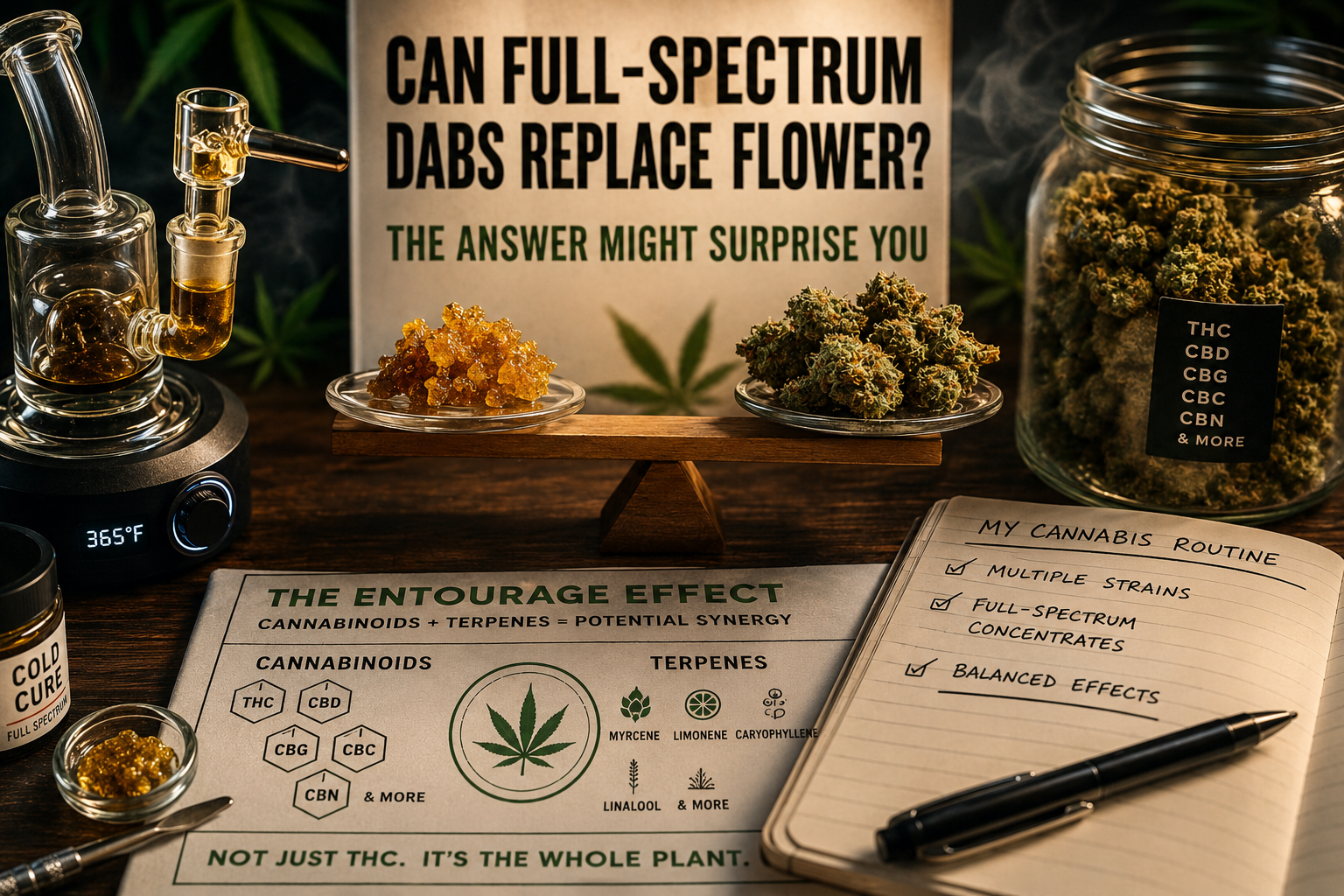
an Full-Spectrum Dabs Replace Flower? The Answer Might Surprise You
I thought I had found the perfect way to simplify my cannabis routine: ditch most of the flower, grab some cold cure, and let the dabs do all the heavy lifting.
What could possibly go wrong?
Well… apparently my body had some opinions.
I started using more cold cure concentrates and less flower. And don’t get me wrong—I was getting high as hell. The concentrates were potent, flavorful and packed with terpenes. I was getting plenty of THC and definitely wasn’t sitting around wondering whether I was high.
But something was missing.
The overall medicinal effect I personally get from flower just wasn’t there.
That’s when I started asking a question that I couldn’t get out of my head:
Could a truly full-spectrum dab give me everything I get from flower—including the cannabinoids and terpenes I’m looking for—or would I still need to keep flower in the rotation?
After digging into the science, I found my answer.
And it wasn’t the answer I was hoping for.
THC Isn’t the Whole Story
Here’s something every cannabis consumer should understand: cannabis isn’t just THC.
The plant contains a huge variety of cannabinoids, including THC, CBD, CBG, CBC, CBN and many others. It also contains terpenes and other natural compounds that contribute to the plant’s chemical profile. Researchers have identified hundreds of compounds in cannabis, with significant differences between varieties.
That’s important because two strains can have similar THC numbers and still feel completely different.
I’ve experienced that myself.
Sometimes I’ll smoke one strain and think, “That’s nice.”
Then I’ll smoke another and think, “Ohhhh… THERE you are.”
And sometimes I need more than one strain to get the overall effect I’m looking for.
That’s what got me thinking about full-spectrum concentrates.
So What Does “Full Spectrum” Actually Mean?
In simple terms, a full-spectrum concentrate is designed to retain a broader mixture of the compounds naturally found in cannabis, rather than stripping the plant down primarily to THC.
That can include multiple cannabinoids and a variety of terpenes.
Sounds perfect, right?
Not so fast, Professor Puff.
Full spectrum does not mean “every single molecule that was in the flower is now sitting inside my dab jar.”
Extraction and processing change the chemical makeup of cannabis. Even products made from the same starting material can end up with different chemical profiles depending on how they’re processed. Research also shows that commercial cannabis products can vary considerably in their cannabinoid and terpene profiles.
So a full-spectrum dab can be broad-spectrum cannabis goodness without being an exact liquid photocopy of the flower it came from.
What About the Entourage Effect?
You’ve probably heard cannabis people talk about the entourage effect.
The basic idea is that cannabinoids and terpenes may interact with each other, potentially creating effects that are different from isolated THC or another single compound.
There is some interesting research supporting the possibility, including preclinical research involving full-spectrum extracts and pain or inflammation. But the scientific evidence isn’t strong enough to say that the entourage effect is a guaranteed medical phenomenon or that full-spectrum products will always work better. Researchers are still debating exactly how much of this effect exists and how important it is.
In other words:
The entourage effect is interesting science—not a magic sticker you slap on a jar and suddenly everything is medically superior.
So Can Full-Spectrum Dabs Replace My Flower?
For me, the answer is no—not completely.
And here’s why.
Even if I use a genuinely full-spectrum concentrate, I’m still getting one particular chemical profile from that particular cannabis product.
But when I smoke different flower strains, I’m changing that chemical profile.
One strain may have one combination of cannabinoids and terpenes. Another strain may have a completely different combination. Research has demonstrated substantial chemical diversity among commercial cannabis samples, even when they’re marketed using familiar strain labels.
That’s exactly what I experience.
I don’t necessarily want more THC.
I want more variety.
That’s why my personal routine has evolved into a combination of flower from different strains along with cold cure concentrates.
I’m basically making myself a cannabis chemical playlist.
Track one: “Let’s Get This Party Started.”
Track two: “Where Did My Pain Go?”
Track three: “Why Am I Standing in the Kitchen?”
You know the album.
More Strains, More Variety
Here’s the big realization I came away with:
There probably isn’t one magical cannabis product that contains every cannabinoid and terpene my body may respond to.
And there certainly isn’t enough evidence to say that one full-spectrum dab can reproduce everything a person gets from multiple different flowers.
Full-spectrum concentrates may give you a broader chemical profile than highly refined THC products, and that makes them very interesting for people who want more than just THC. But they don’t eliminate the natural chemical diversity found across different cannabis varieties.
That’s why, for me, the answer isn’t flower versus concentrate.
It’s flower AND concentrate.
My Takeaway
I started this whole experiment thinking I might discover that full-spectrum dabs were the answer to my problem.
Instead, I discovered something much more useful:
Cannabis isn’t a one-size-fits-all plant.
The more I learn about cannabinoids and terpenes, the less interested I am in simply chasing the biggest THC percentage on the label.
I’m much more interested in the whole chemical profile.
And for my personal experience, that means keeping multiple strains of flower in the rotation and using cold cure concentrates alongside them.
Could somebody eventually make a full-spectrum concentrate that gives a particular person everything they personally get from flower?
Maybe.
Could it replace flower for some cannabis consumers?
Absolutely.
But does “full spectrum” automatically mean I can throw my flower in the trash and live happily ever after with my dab rig?
Not for OG Strain.
At least not yet.
Because apparently my cannabis routine needs to be less like ordering a single entrée and more like hitting the buffet.
And honestly…
I’m perfectly okay with that.
- OG Strain
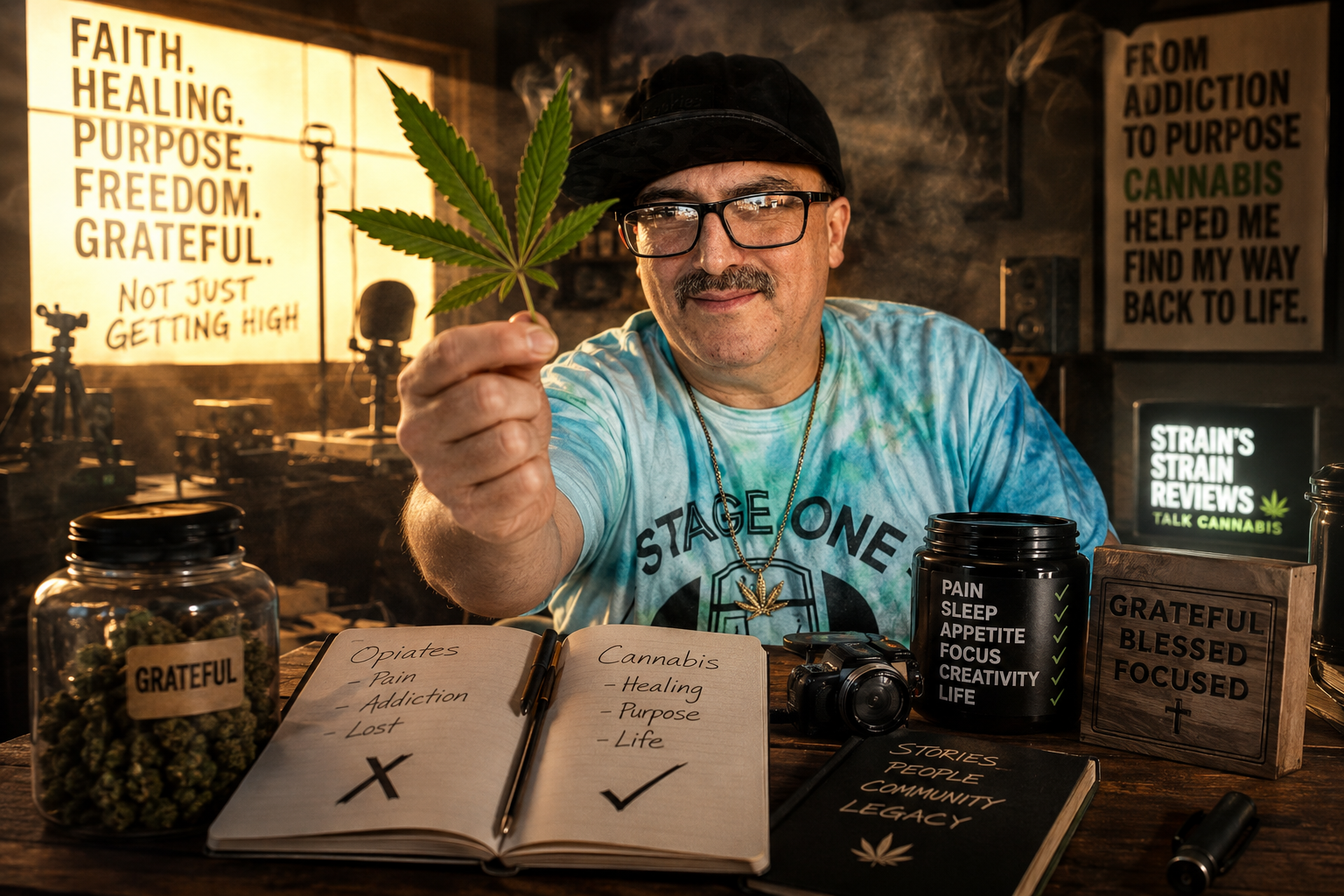
They warned me that cannabis could ruin my life. What nobody warned me about was that it might actually help save it.
For years, people have asked me some version of the same question:
“Why is cannabis so important to you?”
The short answer?
Because it changed my life.
The longer answer is that cannabis has helped me sleep, helped me eat, helped me deal with pain and discomfort, helped me function, helped me meet incredible people, helped me build a career around something I genuinely love—and, most importantly, helped me get away from opiates after many years of addiction.
So when people tell me cannabis is nothing but a problem, I can’t help but laugh a little.
Because my life tells a very different story.
THE PART OF MY STORY THAT MATTERS MOST
For many years, I was addicted to opiates.
That was a major part of my life.
And addiction is no joke.
It can take your time, your energy, your peace, your relationships, and sometimes even your hope.
I’m not going to tell anyone that cannabis is some magical cure or that my experience will be the same as everybody else’s. This is not medical advice.
This is my testimony.
Cannabis helped me get away from opiates.
And that changed everything.
It helped me move in a different direction. It became part of a better life—a life where I could think, create, connect with people, and actually look forward instead of feeling trapped by where I was.
I truly believe cannabis was a gift from God that helped save me.
You don’t have to believe that.
But I do.
And after everything I’ve been through, I’m not afraid to say it.
MORE THAN JUST “GETTING HIGH”
Some people hear the word cannabis and immediately think about getting high.
I think about getting through the day.
Cannabis has helped me sleep when sleep wouldn’t come. It has helped me eat when my appetite disappeared. It has helped me deal with pain and discomfort while still allowing me to function.
And function is important to me.
I don’t want to spend my life staring at the ceiling waiting for the day to end.
I want to write.
I want to research.
I want to create videos.
I want to meet people.
I want to learn.
I want to live.
Cannabis has helped me do those things.
That doesn’t mean cannabis is perfect. It doesn’t mean everybody should use it. And it certainly doesn’t mean every cannabis product is right for every person.
It simply means that for me, the benefits have been real.
CANNABIS INTRODUCED ME TO PEOPLE I WOULDN’T HAVE MET OTHERWISE
One of the biggest surprises cannabis brought into my life was community.
A plant can be a pretty good conversation starter.
You can meet someone you know absolutely nothing about, start talking about strains, terpenes, rosin, growing, or legalization—and before long, you’re laughing like you’ve known each other for years.
Cannabis has opened doors to friendships, conversations, interviews, events, and relationships that I genuinely value.
Some people came into my life through my writing.
Some through my videos.
Some through the cannabis industry.
Some simply because somebody passed something over and said, “You’ve got to try this.”
And suddenly, there’s a conversation.
Cannabis has connected me to people.
Good people.
Creative people.
Funny people.
Passionate people.
People who became more important to me than I ever expected.
IT ALSO KEEPS MY BRAIN WORKING
Getting older doesn’t mean I plan on shutting my brain off.
If anything, cannabis has given my brain a full-time job.
I’m constantly researching new information, learning about strains, terpenes, products, laws, science, businesses, and the people shaping the cannabis community.
Then I write about it.
I talk about it.
I make videos about it.
And by the time I finish researching one subject, somebody has invented a new product or crossed two strains and named it something that sounds like a rapper, a breakfast cereal, and a cartoon character had a meeting.
Cannabis keeps me curious.
And curiosity keeps me engaged.
THERE’S ALSO A WHOLE WORLD OF OPPORTUNITY
Cannabis is not just a plant anymore.
It’s an industry.
And that industry has created opportunities in cultivation, processing, retail, media, marketing, photography, videography, events, education, advocacy, and entrepreneurship.
Cannabis has opened professional doors for me that I never expected.
It gave me stories to tell.
It gave me people to interview.
It gave me a reason to create.
It helped turn an interest into something much bigger.
Through Strain’s Strain Reviews, my writing, and my involvement with the cannabis community, I found purpose in sharing information and telling the stories of the people behind this industry.
And I’m not done yet.
“BUT YOU’VE LOST PEOPLE BECAUSE OF CANNABIS”
Yes.
I have.
I’ve lost some friends.
I’ve lost relationships with some family members.
And I’m not going to pretend that never hurt.
But eventually, I had to ask myself a question:
Did cannabis ruin those relationships—or did it simply expose them?
Because if someone decides they no longer want to know me as a person simply because they don’t approve of cannabis, what exactly were they valuing about me in the first place?
I’m more than cannabis.
But I’m not going to hide cannabis from my life either.
I’m not going to apologize for something that helped me sleep, eat, function, create, meet people, build opportunities—and helped me move away from opiate addiction.
If someone wants to walk away because of that, that’s their choice.
But I’m not going to destroy something positive in my life just to make someone else comfortable.
YES, I’M A CHRISTIAN—AND YES, I STILL FEEL THIS WAY
This might be where some people really start shaking their heads.
That’s okay.
I’m used to it.
I’m a Christian.
And cannabis has not taken me away from my faith.
If anything, it has encouraged me to think more deeply.
It makes me ask questions.
It makes me reflect.
It makes me think about life, creation, purpose, and the things we sometimes rush past without really considering.
And when I ask those questions, I include Jesus.
Why wouldn’t I?
My faith is part of who I am.
Cannabis didn’t erase that.
For me, asking questions and believing in God are not opposites.
Thinking deeply does not mean losing faith.
And no, I’m not claiming cannabis gives me a direct phone line to Heaven.
You can’t call Heaven’s customer service department and ask for Jesus at extension 420.
But I do believe God can work in ways we don’t always understand.
And I believe God knew exactly what I needed when I needed it.
For me, cannabis became part of the road that helped lead me away from opiates and toward a better life.
That’s why I believe it was a gift.
SO, IS CANNABIS GOOD FOR MY LIFE?
For me?
Absolutely.
Cannabis helped me medically.
It helped me psychologically.
It helped me socially.
It helped me creatively.
It helped me professionally.
It helped keep my mind active.
It introduced me to people I value.
And it helped me get away from opiates after years of addiction.
That alone changed my life.
I’m not here to tell you cannabis is the answer for everyone.
I’m here to tell you what it has been for me.
It has been part of my answer.
People are free to judge it.
They’re free to disagree with me.
They’re free to tell me their horror stories.
But nobody gets to rewrite my life and tell me something that helped me was secretly destroying me.
I know where I was.
I know where I am.
And I know what helped me along the way.
Cannabis didn’t ruin my life.
It helped me leave a life of opiate addiction behind.
It helped me find purpose.
It helped me build relationships.
It helped me keep moving forward.
And, from the bottom of my heart, I truly believe it helped save me.
So if you want to know what cannabis is worth to OG Strain, the answer is simple:
It’s worth a lot.
I’m still here.
And I thank God for that.


I DON’T WANT TO WASTE ANOTHER DAY: WHY I’M BUILDING MY LEGACY IN THE 518 CANNABIS COMMUNITY

THE BLACK MARKET GAMBLE: Can Playing by Some of the Rules Keep New York Cannabis Businesses Safe?

GOOD BURGER OR BAD TASTE? THE MOST CONTROVERSIAL STRAIN OF 2026 HAS SMOKERS DIVIDED!

She Didn’t Tiptoe In — OG Granny Blew the Door Off the Internet 💥🌿

Tokalotapot & Cannafae: The Couple That Made Weed Legal (Not Really, But It Feels Like It)

“Damn Sam”, The Man Who Kept the 518 Lit (and Safe) Before It Was Legal to Say “Lit”
-
 Cannabis Hall Of Fame9 months ago
She Didn’t Tiptoe In — OG Granny Blew the Door Off the Internet 💥🌿
-
 Cannabis Hall Of Fame1 year ago
Tokalotapot & Cannafae: The Couple That Made Weed Legal (Not Really, But It Feels Like It)
-
 Cannabis Hall Of Fame7 months ago
“Damn Sam”, The Man Who Kept the 518 Lit (and Safe) Before It Was Legal to Say “Lit”
-

 Cannabis Hall Of Fame1 year ago
Dope as Yola: From the Bottom to Cannabis Hall of Fame
-

 Community9 months ago
Empire State Cannabis Cup: An OG Strain Community Walkthrough
-

 Community1 year ago
🔥 HARVEST HYSTERIA: WHERE THE BUD AT, NEW YORK?!
-

 Community12 months ago
From Soil, Struggle, and Soul: Hudson Valley Green Wins Big at the Palenville Cannabis Cup”
-

 Community2 months ago
STONER MAMA NICOLE Breaking Stigma, One Laugh at a Time