Strains
Belladonna: The Strain That Still Has Me Looking Over My Shoulder


OG Strain
There’s a difference between a good strain… a great strain… and that one strain.
If you’ve been smoking long enough, you know exactly what I’m talking about. That one you still bring up randomly like,
“Yo… remember that one time we had that…?”
And everybody in the room already knows.
For me?
That strain is Belladonna.
⸻
Back When You Didn’t Shop—You Got Lucky
Late ‘90s, early 2000s. No menus. No terp charts. No “add to cart.”
You weren’t shopping—you were linking up, hoping your guy didn’t disappear for three days, and trusting whatever showed up in that bag.
And then one day… Belladonna showed up.
No warning. No branding. No explanation.
Just a bag that, the second it cracked open, made the whole situation change.
You ever open something and immediately look around like you just did something illegal twice?
Yeah… that.
That was Belladonna.
⸻
The Kind of Loud You Couldn’t Play Off
This wasn’t regular loud.
This was the kind of weed where you’d open it for a quick peek—and now your whole house smells like you’re hosting a cannabis festival you didn’t plan.
You’d be trying to act normal like nothing happened, but deep down you knew…
“Yeah, this is not staying low.”
Skunky, sweet, sharp, with this fruity edge that didn’t smell like anything else floating around at the time. It didn’t blend in—it stood out immediately.
And once you smelled it, that was it. Locked in forever.
⸻
The High That Took Over the Room
Some strains creep.
Belladonna didn’t creep—it settled in like it lived there.
First hit… you’re good.
Second hit… you’re thinking, “Okay, yeah this is different.”
Third hit… now nobody’s talking, and for some reason everyone is extremely focused on absolutely nothing.
You ever pass the blunt and forget you passed it?
Then five minutes later you’re like,
“Wait… where did it go?”
And the person holding it is just as confused?
That’s Belladonna territory.
It wasn’t just strong—it had presence. A balanced, slightly sativa-leaning hybrid that hit your head but kept your body right where it needed to be. Functional… until it wasn’t.
⸻
So What Was Belladonna, Really?
Here’s where the mystery clears up a little.
Belladonna wasn’t just a random street name—it was a real, bred strain from the European breeder Paradise Seeds.
Genetically, it’s widely known as a cross between:
• Super Skunk
• and a sativa-leaning lineage from the Netherlands (often cited with South American influence)
That combination explains a lot:
• The loud, skunky backbone from Super Skunk
• The uplifting, heady edge from its sativa side
• And that distinct flavor profile that didn’t taste like everything else
It also had a reputation for:
• Fast flowering
• Heavy yields
• Strong, balanced effects
And yes—it earned recognition in early cannabis competitions, including the High Times Cannabis Cup, which is why some of us didn’t just like it…
We remembered it.
⸻
Why It Hit Different Than What’s Out Now
Let’s keep it real for a second.
A lot of today’s strains? They’re chasing numbers, looks, and names.
Back then, strains like Belladonna were built around experience.
It had:
• A smell you couldn’t mistake
• A flavor that actually translated from nose to smoke
• And a high that made people stop mid-conversation and recalibrate
You know that moment—when nobody says anything, but everybody silently agrees:
“Yeah… this is one of those.”
That’s what made it special.
⸻
What Happened to Belladonna?
So where did it go?
Short answer: it didn’t disappear—but it definitely drifted out of the spotlight.
Belladonna genetics still exist today through breeders like Paradise Seeds. You can find seeds. You can grow it.
But here’s the catch…
👉 The exact cut—the one you had back in 2003?
That’s the part that’s hard to find.
Over the years:
• Growers moved on to newer strains
• Genetics got crossed, renamed, and reworked
• Original phenotypes weren’t always preserved
And unless someone kept that exact plant alive all this time, what’s out there now might not hit exactly the same.
Close?
Maybe.
Exact?
That’s a tougher conversation.
⸻
Chasing That Feeling Today
If you’re trying to get back into that Belladonna lane, look for strains with similar roots:
• Super Skunk and its crosses
• Old-school Skunk #1 hybrids
• Certain fruity-skunk hybrids
• Some sativa-leaning classics like Trainwreck or Jack Herer crosses
They can tap into pieces of that experience—the smell, the brightness, the balance.
But that exact combination?
That’s the part people are still chasing.
⸻
OG Strain’s Final Take
I’ve had expensive weed. Exotic weed. “You gotta try this” weed.
And still…
Belladonna sits at the table like it never left.
Not because it was hyped.
Not because someone told me it was fire.
Because it proved it—immediately, loudly, and without trying too hard.
It had identity.
And if you’ve ever had a strain like that, you already know…
You don’t forget it.
⸻
So Let Me Ask You This…
Have you ever had the real Belladonna back in the day?
And if you did—be honest…
Have you found anything today that really matches it?
Because I’m still out here looking.
And when I find something that hits like that again?
You already know where you’re gonna hear about it first.
- OG Strain








There’s a lot of cannabis being ground up in this world.
But how much of that grinding is actually being done with a plan?
For most people, the answer is probably somewhere between “I grind my weed and smoke it” and “Oh yeah… I forgot I had a grinder.”
Then there’s another breed of cannabis consumer.
The Keif Connoisseur.
These people look at a grinder a little differently. They don’t just see a tool for breaking down flower. They see a tiny cannabis treasure chest sitting underneath a screen, quietly collecting the best little pieces of the plant every time those buds take a spin.
And if they’re doing it right, that golden dust at the bottom isn’t an accident.
It’s a collection.
It’s a cultivation of quality.
It’s a cannabis recipe being built one strain at a time.
And yes… there is such a thing as top-shelf Keif.
WHAT EXACTLY IS KEIF?
Let’s clear something up right away.
Keif isn’t the random little pieces of ground-up flower that end up in your joint.
That’s plant material.
Keif is the collection of the tiny resin-rich trichomes that separate from the flower during grinding or milling and fall through the fine screen into the collection chamber of a grinder designed to catch them.
Think of that screen like the bouncer at the world’s smallest cannabis nightclub.
The big pieces?
“Sorry, buddy. Not tonight.”
The tiny trichomes?
“Come on in.”
Over time, that collection can become something pretty special.
Especially when the person doing the collecting actually gives a damn about what goes into it.
NOT ALL KEIF IS CREATED EQUAL
Here’s where things get interesting.
A lot of people simply grind whatever happens to be in front of them, let the Keif accumulate for months, and eventually dump out whatever is sitting underneath the screen.
At that point, you could have remnants from a dozen different strains, different qualities of flower, different harvests and different cannabinoid and terpene profiles all hanging out together like strangers who accidentally got locked in the same elevator.
That’s one way to do it.
But it isn’t the way a Keif Connoisseur does it.
The serious collector is intentional.
They know what they’re putting into their grinder.
They know which strains they enjoy.
They know which effects they are looking for.
And they understand that every time they grind one of those flowers, they’re potentially adding another ingredient to the final collection.
That changes the whole game.
THE KEIF GRINDER
Some cannabis connoisseurs take this idea a step further and dedicate a grinder or mill specifically to their favorite strains.
No bargain-bin flower.
No questionable leftovers.
No mystery weed that has been sitting in the bottom of a drawer since the Obama administration.
Just the good stuff.
The best of the best.
Why?
Because once those trichomes become part of the collection, you can’t exactly send them back home.
If you’re intentionally building a high-quality Keif collection, every strain matters.
One bad ingredient can change the character of the whole mixture.
It’s kind of like cooking.
You wouldn’t spend all afternoon making an incredible sauce from premium ingredients and then throw a handful of gas-station hot dogs into the pot because they were sitting in the refrigerator.
At least I hope you wouldn’t.
GRANDMA KNEW SOMETHING
There’s an old-school wisdom that fits the Keif game perfectly.
Picture an Italian grandmother in the kitchen.
She makes incredible sausage and meatballs, and instead of throwing away every bit of that flavorful fat left behind from the best cuts of meat, she saves it.
Why?
Because she knows that good ingredients become even more valuable when they’re preserved and used later.
That little jar of saved goodness eventually becomes part of something even better.
That’s how I look at a serious Keif collection.
You’re preserving the best of what you’re working with.
One strain.
Then another.
Then another.
Until eventually you have a collection that represents the flowers you intentionally chose.
That’s not trash from the bottom of a grinder.
That’s a cannabis time capsule.
BUILDING YOUR OWN FORMULA
Here’s where Keif becomes more than something you simply collect.
It can become personal.
Everybody responds to cannabis differently.
Some people want an uplifting daytime experience.
Some want relaxation.
Some want a balanced effect.
Some people chase certain terpene profiles.
Others care primarily about cannabinoid content.
And some people, like me, are always thinking about how different strains might complement each other.
A person who intentionally collects Keif from specific favorite strains is essentially creating their own little cannabis formula.
You’re not just taking whatever the grinder gives you.
You’re deciding what you want in the collection.
You’re selecting the strains that fit your preferences.
You’re building a mixture that reflects your cannabis experience.
That’s where the artistry comes in.
IT’S THE ENTOURAGE EFFECT WITH YOUR NAME ON IT
The cannabis community talks a lot about the entourage effect—the idea that the various compounds found in cannabis may interact with one another and contribute to the overall experience.
A carefully selected Keif collection takes that concept and makes it personal.
Instead of simply saying, “Let’s see what happens,” you’re saying:
“I know what I like. I know what these strains bring to the table. Let’s put together something I actually designed.”
Now, does that mean every Keif mixture will magically produce some perfectly predictable scientific formula?
Absolutely not.
Cannabis doesn’t work like a chemistry set where you throw three trichomes from one strain into two trichomes from another and suddenly Albert Einstein appears in your living room.
But the concept of intentionally selecting your flower based on the characteristics you enjoy?
That’s where the fun begins.
THE DIFFERENCE BETWEEN A COLLECTION AND A CLEANOUT
There is a huge difference between someone who intentionally cultivates a Keif collection and someone who simply cleans out their grinder once in a blue moon.
The accidental collector opens the bottom chamber after six months and says:
“Holy crap! Look what I got!”
The Keif Connoisseur already knows.
They’ve been watching that collection develop.
They know what went into it.
They know what didn’t go into it.
And they may even have separate grinders for different categories of flower.
That’s not being overly complicated.
That’s being a cannabis nerd.
And listen—I say that with respect.
Because cannabis has always had people who obsess over the details.
Growers obsess over genetics.
Extract artists obsess over temperatures, pressures and techniques.
Rosin makers obsess over the quality of the starting material.
Flower connoisseurs obsess over aroma, appearance, trichome development and terpene expression.
And Keif collectors?
They obsess over the little crystals that everybody else was about to sweep into the trash.
KEIF IS THE REWARD
There’s something satisfying about grinding a beautiful piece of flower and seeing that little pile underneath the screen.
It’s like the grinder is quietly saying:
“Congratulations. You bought good weed.”
And when you’ve intentionally selected the strains going into that grinder, the reward becomes even better.
You’re not just grinding flower.
You’re collecting a piece of it.
Every session contributes something.
Every favorite strain leaves its signature.
Eventually, those tiny contributions become a collection.
And when enough of them come together, you’ve got something that didn’t exist before.
Your Keif.
Your strains.
Your preferences.
Your choices.
Your recipe.
THE RARE BREED: THE KEIF CONNOISSEUR
I’ll be honest.
I don’t think there are nearly as many true Keif Connoisseurs out there as there should be.
Most people don’t think about Keif that deeply.
They see it as a bonus.
A little something extra.
Maybe they sprinkle it on a bowl.
Maybe they press it.
Maybe they smoke it.
Maybe they forget about it entirely until they clean their grinder.
But somewhere out there are the people who are doing this intentionally.
They’re choosing premium flower specifically because they want premium trichomes.
They’re keeping lower-quality material away from their collection.
They’re thinking about the strains they’re combining.
They’re thinking about the experience they want.
They’re building their own formula.
And when OG Strain comes across one of these people?
I’m taking my hat off.
I’m bowing down.
Because you, my friend, understand the assignment.
THE ART OF THE LITTLE THINGS
Cannabis culture has always been about appreciating the little things.
The grower notices the trichomes.
The hash maker notices the resin.
The rosin artist notices the quality of the starting material.
The terpene chaser notices the aroma.
And the Keif Connoisseur notices what falls through the screen.
That’s what makes cannabis culture so interesting.
There are always deeper levels to explore.
You can smoke flower your entire life and never once think about intentionally building a Keif collection.
Or you can look at that little chamber underneath your grinder and realize you’ve got an opportunity to create something completely unique.
The difference is intention.
Anyone can collect Keif.
A true connoisseur cultivates it.
And when you start with the best flower, choose your strains carefully, keep the collection clean and build it with a purpose, those tiny trichomes become more than leftovers.
They become the concentrated memory of every great strain you chose to put through that grinder.
A little bit of this.
A little bit of that.
A little bit of yesterday’s favorite.
A little bit of today’s favorite.
And eventually…
a jar full of your own cannabis history.
So the next time you’re about to grind up some top-shelf flower, take a second look at that screen.
Because sitting underneath it might be something you never thought much about.
Something tiny.
Something sparkling.
Something you’ve been throwing away—or ignoring—for years.
Keif isn’t just what falls off your flower.
For the true connoisseur…
it’s what you were saving all along.
Strains
SEVEN WEEKS? NOT OUTSIDE! — THE INDOOR FLOWERING-TIME TRAP THAT HAS PEOPLE COUNTING THE WRONG DAYS
Let’s settle one of the dumbest arguments I’ve seen floating around outdoor cannabis growing:
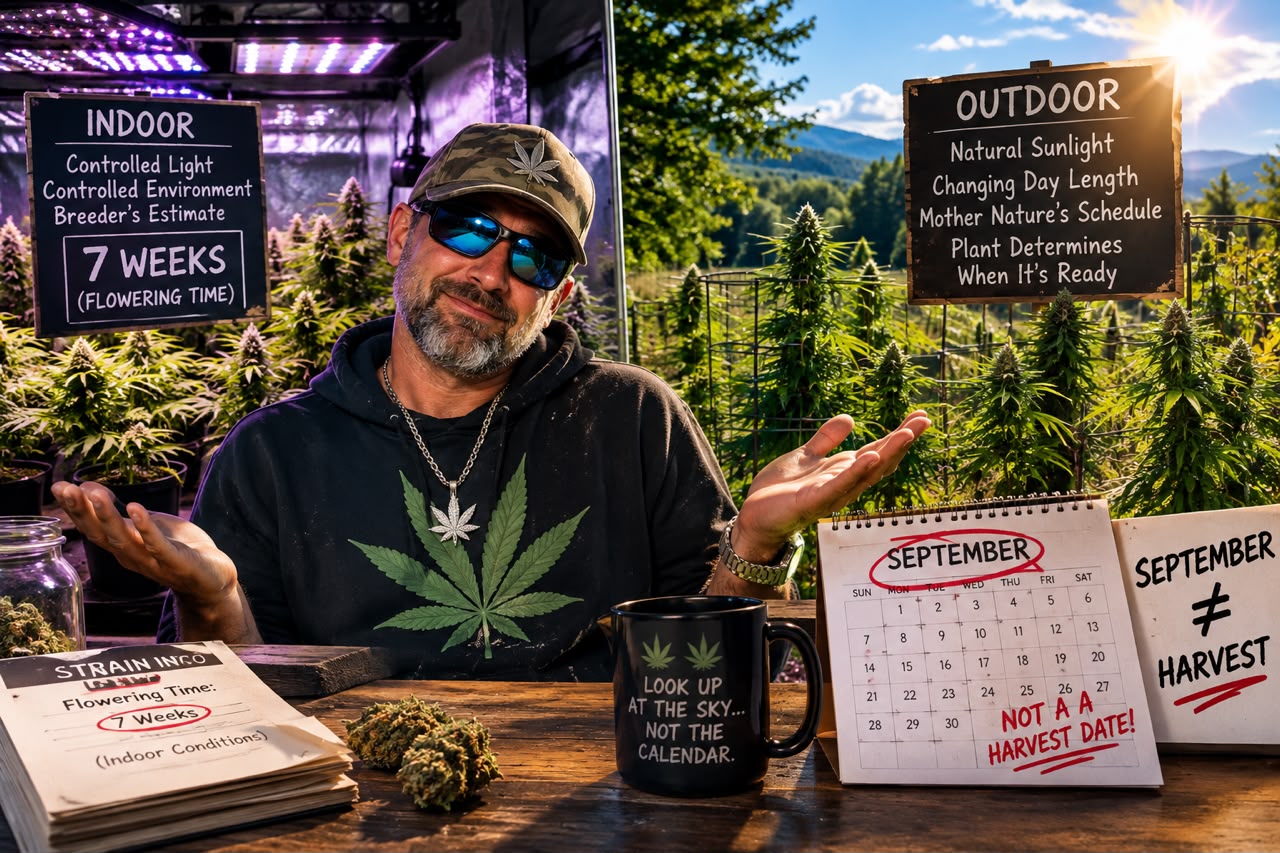
“This strain finishes in seven weeks indoors, so my outdoor plant should be finished in seven weeks.”
Uhh…
NO.
That’s not how the sun works.
And apparently somebody needs to explain this before somebody tries to sue September for not being October.
SEVEN WEEKS OF WHAT?
When a breeder says a strain has a seven-week flowering time, that number generally comes from growing the plant under controlled conditions.
INDOORS.
The grower controls the lighting.
The grower can take a plant from a long vegetative light schedule and deliberately put it into a flowering photoperiod.
Outside?
You don’t control the sun.
You can’t walk outside and say:
“All right, everybody! Starting Monday we’re going 12/12!”
The sun will basically tell you to go pound sand.
Cornell explains that Cannabis sativa is photoperiod-sensitive: as daylight decreases, the plant transitions toward flowering. Cornell also notes that outdoor day length in New York varies with latitude and date, and that varieties differ in when they flower.
That’s the entire point.
OUTDOOR NEW YORK IS NOT AN INDOOR GROW ROOM
An indoor plant can receive a controlled flowering photoperiod.
An outdoor plant in New York gets Mother Nature’s schedule.
The days gradually become shorter.
The nights gradually become longer.
The plant is responding to those changing conditions while continuing to develop.
So when somebody grabs an indoor chart that says:
“7 weeks”
and then looks at an outdoor plant and says:
“Seven weeks! CUT IT!”
they’re using the right calculator for the wrong damn equation.
It’s like using the cooking time for a microwave pizza to cook one in a wood-fired oven and then getting angry at the pizza.
THE CONDITIONS MATTER!
And this is where September gets exposed.
Here’s my point for outdoor growers in Upstate New York:
Do not confuse an indoor flowering-time estimate with an outdoor harvest date.
A strain being advertised as a seven-week indoor finisher does NOT mean your outdoor plant suddenly becomes genetically obligated to be finished in September.
In fact, for the overwhelming majority of outdoor cannabis plants growing in Upstate New York, September is simply too early to assume the plant is at peak maturity just because the calendar says September.
Some varieties can flower earlier than others. Some plants can develop faster than others. Weather, location, genetics and growing conditions all matter.
But the big point remains:
Seven weeks indoors does not equal seven weeks outdoors.
And if you’re growing outdoors in New York, mid-October and beyond is a much more realistic part of the conversation than somebody yelling “HARVEST!” the moment September shows up on the calendar.
Cornell’s own New York production material explains that flowering is tied to decreasing day length and that high-cannabinoid Cannabis continues accumulating floral biomass during the flowering stage.
So if somebody tells you:
“My strain is seven weeks indoors, therefore my outdoor plant is done in September.”
Ask them one question:
“Seven weeks under WHAT conditions?”
Because that’s the part they conveniently left out.
SEPTEMBER IS NOT A MAGIC HARVEST DATE
This is the part I really want outdoor growers to understand.
There is nothing magical about September 1st.
September 15th doesn’t come around and suddenly every outdoor cannabis plant in New York rings a little bell and says:
“Welp! Seven weeks are up! Time to chop!”
😂
That’s not how plants work.
For outdoor growers in Upstate New York, most plants are going to benefit from having the time they need to continue developing rather than being chopped early simply because somebody found a seven-week flowering estimate online.
Most outdoor plants are going to be much closer to their finish in mid-October or later than they are in September.
That doesn’t mean every single plant in every single location should automatically be left outside forever.
It means you should stop treating September like a universal harvest deadline.
Watch the plant.
Watch the weather.
Watch the forecast.
And understand the difference between an indoor breeder estimate and an outdoor growing season.
NICK, THIS ONE’S FOR YOU 😂
Nick Ellingsen recently suggested that everybody else was an idiot because he harvests his outdoor plants in September because his strain only takes seven weeks to finish indoors.
Nick…
My brother in cannabis.
The seven-week number you found didn’t come with a tiny invisible clause saying:
“Congratulations! This applies to every outdoor plant growing underneath the New York sun too.”
You found an indoor flowering estimate.
You can’t take an indoor timetable, throw a plant outside, change the entire lighting environment, and then act surprised when Mother Nature doesn’t follow your Google search.
That’s not how horticulture works.
And telling people that most outdoor plants should be cut in September because your particular strain finishes in seven weeks indoors?
That doesn’t make everybody else stupid.
It just makes the argument look stupid.
Again, Nick.
😂
UPSTATE NEW YORK HAS A FALL PROBLEM
Here’s another thing people forget:
New York is not California.
Our outdoor season has an expiration date.
The farther north you go, the higher the elevation, and the more exposed your plants are to changing fall weather, the more important that late-season weather becomes.
And there is no single statewide “first frost date.”
Cornell climate data show that first frost varies substantially depending on location and year. Some northern parts of New York can see frost much earlier than other areas.
So you can’t simply say:
“September is harvest.”
You also can’t blindly say:
“October 20th is harvest.”
The weather doesn’t care what date you circled on your calendar.
That’s why outdoor growers need to pay attention to the actual conditions where they live.
LET THE PLANT FINISH
This is where I think a lot of people get impatient.
They see flowers.
They see some color.
They see some trichomes.
They hear somebody online say, “Mine is done.”
And suddenly they’re standing outside with scissors like they’re on a countdown clock.
Relax.
😂
If the plant is healthy and the weather is cooperating, there is a big difference between having flowers on the plant and having a plant that has reached the point where you actually want to harvest it.
And that’s especially important in Upstate New York.
For most outdoor growers, the goal shouldn’t be to get the plant down as early as possible.
The goal should be to give the plant the time it needs while keeping an eye on the weather.
If you get into the later part of October and the weather is still cooperating, there may be no reason to panic simply because somebody online harvested three weeks earlier.
Their calendar isn’t your calendar.
Their latitude isn’t your latitude.
Their weather isn’t your weather.
And their seven-week indoor flowering estimate certainly isn’t your outdoor harvest date.
AND THEN THERE’S FROST
This is where common sense has to take over.
You don’t want to blindly leave plants exposed to a serious damaging freeze just to prove a point.
If an early frost threatens, you have to pay attention to your local conditions and make decisions based on the actual weather.
If the season cooperates and you make it well into October, great.
If a serious freeze is coming earlier than expected, that’s a different situation.
The important thing is not to confuse an early frost warning with some imaginary September deadline.
Mother Nature doesn’t hand every New York grower the same schedule.
Sometimes the weather gives you more time.
Sometimes it doesn’t.
That’s why you watch the forecast instead of Facebook.
THE SIMPLEST WAY I CAN PUT IT
INDOOR:
Controlled light → controlled flowering schedule → breeder’s indoor flowering estimate.
OUTDOOR:
Natural sunlight → gradually changing day length → environmental conditions → actual plant determines when it’s ready.
That’s it.
You don’t need a PhD.
You don’t even need a GED.
You just need to look up at the sky.
😂
SO WHEN SHOULD AN OUTDOOR GROWER HARVEST?
Not because some website said “seven weeks.”
Not because somebody on Facebook said “September.”
And definitely not because some guy named Nick said everybody else is an idiot.
😂
You evaluate the actual plant and the actual conditions.
For outdoor growers in Upstate New York, September should not be treated as the automatic finish line.
For the vast majority of outdoor plants, mid-October and beyond is a much more realistic window for plants to be approaching peak maturity than September.
And if the weather is cooperating, giving the plant the time it needs can make a hell of a lot more sense than chopping early just because an indoor flowering chart says seven weeks.
Remember:
INDOOR FLOWERING TIME IS NOT AN OUTDOOR HARVEST DATE.
And there is another important point:
There is no single statewide “first frost date” for New York.
Cornell’s climate data show that frost timing varies substantially by location and year. Some northern and higher-elevation areas can get frost much earlier than other parts of the state.
So don’t blindly follow the calendar.
FOLLOW THE PLANT.
Watch the weather.
Know your local conditions.
And don’t let somebody else’s indoor grow schedule convince you that your outdoor plant is late.
The seed breeder doesn’t control the sun.
Facebook doesn’t control the sun.
Nick doesn’t control the sun.
And thankfully…
NEITHER DO I.
I’m OG Strain.
And sometimes the easiest way to settle a cannabis argument is to stop arguing with the Facebook comments…
and look up.
🌞🌱
— OG Strain
The Plug’s Pages Magazine
Why One Purple-and-Frosty Favorite Was Enough to Earn Strain of the Month
Well, I had a great vacation.
Then I came home to a little bit of drama.
But enough about that.
It’s time to get back to business.
Normally, I like to give you two or even three Strains of the Month to choose from. But this month is a little different. I’ve been spending a lot more of my time exploring cold-cure rosin lately, so I simply haven’t been working through as much new flower as I normally do.
I did receive a few samples recently, but I haven’t made my way through all of them yet.
One of those samples, however, immediately caught my attention.
Bankroll.
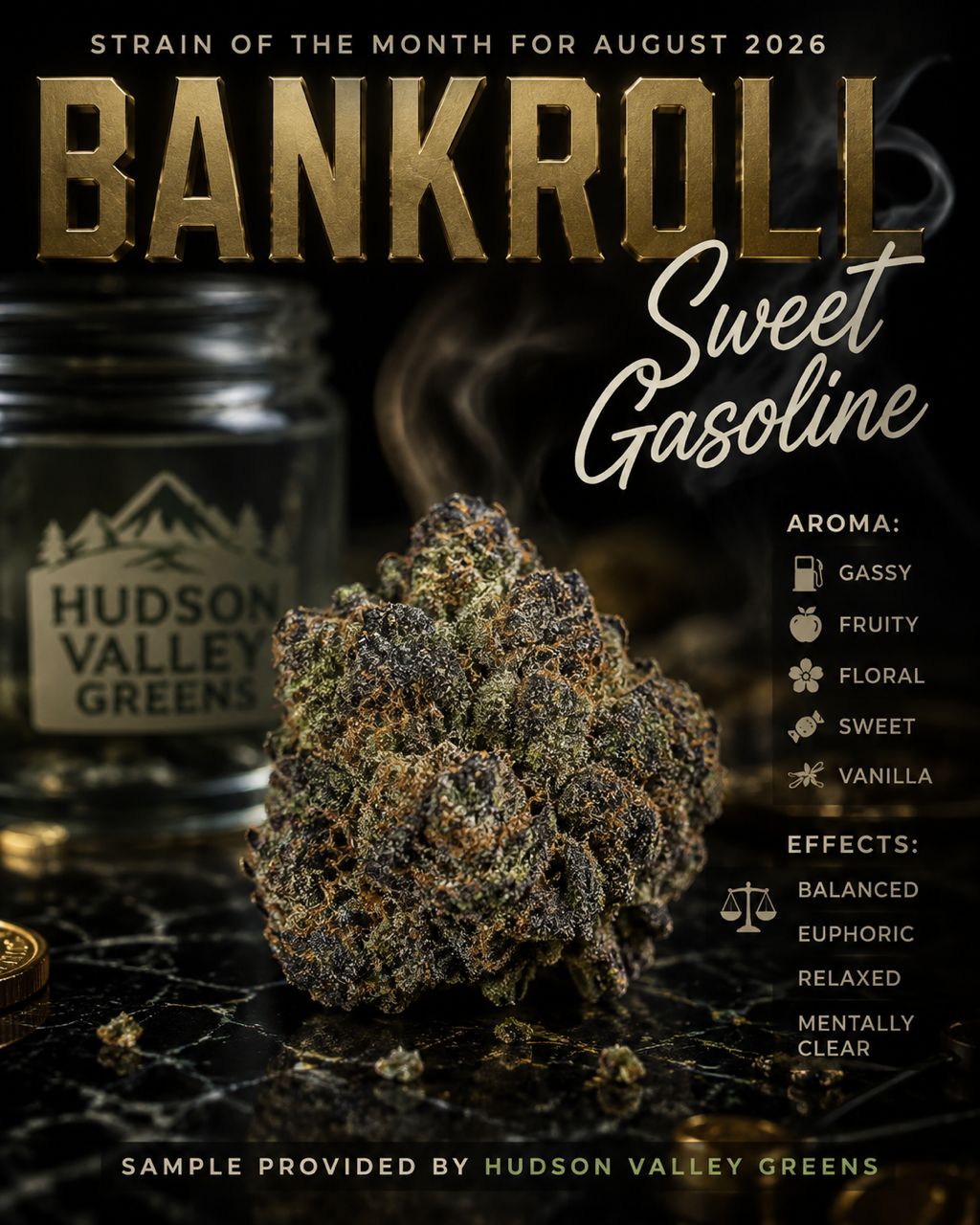
The Bankroll sample reviewed for this month’s feature came from Hudson Valley Greens, and while I’ve had Bankroll before, this particular sample stood out enough to earn the title of The Plug’s Pages Magazine’s August 2026 Strain of the Month.
And after spending some time with it, I came up with a name of my own.
If I were naming this strain?
I’d call it:
SWEET GASOLINE.
And once you get into the appearance, aroma and flavor, you’ll understand why.
FIRST IMPRESSIONS: PURPLE TAKES CENTER STAGE
Let’s start with the look.
Bankroll is an eye-catching cannabis strain, with buds showing a mixture of purple and green coloration. Purple is definitely the dominant color in most of the sample, while the orange pistils provide a nice contrast throughout the buds.
But the real attention-grabber is the trichome coverage.
There’s an above-average amount of visible trichomes here—enough that the buds have a distinctly frosty appearance.
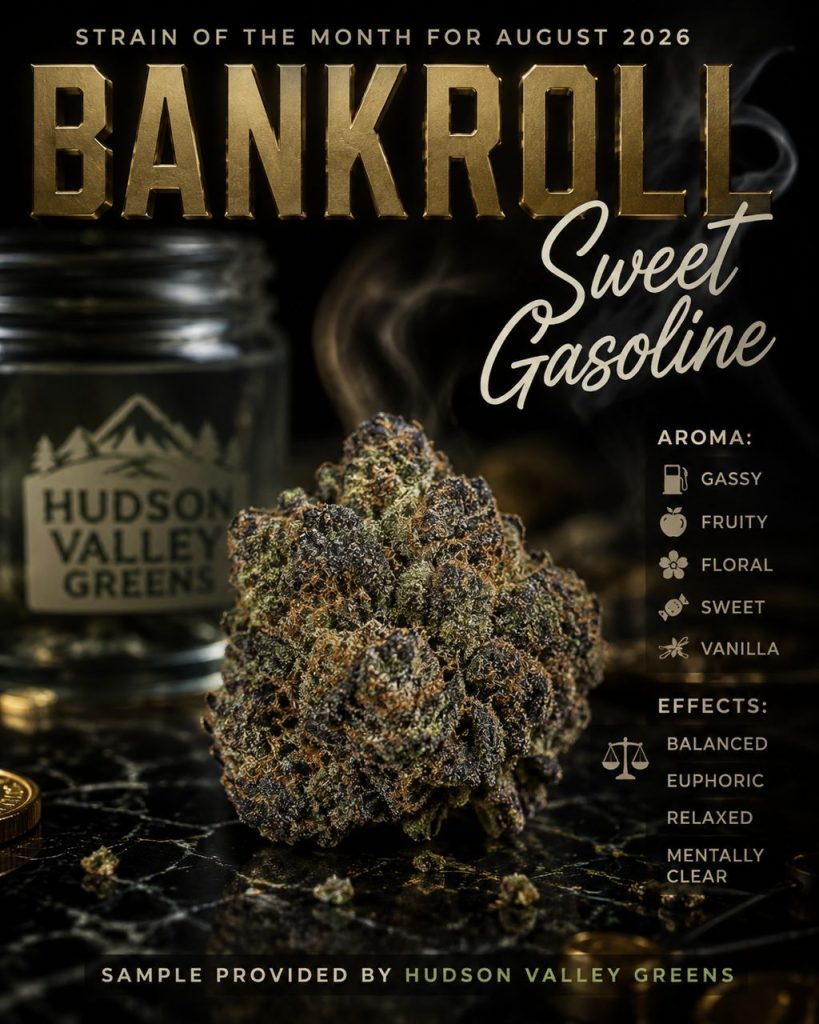
Basically, Bankroll showed up dressed for the occasion.
And apparently, it didn’t get the memo that August was supposed to be a quiet month.
THE NOSE KNOWS
The aroma is where Bankroll really starts getting interesting.
To me, the first thing that comes through is gas.
But it doesn’t stop there.
I’m also picking up fruity, floral and slightly sweet notes. There’s even something about the aroma that reminds me of vanilla.
That combination makes for a surprisingly complex smell.
You get the gassy character first, but as you spend more time with the flower, the sweeter and more floral notes become easier to recognize.
It’s not simply a one-note “gas” strain.
There’s considerably more going on.
And that made me curious about whether the flavor would follow the same path.
THE FLAVOR: SWEET GASOLINE
The flavor doesn’t hit quite as hard as the aroma initially does.
The aroma is stronger and more immediately recognizable, while the flavor takes a little more time to reveal itself.
The first impressions are smooth and gassy, with a slightly sweet character coming through.
As I spent more time evaluating it, those floral and vanilla-like notes became easier to identify.
And that’s when I knew what I would call it.
Sweet Gasoline.
It’s an unusual combination, but that’s exactly what makes the profile memorable.
The more time I spent with the strain, the more recognizable the flavor became. Instead of getting tired of the profile, I found myself picking up additional characteristics as I continued evaluating it.
That’s always a good sign when I’m reviewing a strain.
THE BALANCED EXPERIENCE
Bankroll is generally described as a balanced hybrid, and that description made sense based on my experience with the sample.
The overall effects felt balanced rather than heavily tilted in one direction.
I experienced a euphoric and relaxed feeling while remaining mentally alert. I wasn’t particularly tired or ready to go straight to sleep.
Instead, the overall feeling was more along the lines of: “I’m good. I’m comfortable. Let’s put something on TV.” And honestly, sometimes that’s exactly what you want.
Bankroll didn’t leave me feeling like I needed to accomplish twelve things before midnight.
It was more of a relax, watch a movie, watch some YouTube and let the brain take the evening off kind of experience.
That balance is one of the characteristics that stood out most to me.
A SURPRISINGLY STRONG SAMPLE
Another thing that stood out was the overall strength of the sample.
Because I have a high tolerance from regular cannabis use and my experience with concentrates, I don’t always expect flower to make a particularly strong impression.
Bankroll did.
The sample produced a noticeable effect without requiring a large amount, which made it clear that this was not flower I would describe as lacking character.
Of course, everyone’s response to cannabis can be different. Individual tolerance, body chemistry and other factors can dramatically change how someone experiences the same strain.
That’s worth remembering whenever cannabis products are discussed.
My experience is exactly that—my experience.
It shouldn’t be treated as a guarantee of what somebody else will experience.
THE GREEN NUG THAT CHANGED THE PROFILE
Interestingly, one of the final buds I evaluated looked noticeably different from the others.
This particular nug had considerably more green coloration—roughly 30% green compared with the more purple-dominant appearance of the rest of the sample.
And guess what?
That particular nug tasted really gassy.
It was another reminder that even within the same cannabis strain, individual buds can sometimes present slightly different characteristics.
For someone who pays attention to flavor and aroma, those differences can be fascinating.
SO, WHY BANKROLL?
This brings us back to the obvious question:
Why did Bankroll earn the August Strain of the Month title when I normally feature multiple strains?
Simple.
Because I only need one winner.
I haven’t been getting through as much new flower lately because so much new flower lately because so much of my attention has been on cold-cure rosin. I still have additional flower samples waiting to be properly evaluated, and I don’t want to give a strain a spot in the magazine simply because I need to fill a space.
If something earns Strain of the Month, I want it to actually stand out.
Bankroll did.
I’ve had this strain before, but the Hudson Valley Greens sample I evaluated for August was impressive enough to make the cut.
The purple-dominant appearance caught my attention.
The heavy trichome coverage kept it there.
The gassy, fruity, floral and slightly sweet aroma made me want to investigate further.
And the flavor profile ultimately gave me the name that sums up my experience with it better than anything else:
SWEET GASOLINE.
THE FINAL WORD
After returning from vacation, I wasn’t necessarily expecting Bankroll to become the highlight of my first month back.
But that’s the funny thing about reviewing cannabis.
Sometimes you think you already know what you’re going to find.
Then a strain comes along and says, “Hold my jar.”
For August 2026, Bankroll did exactly that.
It delivered an impressive visual presentation, a complex aroma, a distinctive gassy-sweet flavor profile and the balanced character that made the sample memorable.
There may only be one Strain of the Month this time around.
But when that one strain makes enough of an impression to earn the title on its own, I don’t think I need three.
Bankroll is officially The Plug’s Pages Magazine’s August 2026 Strain of the Month.
And if you ask OG Strain what I’d have named it?
There’s only one answer:
Sweet Gasoline.
Stay Tuned for the cold cure rosin of the month article!


KEIF: THE ART OF SAVING THE BEST FOR LAST

HUDSON VALLEY GREEN’S COLD CURE ROSIN RANKED: SIX JARS, ONE CHAMPION

30 YEARS, ONE LEGENDARY GATHERING

She Didn’t Tiptoe In — OG Granny Blew the Door Off the Internet 💥🌿

Tokalotapot & Cannafae: The Couple That Made Weed Legal (Not Really, But It Feels Like It)

“Damn Sam”, The Man Who Kept the 518 Lit (and Safe) Before It Was Legal to Say “Lit”
-
 Cannabis Hall Of Fame9 months ago
She Didn’t Tiptoe In — OG Granny Blew the Door Off the Internet 💥🌿
-
 Cannabis Hall Of Fame1 year ago
Tokalotapot & Cannafae: The Couple That Made Weed Legal (Not Really, But It Feels Like It)
-
 Cannabis Hall Of Fame7 months ago
“Damn Sam”, The Man Who Kept the 518 Lit (and Safe) Before It Was Legal to Say “Lit”
-

 Cannabis Hall Of Fame1 year ago
Dope as Yola: From the Bottom to Cannabis Hall of Fame
-

 Community8 months ago
Empire State Cannabis Cup: An OG Strain Community Walkthrough
-

 Community1 year ago
🔥 HARVEST HYSTERIA: WHERE THE BUD AT, NEW YORK?!
-

 Community11 months ago
From Soil, Struggle, and Soul: Hudson Valley Green Wins Big at the Palenville Cannabis Cup”
-

 Humor1 year ago
OG Strain: The 518’s True Connoisseur Bringing Cannabis Reviews and Comedy Gold to YouTube