Strains
Why I’ve Been Smoking “Indicas” During the Day (And Why the Sativa vs. Indica Argument Is Basically a Lie)


Written by OG Strain for The Plug’s Pages Magazine
Let me start with a confession that would’ve gotten my cannabis card revoked in 2005:
Lately… I’ve been reaching for indica-leaning hybrids during the daytime.
I know.
Somewhere, a budtender just dropped a tray.
According to the old stoner rulebook, this makes no sense. We were taught the gospel early:
• Sativa = daytime, energy, creativity, productivity
• Indica = nighttime, couch-lock, snacks, sleep, questioning life at 2 a.m.
Simple. Clean. Easy.
Also… wrong.
And before the internet jumps me, let me be clear: anybody who knows me knows I fall into that under-30% category of cannabis users who are not chasing couch-lock, droopy eyelids, or melting into the furniture like a forgotten candle. I’m here for uplift, clarity, mood elevation, and energy.
That has always been my lane.
So why am I suddenly enjoying “indica” strains during the day while some so-called sativas are putting me straight into nap mode?
Because the whole sativa vs. indica thing is mostly marketing nonsense.
Yeah, I said it. Let’s talk about it.
⸻
The Moment the Labels Fell Apart
Here’s what really sparked this realization:
I reached for classic sativa-leaning strains — the ones that are supposed to lift you up, sharpen your mind, and get your day moving — and they just weren’t hitting. Not bad… just flat. Meh. Background noise.
Then I tried strains labeled as indica-leaning, the kind that are supposed to tuck you in at night…
…and instead of getting sleepy, I felt great. Clear. Happy. Motivated. Focused. No couch-lock. No yawns. Just a clean, uplifting buzz.
That’s when it clicked:
The plant didn’t change.
The labels lied.
⸻
The Truth: Terpenes Are Running the Show
Here’s the part most people either don’t know — or were never told properly:
👉 Cannabis effects are driven by terpene profiles, not by whether a strain is labeled indica or sativa.
Terpenes are aromatic compounds found in cannabis (and many other plants) that do way more than make weed smell good. They actively influence how THC and other cannabinoids interact with your body and brain.
Think of THC as the engine…
Terpenes are the steering wheel.
Some quick real-world examples:
• Limonene – Uplifting, mood-boosting, often energizing
• Pinene – Alertness, focus, mental clarity
• Terpinolene – Bright, energetic, sometimes even racy
• Myrcene – Sedating at higher levels, relaxing, body-heavy
• Linalool – Calm, soothing, anxiety-reducing
Here’s the kicker:
🔹 A strain labeled indica can be rich in uplifting terpenes
🔹 A strain labeled sativa can be heavy in sedating ones
So yes — there are sativas that will put you to sleep
And indicas that will give you energy
If that sounds backwards, it’s only because we were taught backwards.
⸻
Why the Old System Stuck Around
The sativa/indica classification originally had more to do with plant structure and growth patterns, not effects.
• Tall, thin-leaf plants? Sativa
• Short, bushy plants? Indica
Somewhere along the way, that turned into a personality test for your high — and the industry just ran with it because it was easy to explain on a menu board.
But modern cannabis genetics are so hybridized that calling something “pure indica” or “pure sativa” is like calling a mule either a horse or a donkey and pretending that settles it.
Spoiler: it doesn’t.
⸻
Why Your Experience Can Change Day to Day
Here’s another truth people don’t talk about enough:
👉 Your body chemistry changes daily.
Sleep, stress, food, hydration, tolerance, mood — all of it affects how cannabis hits you. A strain that energizes you on Monday might relax you on Friday.
That’s not inconsistency.
That’s biology.
Which is another reason rigid labels fall apart in real-world use.
⸻
So What Should You Actually Look At?
If you want predictable effects, stop asking:
❌ “Is this indica or sativa?”
Start asking:
✅ “What are the dominant terpenes?”
✅ “How does my body respond to those terpenes?”
✅ “How does this strain make me feel — not how it’s marketed?”
Follow the terps.
Trust your experience.
Ignore the stereotype.
⸻
Final Hit
The moment I stopped chasing labels and started paying attention to terpene profiles, cannabis made more sense than ever.
Now I’ll smoke an “indica” at noon, a “sativa” at night, and judge the plant by what it actually does — not what the jar tells me it’s supposed to do.
Cannabis isn’t broken.
The conversation around it is.
And once you understand that?
You don’t just get higher —
You get smarter about your smoke.
— OG Strain







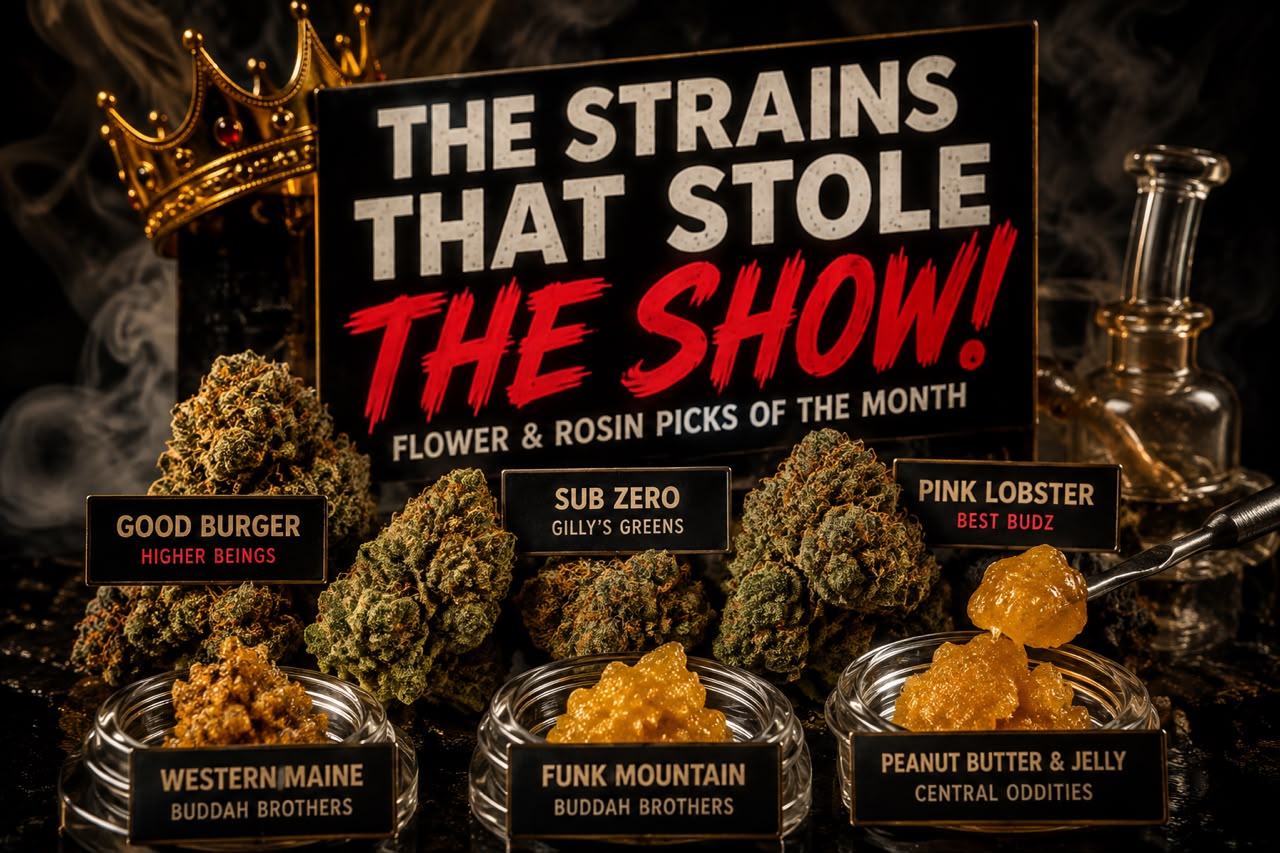
🥇 Good Burger — Higher Beings Powered by Hudson Valley Green
If you haven’t tried Good Burger yet… what are you doing?
Seriously.
This was hands-down my favorite flower of the month.
The first thing that hits you is that loud, earthy, musky aroma that immediately reminds me of some classic New York haze cuts. Crack open the jar and it’s like Mother Nature slapped you across the face with a handful of fresh earth, herbs, and funk—in the best possible way. Many modern “dessert strains” lean heavily on candy terps, but Good Burger proudly marches in the opposite direction with a savory, earthy profile that keeps you coming back for another bowl.
The flavor is every bit as satisfying as the aroma. Rich earth, herbal spice, subtle fuel, and just enough sweetness to round everything out. Burger-family genetics are well known for their funky, garlic-forward and earthy terpene profiles, and Good Burger delivers that signature character while remaining remarkably smooth.
The effects?
Absolutely balanced.
A happy cerebral buzz gets the mind moving while a comfortable body relaxation settles in without gluing you to the couch. It’s the kind of hybrid that works whether you’re hanging with friends, watching movies, or spending twenty minutes trying to remember why you walked into the kitchen.
Trust me…
Most people who try this strain end up asking where they can get more.
⸻
🥈 Sub Zero — Gilly’s Greens
If Good Burger is the laid-back friend who always has great stories…
Sub Zero is the friend who drinks three energy drinks before breakfast.
Coming from the Blockberry (Super Boof) × Oreoz lineage, Sub Zero is absolutely loaded with bright citrus, creamy sweetness, and that unmistakable Super Boof influence that has become one of the hottest terp profiles around.
For me, this one leaned heavily toward an energetic experience. It’s uplifting, motivating and incredibly heady. Sensitive consumers may even notice their heart racing a bit—something energetic sativas can occasionally produce—so know your limits before diving in.
But if you’re a die-hard sativa lover?
You’re probably going to fall in love.
This is daytime smoke. Creative smoke. Get-things-done smoke.
Just maybe don’t clean your entire house at 2:00 in the morning because Sub Zero convinced you it was a good idea.
⸻
🥉 Pink Lobster — Best Budz
I’ve smoked Blue Lobster.
I’ve smoked Black Lobster.
I’ve smoked enough lobster strains that Red Lobster should probably start charging me rent.
But Pink Lobster?
This one surprised me.
It took everything I enjoy about the Lobster family and somehow made it even more enjoyable. Dense, frosty buds, a loud aroma, excellent flavor and effects that strike a beautiful balance between mental stimulation and body comfort.
Out of every Lobster phenotype I’ve personally tried…
Pink Lobster wins.
No debate.
⸻
🧊 COLD CURE ROSIN OF THE MONTH
Now let’s talk about the real terp hunters.
If flower is the movie…
Cold cure rosin is the director’s cut.
⸻
🥇 Western Maine — Buddah Brothers
I don’t throw around the phrase “favorite of all time” very often.
But Western Maine from Buddah Brothers might honestly deserve it.
This rosin is unbelievably smooth.
The flavor is difficult to describe because it refuses to fit neatly into one category. It opens with rich earthy sweetness before evolving into creamy herbal notes with a lingering finish that keeps coating your palate long after the exhale.
Every dab somehow tastes better than the last.
It’s the kind of concentrate that makes you stare at your rig after exhaling and quietly whisper…
“Yep… we’re doing another one.”
That’s usually how you know you’ve found something special.
⸻
🥈 Funk Mountain — Buddah Brothers
Don’t judge this one by the smell.
Seriously.
The aroma is downright bizarre.
Imagine swamp water, wet forest floor, funky cheese and old-school skunk somehow deciding to throw a family reunion.
Sounds terrible.
It isn’t.
The flavor completely changes once it hits the nail. Instead of tasting like the aroma suggests, the smoke becomes surprisingly smooth with earthy sweetness, herbal spice and a complex funky finish that keeps evolving throughout the dab.
This is one of those rosins where your nose says one thing…
…and your taste buds completely disagree.
⸻
🥉 Peanut Butter & Jelly — Central Oddities
Leave it to Central Oddities to sneak into the rankings with one of the sweetest rosins I’ve had this month.
Peanut Butter & Jelly delivers exactly what the name suggests.
Sweet berry notes mingle with creamy, nutty undertones and just enough earthy funk to keep everything balanced. Every dab is rich, flavorful and leaves behind a lingering sweetness that keeps you reaching for another.
It’s flavorful.
Potent.
Ridiculously smooth.
And one of those jars you accidentally empty way faster than you planned.
Don’t ask me how.
Science still hasn’t figured that one out.
⸻
FINAL PUFF
This month’s winners proved one thing…
You don’t always need the highest THC percentage to have the best experience.
Great cannabis is about terpenes, flavor, balance, and how the strain makes you feel.
Whether you’re rolling up some Good Burger, blasting off with Sub Zero, relaxing with Pink Lobster, or loading a dab of Western Maine, Funk Mountain, or Peanut Butter & Jelly, these are the strains that earned permanent real estate in my stash this month.
Until next month…
Stay lifted.
Stay laughing.
And as always…
Keep chasing flavor—not just numbers.
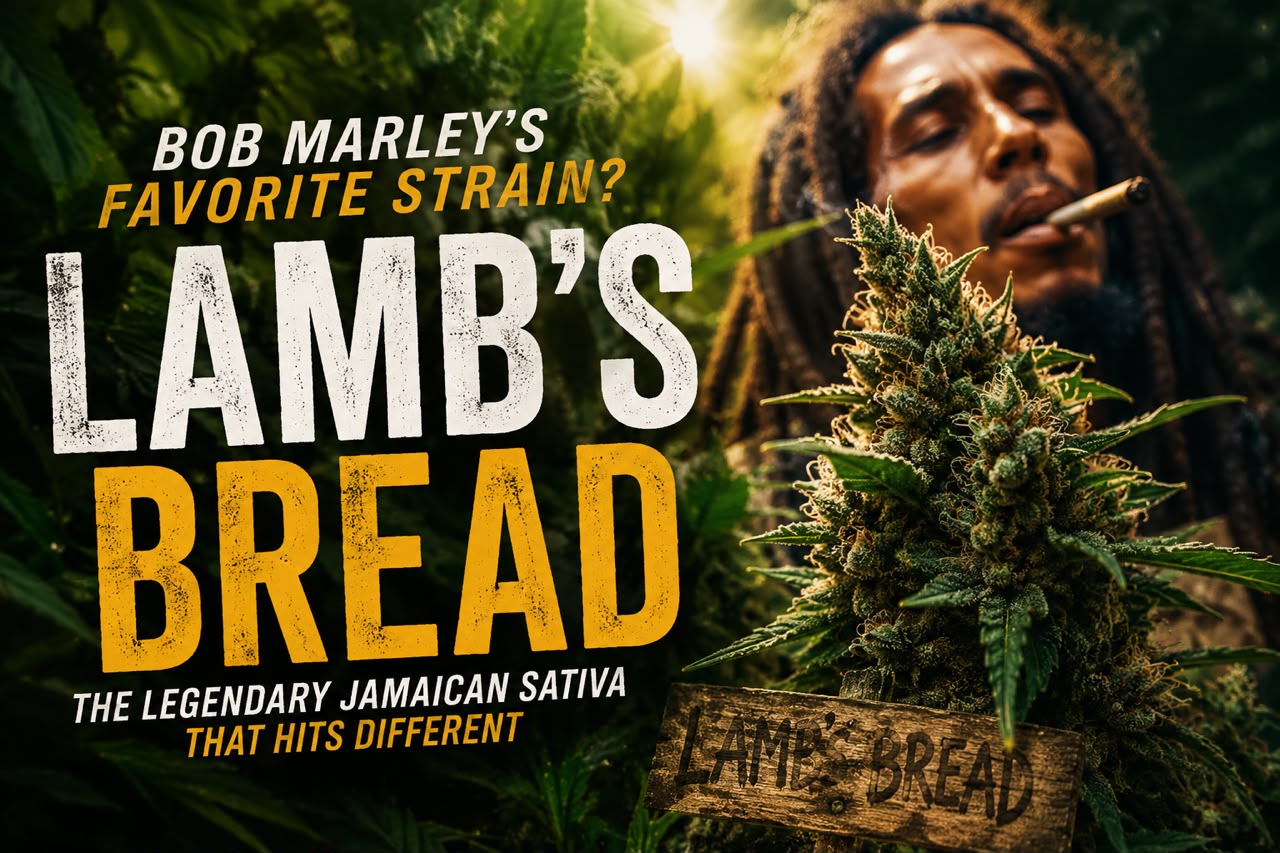
Some strains get famous because they test at ridiculous THC percentages. Some get famous because they have flashy packaging and marketing budgets bigger than a small town’s annual budget.
Then there’s Lamb’s Bread.
Lamb’s Bread didn’t need any of that.
This legendary Jamaican landrace sativa earned its reputation the old-fashioned way—by delivering one of the most uplifting and energetic experiences cannabis has to offer. Long before dispensaries were arguing over whether 34% THC is somehow better than 33%, Lamb’s Bread was already building a worldwide reputation from the hills of Jamaica.
And if the stories are true, it was reportedly one of the favorite strains of reggae legend Bob Marley. Whether you’re a cannabis historian, a sativa enthusiast, or just somebody who occasionally loses their car keys while they’re still in their hand, Lamb’s Bread is a strain worth knowing.
A PIECE OF CANNABIS HISTORY
Lamb’s Bread, often called Lamb’s Breath, traces its roots back to Jamaica where it developed naturally as a landrace strain. Unlike many modern varieties that have been crossed, recrossed, and crossed again until their family tree looks like a plate of spaghetti, landrace strains evolved naturally in specific regions over generations.
That makes Lamb’s Bread something special.
It’s a living piece of cannabis history—a genetic snapshot from a time before breeders started combining everything with everything else.
Many modern “sativas” on dispensary shelves are actually sativa-leaning hybrids. True pure sativas have become increasingly rare, making Lamb’s Bread one of those strains that seasoned consumers get excited about when they actually find it.
APPEARANCE: SUNSHINE IN FLOWER FORM
Lamb’s Bread doesn’t always have the dark purples or exotic color combinations that dominate social media these days.
Instead, it typically produces bright green flowers covered in a healthy layer of sparkling trichomes. The buds are often somewhat airy and elongated compared to the dense golf-ball nuggets many modern hybrids produce.
In other words, Lamb’s Bread looks like a strain that spent its childhood running around tropical mountains instead of sitting in a laboratory taking selfies.
AROMA AND FLAVOR
Open a jar of quality Lamb’s Bread and you’ll often be greeted with a unique combination of earthy, herbal, citrus, and slightly sweet aromas.
Some phenotypes lean toward spicy and peppery notes, while others offer tropical fruit characteristics that remind you of its Caribbean origins.
The flavor follows a similar path. Expect herbal earthiness mixed with citrus and subtle sweetness, often finishing with a spicy kick that lingers pleasantly on the palate.
It’s not one of those strains that tastes like a blueberry cheesecake dipped in rainbow sherbet and wrapped in cotton candy.
It’s cannabis-flavored cannabis.
And sometimes that’s exactly what the doctor ordered.
THE EFFECTS: WHY PEOPLE FALL IN LOVE WITH THIS STRAIN
This is where Lamb’s Bread separates itself from the crowd.
Many strains promise energy. Lamb’s Bread actually delivers it.
Consumers frequently report feelings of mental clarity, creativity, focus, motivation, and an overall sense of positivity. Instead of feeling glued to the couch while debating whether ordering pizza counts as exercise, Lamb’s Bread often encourages activity, conversation, creativity, and productivity.
This is the strain you reach for before tackling a project.
Before going on an adventure.
Before cleaning the house.
Or before convincing yourself that reorganizing your entire collection of smoking accessories at 2 PM is somehow a life-changing achievement.
For daytime consumers, artists, musicians, writers, and anyone seeking an uplifting experience, Lamb’s Bread has remained a favorite for decades.
MY EXPERIENCE WITH LAMB’S BREAD
I recently had the opportunity to pick up some Lamb’s Bread from Buddah Brothers, and I have to say, I thoroughly enjoyed it.
What stood out most was how genuinely sativa the experience felt.
These days, a lot of strains marketed as sativas turn out to be sativa-leaning hybrids that eventually settle into a relaxing body effect. Not Lamb’s Bread.
This one reminded me why pure sativas became legendary in the first place.
The uplifting nature of the experience was exactly what I look for when I’m reaching for a daytime strain. The mental clarity, the positive mood, the motivation—it all felt authentic and true to what cannabis enthusiasts have historically associated with classic sativas.
If you’re somebody who loves the energetic, creative, and uplifting effects typically associated with sativa strains, this is absolutely one I would recommend experiencing for yourself.
WHY LAMB’S BREAD STILL MATTERS
Cannabis trends come and go.
Every year there’s a new flavor, a new cross, a new “must-have” strain that everybody forgets about six months later.
But Lamb’s Bread continues to stand the test of time.
Why?
Because it offers something increasingly difficult to find: authenticity.
It’s a genuine landrace with a rich history, legendary status, unique genetics, and effects that have earned respect from generations of cannabis consumers.
In a market filled with flashy names and endless hybrids, Lamb’s Bread serves as a reminder that sometimes the classics become classics for a reason.
And if Bob Marley really did enjoy it as much as the stories suggest, who are we to argue with the King of Reggae?
OG Strain Approved!
By OG Strain | Plugs Pages Magazine
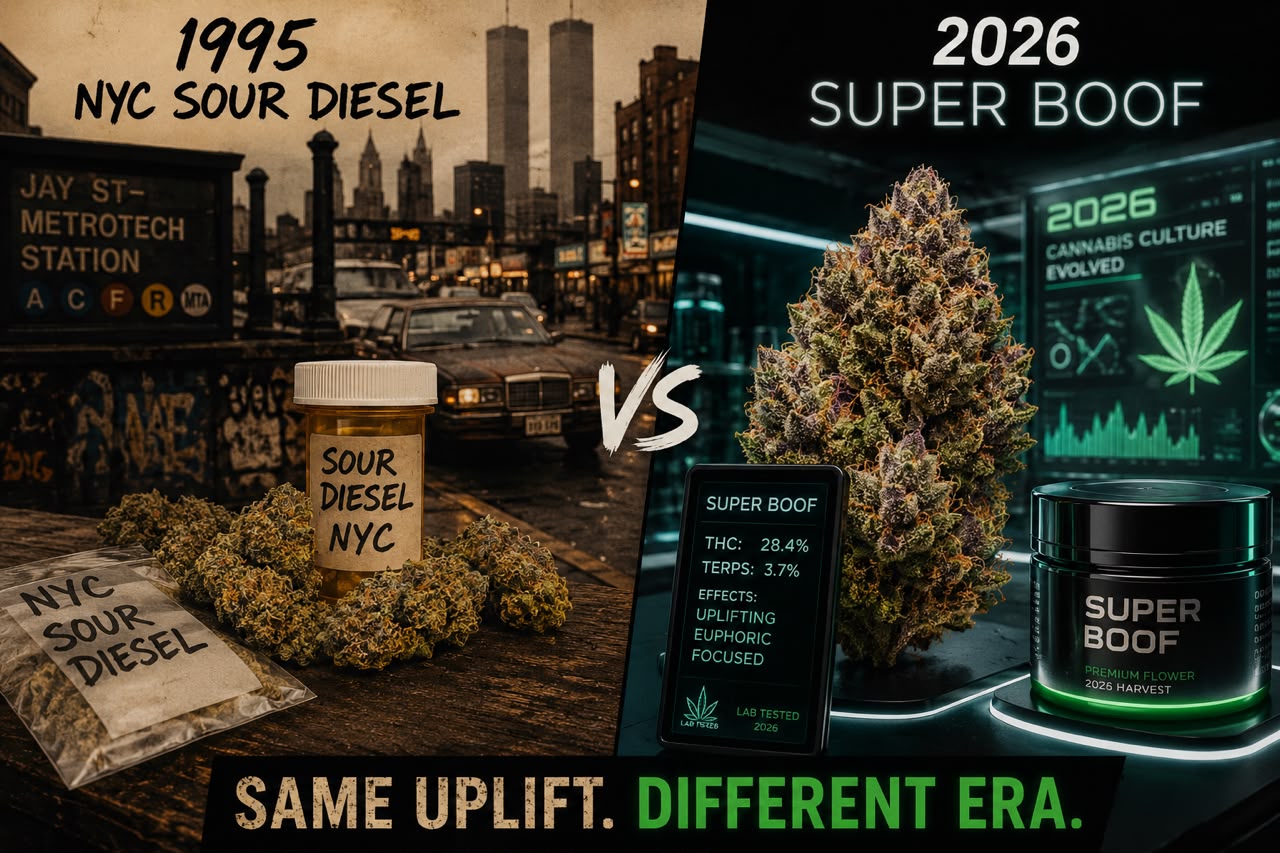
There’s a certain smell in cannabis history that never really leaves your memory. If you were around for it, you already know. If you weren’t, you’ve probably been chasing it ever since like it owes you money.
I’m talking about that old-school New York City Sour Diesel energy. The kind that didn’t just get you high—it got you moving. Thinking. Smiling at strangers for no reason. Questioning why you were standing in the kitchen holding car keys you didn’t need.
And now, in 2026, a new name keeps coming up in conversations like it’s trying to sit at that same legendary table:
Super Boof.
People are calling it the “new Sour Diesel.”
That’s a bold sentence in cannabis culture. Almost disrespectful… until you actually listen to what smokers are saying.
⸻
Sour Diesel: The Original Uplift Era
Let’s get something straight first.
Sour Diesel wasn’t just popular—it was a personality. In the 90s New York scene, it became known for that sharp, fuel-forward aroma and a fast, cerebral type of lift that people still try to describe but rarely recreate accurately.
Old heads will tell you it wasn’t just “strong.” It was loud in your brain. Creative, social, sometimes chaotic in the best way. You didn’t sit still on Sour Diesel—you had plans, even if those plans were just walking to the corner store and ending up in a philosophical debate about pizza quality.
Modern Sour Diesel cuts, however, don’t always hit that same emotional frequency. The genetics may be similar on paper, but smokers often report a softer, less electric version of what once felt like a lightning bolt wrapped in citrus fuel.
And that’s where Super Boof enters the conversation.
⸻
Super Boof: The New Name With Old Energy
Super Boof is one of those strains that doesn’t politely introduce itself—it just shows up and changes the vibe of the room.
What’s interesting is not that it tastes like Sour Diesel. It doesn’t. In fact, flavor-wise, it stands in its own lane entirely. Fruit-forward, candy-like notes with a funky undertone that doesn’t try to imitate anything from the diesel family tree.
But the effect?
That’s where the comparisons start getting loud.
Users consistently describe Super Boof as extremely uplifting, euphoric, and mentally activating in a way that reminds them of that classic NYC Sour Diesel experience—not the taste, not the smell, but the feeling.
It’s like hearing an old song remixed by someone who didn’t copy it… they just understood the energy behind it.
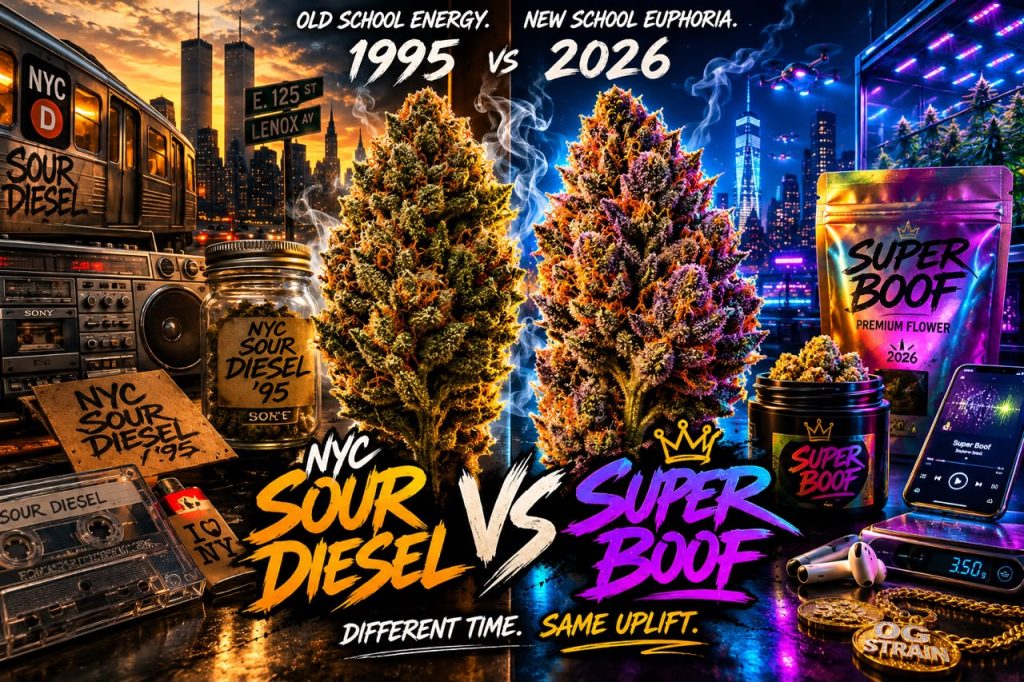
And that’s a key difference.
⸻
Side-by-Side: Same Destination, Different Roads
Let’s break it down without overcomplicating it:
Sour Diesel (NYC era):
Fuel-heavy, sharp aroma
Fast cerebral onset
Creative stimulation, social energy
Iconic “wake up your thoughts” effect
Super Boof:
Fruity, funky, unmistakable flavor profile
Strong euphoric uplift
Clear-headed, mood-boosting experience
Modern expression of high-energy genetics
The overlap isn’t in taste. It’s not even fully in lineage.
The overlap is in impact.
Both strains seem to push people upward mentally—out of sluggishness, out of silence, into conversation, curiosity, and motion.
But Super Boof does it with a smoother, more modern personality. Less gasoline, more glow.
⸻
Why People Are Making the Comparison
In cannabis culture, nostalgia is powerful. Anything that reminds people of a “lost era” gets elevated quickly in conversation.
So when smokers experience Super Boof and feel that familiar “lift-off” sensation—especially those who remember what NYC Sour Diesel felt like in its prime—the comparison becomes inevitable.
But here’s the nuance that gets missed in the hype:
Super Boof isn’t replacing Sour Diesel.
It’s echoing its energy signature in a new form.
That distinction matters.
Because Sour Diesel was a product of its time—raw, loud, urban, almost chaotic in its expression.
Super Boof feels more refined, more controlled, like that same energy grew up, got organized, and learned timing.
⸻
OG Strain’s Take: Which One Wins?
Now the part everybody wants but nobody agrees on.
If we’re talking pure legacy, cultural impact, and historical significance, Sour Diesel still holds the crown. You don’t rewrite cannabis history—you respect it.
But if we’re talking about what smokers are feeling right now, in today’s market, in today’s genetics, with today’s expectations for flavor, smoothness, and euphoric clarity…
Super Boof might actually edge it out in the modern conversation.
Not because it’s “better.”
Because it’s newer, cleaner, and delivers that same type of upward mental push in a way that feels more dialed-in for today’s consumer.
So my answer?
If you want history, take Sour Diesel.
If you want the closest thing to that feeling in a modern body, take Super Boof.
But either way—don’t pretend like you’re just “smoking a strain.”
You’re revisiting a feeling.
And that’s what people are really chasing.


Can Full-Spectrum Dabs Replace Flower? The Answer Might Surprise You

Cannabis Didn’t Ruin My Life—It Helped Save It

STONER MAMA NICOLE Breaking Stigma, One Laugh at a Time

She Didn’t Tiptoe In — OG Granny Blew the Door Off the Internet 💥🌿

Tokalotapot & Cannafae: The Couple That Made Weed Legal (Not Really, But It Feels Like It)

“Damn Sam”, The Man Who Kept the 518 Lit (and Safe) Before It Was Legal to Say “Lit”
-
 Cannabis Hall Of Fame8 months ago
She Didn’t Tiptoe In — OG Granny Blew the Door Off the Internet 💥🌿
-
 Cannabis Hall Of Fame11 months ago
Tokalotapot & Cannafae: The Couple That Made Weed Legal (Not Really, But It Feels Like It)
-
 Cannabis Hall Of Fame6 months ago
“Damn Sam”, The Man Who Kept the 518 Lit (and Safe) Before It Was Legal to Say “Lit”
-

 Cannabis Hall Of Fame12 months ago
Dope as Yola: From the Bottom to Cannabis Hall of Fame
-

 Community7 months ago
Empire State Cannabis Cup: An OG Strain Community Walkthrough
-

 Community10 months ago
From Soil, Struggle, and Soul: Hudson Valley Green Wins Big at the Palenville Cannabis Cup”
-

 Community11 months ago
🔥 HARVEST HYSTERIA: WHERE THE BUD AT, NEW YORK?!
-

 Humor12 months ago
OG Strain: The 518’s True Connoisseur Bringing Cannabis Reviews and Comedy Gold to YouTube