Strains
🌿 FLOWER FAVORITES OF THE MONTH

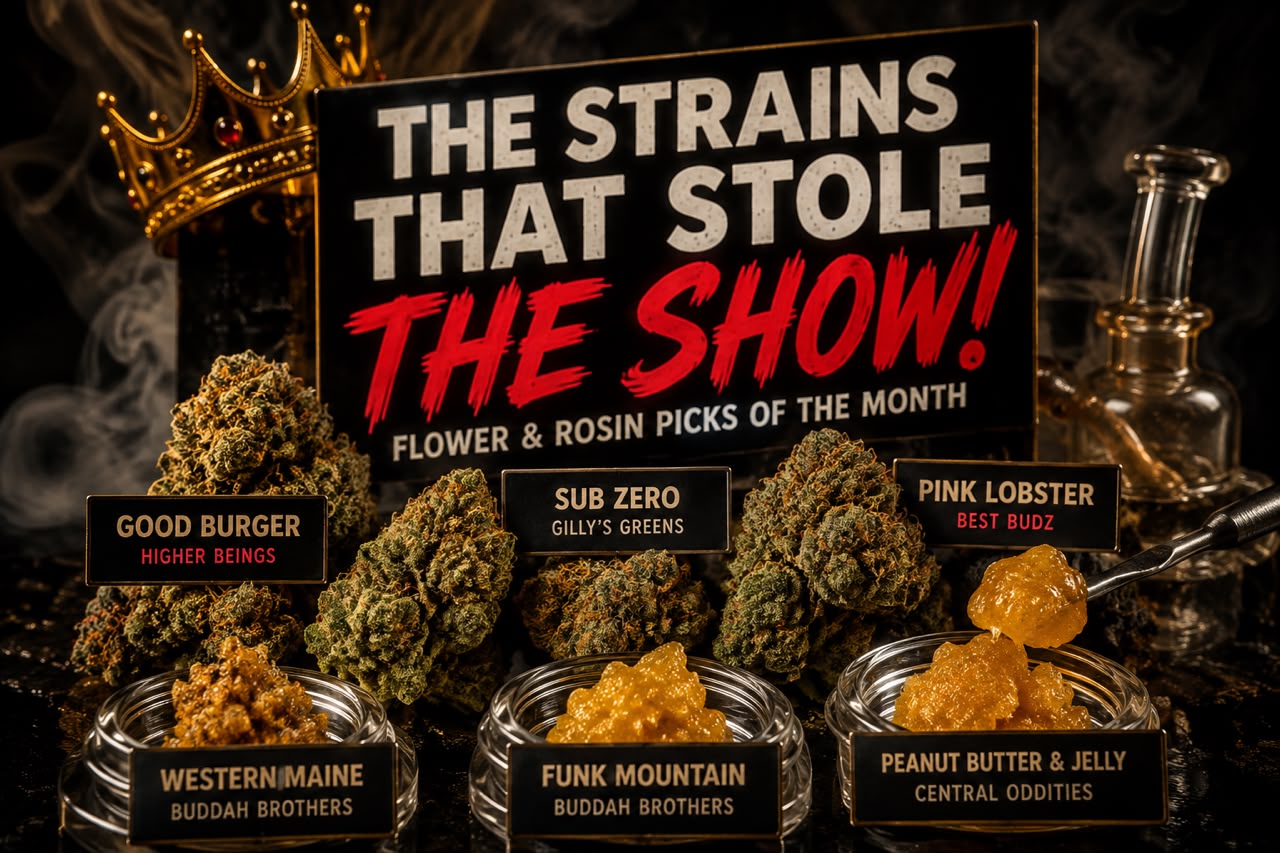
🥇 Good Burger — Higher Beings Powered by Hudson Valley Green
If you haven’t tried Good Burger yet… what are you doing?
Seriously.
This was hands-down my favorite flower of the month.
The first thing that hits you is that loud, earthy, musky aroma that immediately reminds me of some classic New York haze cuts. Crack open the jar and it’s like Mother Nature slapped you across the face with a handful of fresh earth, herbs, and funk—in the best possible way. Many modern “dessert strains” lean heavily on candy terps, but Good Burger proudly marches in the opposite direction with a savory, earthy profile that keeps you coming back for another bowl.
The flavor is every bit as satisfying as the aroma. Rich earth, herbal spice, subtle fuel, and just enough sweetness to round everything out. Burger-family genetics are well known for their funky, garlic-forward and earthy terpene profiles, and Good Burger delivers that signature character while remaining remarkably smooth.
The effects?
Absolutely balanced.
A happy cerebral buzz gets the mind moving while a comfortable body relaxation settles in without gluing you to the couch. It’s the kind of hybrid that works whether you’re hanging with friends, watching movies, or spending twenty minutes trying to remember why you walked into the kitchen.
Trust me…
Most people who try this strain end up asking where they can get more.
⸻
🥈 Sub Zero — Gilly’s Greens
If Good Burger is the laid-back friend who always has great stories…
Sub Zero is the friend who drinks three energy drinks before breakfast.
Coming from the Blockberry (Super Boof) × Oreoz lineage, Sub Zero is absolutely loaded with bright citrus, creamy sweetness, and that unmistakable Super Boof influence that has become one of the hottest terp profiles around.
For me, this one leaned heavily toward an energetic experience. It’s uplifting, motivating and incredibly heady. Sensitive consumers may even notice their heart racing a bit—something energetic sativas can occasionally produce—so know your limits before diving in.
But if you’re a die-hard sativa lover?
You’re probably going to fall in love.
This is daytime smoke. Creative smoke. Get-things-done smoke.
Just maybe don’t clean your entire house at 2:00 in the morning because Sub Zero convinced you it was a good idea.
⸻
🥉 Pink Lobster — Best Budz
I’ve smoked Blue Lobster.
I’ve smoked Black Lobster.
I’ve smoked enough lobster strains that Red Lobster should probably start charging me rent.
But Pink Lobster?
This one surprised me.
It took everything I enjoy about the Lobster family and somehow made it even more enjoyable. Dense, frosty buds, a loud aroma, excellent flavor and effects that strike a beautiful balance between mental stimulation and body comfort.
Out of every Lobster phenotype I’ve personally tried…
Pink Lobster wins.
No debate.
⸻
🧊 COLD CURE ROSIN OF THE MONTH
Now let’s talk about the real terp hunters.
If flower is the movie…
Cold cure rosin is the director’s cut.
⸻
🥇 Western Maine — Buddah Brothers
I don’t throw around the phrase “favorite of all time” very often.
But Western Maine from Buddah Brothers might honestly deserve it.
This rosin is unbelievably smooth.
The flavor is difficult to describe because it refuses to fit neatly into one category. It opens with rich earthy sweetness before evolving into creamy herbal notes with a lingering finish that keeps coating your palate long after the exhale.
Every dab somehow tastes better than the last.
It’s the kind of concentrate that makes you stare at your rig after exhaling and quietly whisper…
“Yep… we’re doing another one.”
That’s usually how you know you’ve found something special.
⸻
🥈 Funk Mountain — Buddah Brothers
Don’t judge this one by the smell.
Seriously.
The aroma is downright bizarre.
Imagine swamp water, wet forest floor, funky cheese and old-school skunk somehow deciding to throw a family reunion.
Sounds terrible.
It isn’t.
The flavor completely changes once it hits the nail. Instead of tasting like the aroma suggests, the smoke becomes surprisingly smooth with earthy sweetness, herbal spice and a complex funky finish that keeps evolving throughout the dab.
This is one of those rosins where your nose says one thing…
…and your taste buds completely disagree.
⸻
🥉 Peanut Butter & Jelly — Central Oddities
Leave it to Central Oddities to sneak into the rankings with one of the sweetest rosins I’ve had this month.
Peanut Butter & Jelly delivers exactly what the name suggests.
Sweet berry notes mingle with creamy, nutty undertones and just enough earthy funk to keep everything balanced. Every dab is rich, flavorful and leaves behind a lingering sweetness that keeps you reaching for another.
It’s flavorful.
Potent.
Ridiculously smooth.
And one of those jars you accidentally empty way faster than you planned.
Don’t ask me how.
Science still hasn’t figured that one out.
⸻
FINAL PUFF
This month’s winners proved one thing…
You don’t always need the highest THC percentage to have the best experience.
Great cannabis is about terpenes, flavor, balance, and how the strain makes you feel.
Whether you’re rolling up some Good Burger, blasting off with Sub Zero, relaxing with Pink Lobster, or loading a dab of Western Maine, Funk Mountain, or Peanut Butter & Jelly, these are the strains that earned permanent real estate in my stash this month.
Until next month…
Stay lifted.
Stay laughing.
And as always…
Keep chasing flavor—not just numbers.









There are strains that bring people together, strains that start arguments, and then there’s Good Burger—a strain that can make one smoker close their eyes in appreciation while another opens the bag, takes one whiff, and starts looking for the return policy.
One person smells legendary old-school Haze. Another smells like somebody left a damp basement sealed up since the Clinton administration.
Same funky aroma. Two completely different reactions. Welcome to the cannabis world’s most controversial dinner party!
DANNI BURNS TOLD ME PEOPLE WERE RETURNING IT!
According to Danni Burns, this debate goes beyond a few smokers disagreeing about flavor. Danni has told me more than once, “I know, OG Strain, I deal with it all the time. People return it and think it’s old or moldy.”
When I first heard that, I was genuinely shocked. But after seeing the reactions for myself, I started to understand just how divided people are over this particular profile.
Here’s the thing: I believe a big part of the divide comes down to experience. From what I’ve observed, it seems like some of the younger, less experienced smokers are more likely to reject that funky aroma, while older smokers who remember the Haze profiles of back in the day recognize it almost immediately.

I’ve even seen it happen within the same family. A mother absolutely loved Good Burger and couldn’t get enough of it, while her own son couldn’t stand the smell!
Think about that for a minute. Same household, same flower, completely different opinions.
Apparently, even family dinners aren’t safe from the Haze debate!
GOOD BURGER: THAT OLD-SCHOOL HAZE FUNK
When I open a bag of Good Burger from Higher Beings, powered by Hudson Valley Green, I’m not looking for candy, strawberries, or a tropical fruit salad. I’m looking for that deeply earthy, musky, funky aroma that takes me back to the old-school Haze profiles I remember.
It’s pungent. It’s unusual. It’s got that musty, basement-like character that some people love and others can’t get past.
And I’m firmly in the love-it camp.
For me, that distinctive funk is part of the attraction. It’s the reason Good Burger is one of my favorites, not a reason to run for the hills.
I suspect some smokers encountering this profile for the first time simply don’t recognize what they’re smelling. If you’re accustomed to modern flower that smells sweet, fruity, or like candy, a classic earthy Haze profile can be quite a surprise.
But here’s where I draw the line: not liking the smell doesn’t automatically mean the flower is bad.
You don’t have to enjoy Good Burger. You don’t have to buy it. You can think it smells like a wet basement, dirty socks, or whatever else comes to mind. That’s your prerogative!
But dismissing it as old or moldy simply because you don’t recognize or appreciate its aroma is a different story.
Sometimes, what you’re smelling isn’t a defect. It’s the very characteristic that other smokers are looking for.
GOOD BURGER, HAZE, AND THE PRICE OF A NEW NAME
Now here’s where things get particularly interesting, because this isn’t just about what people call the strain. It’s also about what they’re paying for it.
Good Burger is associated with Higher Beings, powered by Hudson Valley Green. But I’ve personally seen how this flower can show up in the marketplace under a different name.
I personally know more than one vendor who buys Hudson Valley Green’s Good Burger and rebrands it as Haze. And I’m not talking about a slight markup, either. I’m talking about prices that are double to triple what Hudson Valley Green or Higher Beings charge!
More than one vendor. The same flower, a different name, and potentially two to three times the price.
And why does it work? Because the name Haze has recognition, the flower has a following, and customers who don’t know the product’s origins may not realize they’re paying a premium for something available elsewhere under its original name.
Let’s be honest: if a vendor can sell a product under a familiar name for two or three times the price, there’s an obvious financial incentive.
Meanwhile, consumers who know where to find the original product have a different option.
In my experience, you’re not going to find this strain cheaper than you can from Hudson Valley Green or Higher Beings. That’s my take based on what I’ve seen firsthand.
I’m not saying every product sold as Haze is Good Burger. Names alone don’t establish a flower’s identity, and not every vendor is necessarily selling the same product. But I personally know multiple vendors who buy this specific flower and sell it under the Haze name at substantially higher prices.
So, if you’re a fan of that old-school Haze funk, it pays to know what you’re buying and where it’s coming from.
Why pay double or triple for a name when you can find the flower under the name you already know?
LET’S CLEAR SOMETHING UP ABOUT MOLD
Now, before somebody accuses me of telling people to smoke questionable flower, let’s get one thing straight.
I’m not saying every musty-smelling strain is good Haze, and I’m certainly not saying you should ignore signs of contamination.
A distinctive earthy aroma and actual mold contamination are two different things. Smell alone cannot reliably establish whether cannabis is safe or contaminated. If you see suspicious growth, notice unusual moisture, or have legitimate concerns about contamination, don’t smoke it. Set it aside and contact the supplier.
My point is simple: a funky aroma alone isn’t proof that flower is moldy, just as calling something Haze isn’t proof that it’s safe.
There’s a difference between recognizing a particular cannabis profile and making assumptions based solely on whether you like the smell.
THE FINAL WORD: KNOW YOUR HAZE!
I consider Good Burger one of the most controversial and divisive strains in Hudson Valley Green’s 2026 lineup. What makes it so interesting is that the very characteristic some smokers can’t stand is precisely what others love.
Personally, I believe smokers familiar with the old-school Haze profiles will understand what I’m talking about. That deep, earthy, musty funk is recognizable to those who’ve spent years appreciating that style of flower.
Does that mean every older smoker loves it or every younger smoker hates it? Absolutely not. Everybody’s nose and preferences are different. But experience can give you a reference point that you might not have developed yet.
And if you try Good Burger and decide it’s not for you, that’s perfectly fine. Cannabis has enough variety for everyone.
Just remember that disliking a strain doesn’t make it bad, and not recognizing an aroma doesn’t automatically make it a sign of mold.
As for me, I’ll keep appreciating that old-school Haze funk while somebody else is busy looking for the return policy!
And if you’re paying two or three times the price for that same flower under a different name, you might just want to skip the middleman and go directly to Hudson Valley Green or Higher Beings. They’re the source I’d point people toward for the best price on Good Burger, rather than paying an inflated markup to a middleman selling the same flower as Haze. Based on what I’ve personally seen, some of these vendors are buying Hudson Valley Green’s Good Burger, changing the name, and charging two to three times what Hudson Valley Green or Higher Beings charge. Why pay that much more when you can go straight to the source?
Now I want to hear from you: Are you Team Good Burger, or does that Haze funk send you running for the hills?

There’s a lot of cannabis being ground up in this world.
But how much of that grinding is actually being done with a plan?
For most people, the answer is probably somewhere between “I grind my weed and smoke it” and “Oh yeah… I forgot I had a grinder.”
Then there’s another breed of cannabis consumer.
The Keif Connoisseur.
These people look at a grinder a little differently. They don’t just see a tool for breaking down flower. They see a tiny cannabis treasure chest sitting underneath a screen, quietly collecting the best little pieces of the plant every time those buds take a spin.
And if they’re doing it right, that golden dust at the bottom isn’t an accident.
It’s a collection.
It’s a cultivation of quality.
It’s a cannabis recipe being built one strain at a time.
And yes… there is such a thing as top-shelf Keif.
WHAT EXACTLY IS KEIF?
Let’s clear something up right away.
Keif isn’t the random little pieces of ground-up flower that end up in your joint.
That’s plant material.
Keif is the collection of the tiny resin-rich trichomes that separate from the flower during grinding or milling and fall through the fine screen into the collection chamber of a grinder designed to catch them.
Think of that screen like the bouncer at the world’s smallest cannabis nightclub.
The big pieces?
“Sorry, buddy. Not tonight.”
The tiny trichomes?
“Come on in.”
Over time, that collection can become something pretty special.
Especially when the person doing the collecting actually gives a damn about what goes into it.
NOT ALL KEIF IS CREATED EQUAL
Here’s where things get interesting.
A lot of people simply grind whatever happens to be in front of them, let the Keif accumulate for months, and eventually dump out whatever is sitting underneath the screen.
At that point, you could have remnants from a dozen different strains, different qualities of flower, different harvests and different cannabinoid and terpene profiles all hanging out together like strangers who accidentally got locked in the same elevator.
That’s one way to do it.
But it isn’t the way a Keif Connoisseur does it.
The serious collector is intentional.
They know what they’re putting into their grinder.
They know which strains they enjoy.
They know which effects they are looking for.
And they understand that every time they grind one of those flowers, they’re potentially adding another ingredient to the final collection.
That changes the whole game.
THE KEIF GRINDER
Some cannabis connoisseurs take this idea a step further and dedicate a grinder or mill specifically to their favorite strains.
No bargain-bin flower.
No questionable leftovers.
No mystery weed that has been sitting in the bottom of a drawer since the Obama administration.
Just the good stuff.
The best of the best.
Why?
Because once those trichomes become part of the collection, you can’t exactly send them back home.
If you’re intentionally building a high-quality Keif collection, every strain matters.
One bad ingredient can change the character of the whole mixture.
It’s kind of like cooking.
You wouldn’t spend all afternoon making an incredible sauce from premium ingredients and then throw a handful of gas-station hot dogs into the pot because they were sitting in the refrigerator.
At least I hope you wouldn’t.
GRANDMA KNEW SOMETHING
There’s an old-school wisdom that fits the Keif game perfectly.
Picture an Italian grandmother in the kitchen.
She makes incredible sausage and meatballs, and instead of throwing away every bit of that flavorful fat left behind from the best cuts of meat, she saves it.
Why?
Because she knows that good ingredients become even more valuable when they’re preserved and used later.
That little jar of saved goodness eventually becomes part of something even better.
That’s how I look at a serious Keif collection.
You’re preserving the best of what you’re working with.
One strain.
Then another.
Then another.
Until eventually you have a collection that represents the flowers you intentionally chose.
That’s not trash from the bottom of a grinder.
That’s a cannabis time capsule.
BUILDING YOUR OWN FORMULA
Here’s where Keif becomes more than something you simply collect.
It can become personal.
Everybody responds to cannabis differently.
Some people want an uplifting daytime experience.
Some want relaxation.
Some want a balanced effect.
Some people chase certain terpene profiles.
Others care primarily about cannabinoid content.
And some people, like me, are always thinking about how different strains might complement each other.
A person who intentionally collects Keif from specific favorite strains is essentially creating their own little cannabis formula.
You’re not just taking whatever the grinder gives you.
You’re deciding what you want in the collection.
You’re selecting the strains that fit your preferences.
You’re building a mixture that reflects your cannabis experience.
That’s where the artistry comes in.
IT’S THE ENTOURAGE EFFECT WITH YOUR NAME ON IT
The cannabis community talks a lot about the entourage effect—the idea that the various compounds found in cannabis may interact with one another and contribute to the overall experience.
A carefully selected Keif collection takes that concept and makes it personal.
Instead of simply saying, “Let’s see what happens,” you’re saying:
“I know what I like. I know what these strains bring to the table. Let’s put together something I actually designed.”
Now, does that mean every Keif mixture will magically produce some perfectly predictable scientific formula?
Absolutely not.
Cannabis doesn’t work like a chemistry set where you throw three trichomes from one strain into two trichomes from another and suddenly Albert Einstein appears in your living room.
But the concept of intentionally selecting your flower based on the characteristics you enjoy?
That’s where the fun begins.
THE DIFFERENCE BETWEEN A COLLECTION AND A CLEANOUT
There is a huge difference between someone who intentionally cultivates a Keif collection and someone who simply cleans out their grinder once in a blue moon.
The accidental collector opens the bottom chamber after six months and says:
“Holy crap! Look what I got!”
The Keif Connoisseur already knows.
They’ve been watching that collection develop.
They know what went into it.
They know what didn’t go into it.
And they may even have separate grinders for different categories of flower.
That’s not being overly complicated.
That’s being a cannabis nerd.
And listen—I say that with respect.
Because cannabis has always had people who obsess over the details.
Growers obsess over genetics.
Extract artists obsess over temperatures, pressures and techniques.
Rosin makers obsess over the quality of the starting material.
Flower connoisseurs obsess over aroma, appearance, trichome development and terpene expression.
And Keif collectors?
They obsess over the little crystals that everybody else was about to sweep into the trash.
KEIF IS THE REWARD
There’s something satisfying about grinding a beautiful piece of flower and seeing that little pile underneath the screen.
It’s like the grinder is quietly saying:
“Congratulations. You bought good weed.”
And when you’ve intentionally selected the strains going into that grinder, the reward becomes even better.
You’re not just grinding flower.
You’re collecting a piece of it.
Every session contributes something.
Every favorite strain leaves its signature.
Eventually, those tiny contributions become a collection.
And when enough of them come together, you’ve got something that didn’t exist before.
Your Keif.
Your strains.
Your preferences.
Your choices.
Your recipe.
THE RARE BREED: THE KEIF CONNOISSEUR
I’ll be honest.
I don’t think there are nearly as many true Keif Connoisseurs out there as there should be.
Most people don’t think about Keif that deeply.
They see it as a bonus.
A little something extra.
Maybe they sprinkle it on a bowl.
Maybe they press it.
Maybe they smoke it.
Maybe they forget about it entirely until they clean their grinder.
But somewhere out there are the people who are doing this intentionally.
They’re choosing premium flower specifically because they want premium trichomes.
They’re keeping lower-quality material away from their collection.
They’re thinking about the strains they’re combining.
They’re thinking about the experience they want.
They’re building their own formula.
And when OG Strain comes across one of these people?
I’m taking my hat off.
I’m bowing down.
Because you, my friend, understand the assignment.
THE ART OF THE LITTLE THINGS
Cannabis culture has always been about appreciating the little things.
The grower notices the trichomes.
The hash maker notices the resin.
The rosin artist notices the quality of the starting material.
The terpene chaser notices the aroma.
And the Keif Connoisseur notices what falls through the screen.
That’s what makes cannabis culture so interesting.
There are always deeper levels to explore.
You can smoke flower your entire life and never once think about intentionally building a Keif collection.
Or you can look at that little chamber underneath your grinder and realize you’ve got an opportunity to create something completely unique.
The difference is intention.
Anyone can collect Keif.
A true connoisseur cultivates it.
And when you start with the best flower, choose your strains carefully, keep the collection clean and build it with a purpose, those tiny trichomes become more than leftovers.
They become the concentrated memory of every great strain you chose to put through that grinder.
A little bit of this.
A little bit of that.
A little bit of yesterday’s favorite.
A little bit of today’s favorite.
And eventually…
a jar full of your own cannabis history.
So the next time you’re about to grind up some top-shelf flower, take a second look at that screen.
Because sitting underneath it might be something you never thought much about.
Something tiny.
Something sparkling.
Something you’ve been throwing away—or ignoring—for years.
Keif isn’t just what falls off your flower.
For the true connoisseur…
it’s what you were saving all along.
Strains
SEVEN WEEKS? NOT OUTSIDE! — THE INDOOR FLOWERING-TIME TRAP THAT HAS PEOPLE COUNTING THE WRONG DAYS
Let’s settle one of the dumbest arguments I’ve seen floating around outdoor cannabis growing:
“This strain finishes in seven weeks indoors, so my outdoor plant should be finished in seven weeks.”
Uhh…
NO.
That’s not how the sun works.
And apparently somebody needs to explain this before somebody tries to sue September for not being October.
SEVEN WEEKS OF WHAT?
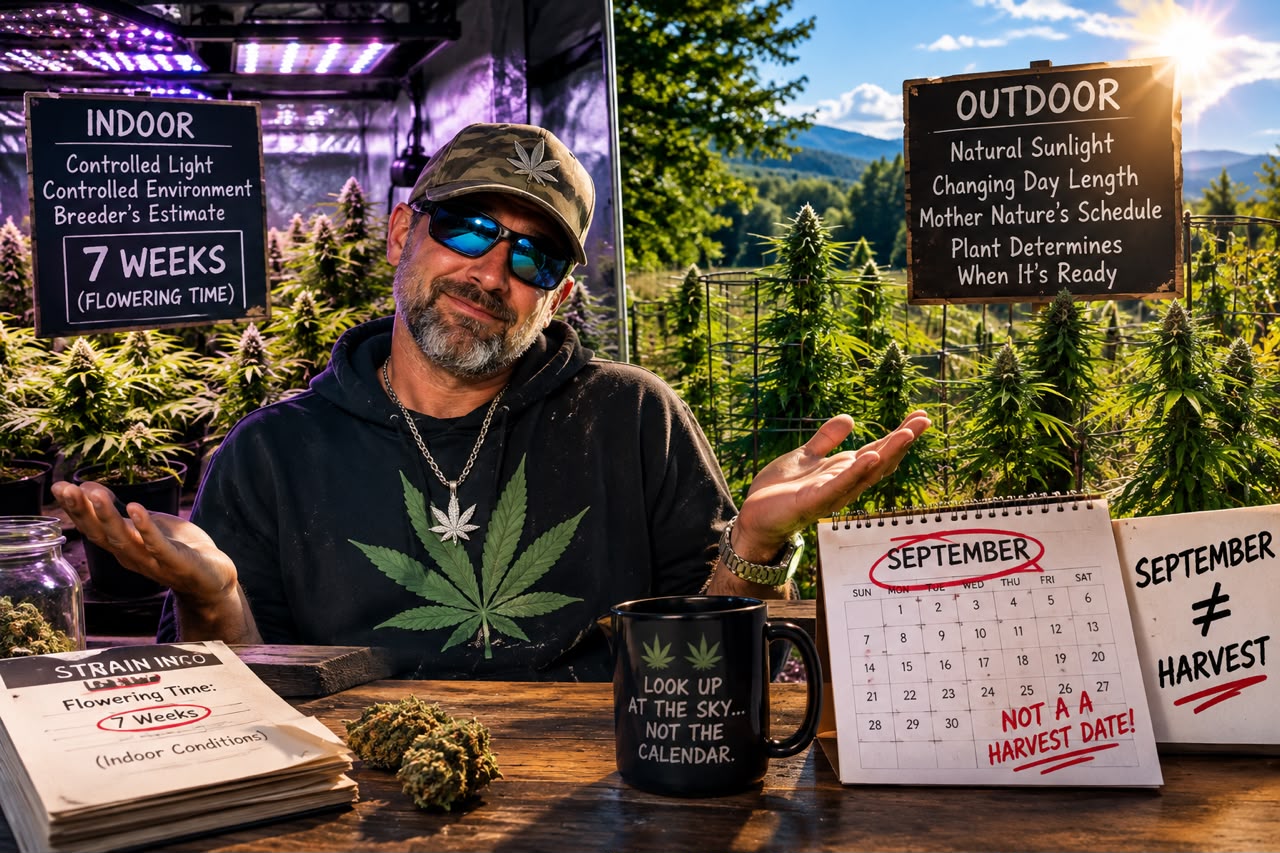
When a breeder says a strain has a seven-week flowering time, that number generally comes from growing the plant under controlled conditions.
INDOORS.
The grower controls the lighting.
The grower can take a plant from a long vegetative light schedule and deliberately put it into a flowering photoperiod.
Outside?
You don’t control the sun.
You can’t walk outside and say:
“All right, everybody! Starting Monday we’re going 12/12!”
The sun will basically tell you to go pound sand.
Cornell explains that Cannabis sativa is photoperiod-sensitive: as daylight decreases, the plant transitions toward flowering. Cornell also notes that outdoor day length in New York varies with latitude and date, and that varieties differ in when they flower.
That’s the entire point.
OUTDOOR NEW YORK IS NOT AN INDOOR GROW ROOM
An indoor plant can receive a controlled flowering photoperiod.
An outdoor plant in New York gets Mother Nature’s schedule.
The days gradually become shorter.
The nights gradually become longer.
The plant is responding to those changing conditions while continuing to develop.
So when somebody grabs an indoor chart that says:
“7 weeks”
and then looks at an outdoor plant and says:
“Seven weeks! CUT IT!”
they’re using the right calculator for the wrong damn equation.
It’s like using the cooking time for a microwave pizza to cook one in a wood-fired oven and then getting angry at the pizza.
THE CONDITIONS MATTER!
And this is where September gets exposed.
Here’s my point for outdoor growers in Upstate New York:
Do not confuse an indoor flowering-time estimate with an outdoor harvest date.
A strain being advertised as a seven-week indoor finisher does NOT mean your outdoor plant suddenly becomes genetically obligated to be finished in September.
In fact, for the overwhelming majority of outdoor cannabis plants growing in Upstate New York, September is simply too early to assume the plant is at peak maturity just because the calendar says September.
Some varieties can flower earlier than others. Some plants can develop faster than others. Weather, location, genetics and growing conditions all matter.
But the big point remains:
Seven weeks indoors does not equal seven weeks outdoors.
And if you’re growing outdoors in New York, mid-October and beyond is a much more realistic part of the conversation than somebody yelling “HARVEST!” the moment September shows up on the calendar.
Cornell’s own New York production material explains that flowering is tied to decreasing day length and that high-cannabinoid Cannabis continues accumulating floral biomass during the flowering stage.
So if somebody tells you:
“My strain is seven weeks indoors, therefore my outdoor plant is done in September.”
Ask them one question:
“Seven weeks under WHAT conditions?”
Because that’s the part they conveniently left out.
SEPTEMBER IS NOT A MAGIC HARVEST DATE
This is the part I really want outdoor growers to understand.
There is nothing magical about September 1st.
September 15th doesn’t come around and suddenly every outdoor cannabis plant in New York rings a little bell and says:
“Welp! Seven weeks are up! Time to chop!”
😂
That’s not how plants work.
For outdoor growers in Upstate New York, most plants are going to benefit from having the time they need to continue developing rather than being chopped early simply because somebody found a seven-week flowering estimate online.
Most outdoor plants are going to be much closer to their finish in mid-October or later than they are in September.
That doesn’t mean every single plant in every single location should automatically be left outside forever.
It means you should stop treating September like a universal harvest deadline.
Watch the plant.
Watch the weather.
Watch the forecast.
And understand the difference between an indoor breeder estimate and an outdoor growing season.
NICK, THIS ONE’S FOR YOU 😂
Nick Ellingsen recently suggested that everybody else was an idiot because he harvests his outdoor plants in September because his strain only takes seven weeks to finish indoors.
Nick…
My brother in cannabis.
The seven-week number you found didn’t come with a tiny invisible clause saying:
“Congratulations! This applies to every outdoor plant growing underneath the New York sun too.”
You found an indoor flowering estimate.
You can’t take an indoor timetable, throw a plant outside, change the entire lighting environment, and then act surprised when Mother Nature doesn’t follow your Google search.
That’s not how horticulture works.
And telling people that most outdoor plants should be cut in September because your particular strain finishes in seven weeks indoors?
That doesn’t make everybody else stupid.
It just makes the argument look stupid.
Again, Nick.
😂
UPSTATE NEW YORK HAS A FALL PROBLEM
Here’s another thing people forget:
New York is not California.
Our outdoor season has an expiration date.
The farther north you go, the higher the elevation, and the more exposed your plants are to changing fall weather, the more important that late-season weather becomes.
And there is no single statewide “first frost date.”
Cornell climate data show that first frost varies substantially depending on location and year. Some northern parts of New York can see frost much earlier than other areas.
So you can’t simply say:
“September is harvest.”
You also can’t blindly say:
“October 20th is harvest.”
The weather doesn’t care what date you circled on your calendar.
That’s why outdoor growers need to pay attention to the actual conditions where they live.
LET THE PLANT FINISH
This is where I think a lot of people get impatient.
They see flowers.
They see some color.
They see some trichomes.
They hear somebody online say, “Mine is done.”
And suddenly they’re standing outside with scissors like they’re on a countdown clock.
Relax.
😂
If the plant is healthy and the weather is cooperating, there is a big difference between having flowers on the plant and having a plant that has reached the point where you actually want to harvest it.
And that’s especially important in Upstate New York.
For most outdoor growers, the goal shouldn’t be to get the plant down as early as possible.
The goal should be to give the plant the time it needs while keeping an eye on the weather.
If you get into the later part of October and the weather is still cooperating, there may be no reason to panic simply because somebody online harvested three weeks earlier.
Their calendar isn’t your calendar.
Their latitude isn’t your latitude.
Their weather isn’t your weather.
And their seven-week indoor flowering estimate certainly isn’t your outdoor harvest date.
AND THEN THERE’S FROST
This is where common sense has to take over.
You don’t want to blindly leave plants exposed to a serious damaging freeze just to prove a point.
If an early frost threatens, you have to pay attention to your local conditions and make decisions based on the actual weather.
If the season cooperates and you make it well into October, great.
If a serious freeze is coming earlier than expected, that’s a different situation.
The important thing is not to confuse an early frost warning with some imaginary September deadline.
Mother Nature doesn’t hand every New York grower the same schedule.
Sometimes the weather gives you more time.
Sometimes it doesn’t.
That’s why you watch the forecast instead of Facebook.
THE SIMPLEST WAY I CAN PUT IT
INDOOR:
Controlled light → controlled flowering schedule → breeder’s indoor flowering estimate.
OUTDOOR:
Natural sunlight → gradually changing day length → environmental conditions → actual plant determines when it’s ready.
That’s it.
You don’t need a PhD.
You don’t even need a GED.
You just need to look up at the sky.
😂
SO WHEN SHOULD AN OUTDOOR GROWER HARVEST?
Not because some website said “seven weeks.”
Not because somebody on Facebook said “September.”
And definitely not because some guy named Nick said everybody else is an idiot.
😂
You evaluate the actual plant and the actual conditions.
For outdoor growers in Upstate New York, September should not be treated as the automatic finish line.
For the vast majority of outdoor plants, mid-October and beyond is a much more realistic window for plants to be approaching peak maturity than September.
And if the weather is cooperating, giving the plant the time it needs can make a hell of a lot more sense than chopping early just because an indoor flowering chart says seven weeks.
Remember:
INDOOR FLOWERING TIME IS NOT AN OUTDOOR HARVEST DATE.
And there is another important point:
There is no single statewide “first frost date” for New York.
Cornell’s climate data show that frost timing varies substantially by location and year. Some northern and higher-elevation areas can get frost much earlier than other parts of the state.
So don’t blindly follow the calendar.
FOLLOW THE PLANT.
Watch the weather.
Know your local conditions.
And don’t let somebody else’s indoor grow schedule convince you that your outdoor plant is late.
The seed breeder doesn’t control the sun.
Facebook doesn’t control the sun.
Nick doesn’t control the sun.
And thankfully…
NEITHER DO I.
I’m OG Strain.
And sometimes the easiest way to settle a cannabis argument is to stop arguing with the Facebook comments…
and look up.
🌞🌱
— OG Strain
The Plug’s Pages Magazine


HARVEST FEST 2026: RECORD CROWDS, A THOUSAND STORIES & ONE UNEXPECTED NIGHT IN THE CATSKILLS!

YOUR ROSIN JAR MIGHT BE RUINING YOUR TERPS: THE TRUTH ABOUT COLD CURE, AIR & MOISTURE

STOP BLOWING OUT OTHER PEOPLE’S CANDLES: A MESSAGE TO THE CANNABIS INDUSTRY HATERS

She Didn’t Tiptoe In — OG Granny Blew the Door Off the Internet 💥🌿

“Damn Sam”, The Man Who Kept the 518 Lit (and Safe) Before It Was Legal to Say “Lit”

Tokalotapot & Cannafae: The Couple That Made Weed Legal (Not Really, But It Feels Like It)
-
 Cannabis Hall Of Fame10 months ago
She Didn’t Tiptoe In — OG Granny Blew the Door Off the Internet 💥🌿
-
 Cannabis Hall Of Fame8 months ago
“Damn Sam”, The Man Who Kept the 518 Lit (and Safe) Before It Was Legal to Say “Lit”
-
 Cannabis Hall Of Fame1 year ago
Tokalotapot & Cannafae: The Couple That Made Weed Legal (Not Really, But It Feels Like It)
-

 Cannabis Hall Of Fame1 year ago
Dope as Yola: From the Bottom to Cannabis Hall of Fame
-

 Community9 months ago
Empire State Cannabis Cup: An OG Strain Community Walkthrough
-

 Community1 year ago
🔥 HARVEST HYSTERIA: WHERE THE BUD AT, NEW YORK?!
-

 Community12 months ago
From Soil, Struggle, and Soul: Hudson Valley Green Wins Big at the Palenville Cannabis Cup”
-

 Community3 months ago
STONER MAMA NICOLE Breaking Stigma, One Laugh at a Time