Products
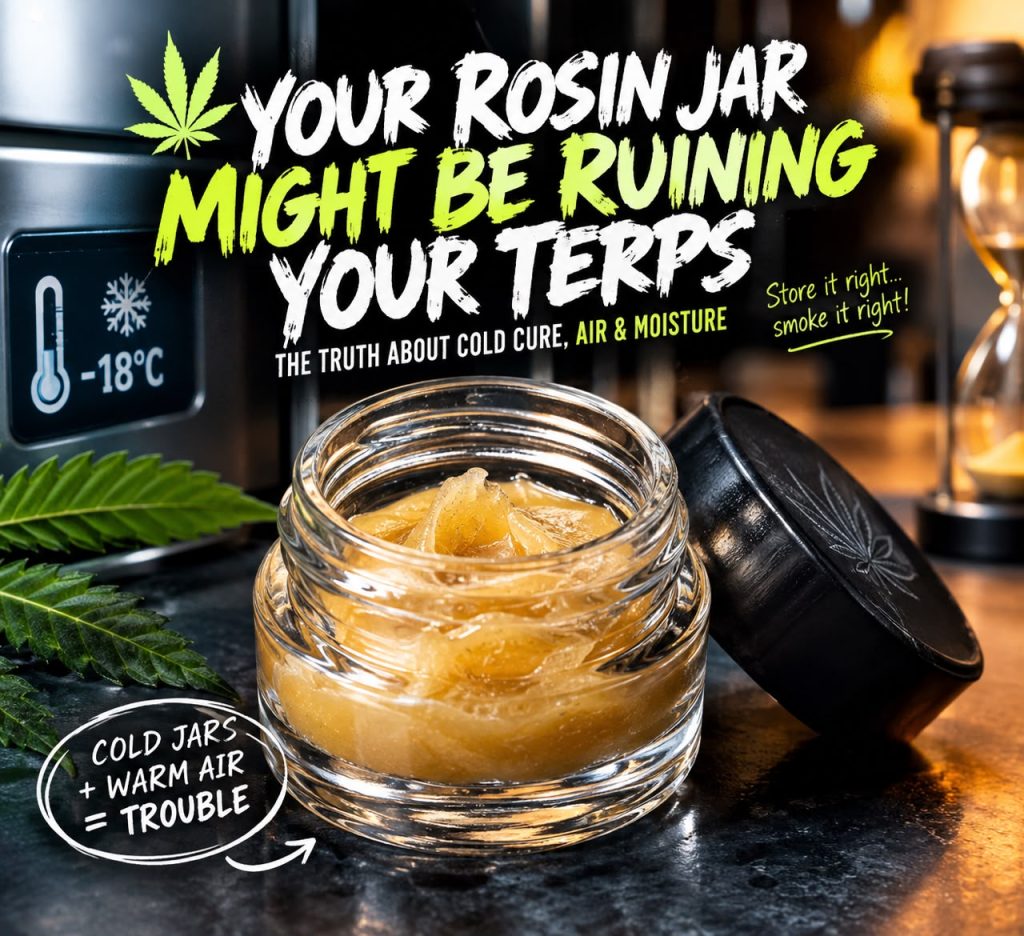
YOUR ROSIN JAR MIGHT BE RUINING YOUR TERPS: THE TRUTH ABOUT COLD CURE, AIR & MOISTURE

Let’s talk about something that doesn’t get nearly enough attention in the cannabis community: what happens AFTER you buy that beautiful jar of cold-cure rosin.
We spend plenty of time talking about genetics, extraction methods, flavor, consistency, and which strains deserve a permanent spot in our rotation. We debate the terps, admire the badder, and sometimes stare into a jar like we’ve just discovered buried treasure.
But how much attention are we paying to the container protecting that treasure?
I’ve noticed something while enjoying different brands of cold-cure rosin. Some come in jars that close securely and tighten down. Others have caps that never seem to tighten completely. You twist them, turn them, and wait for that satisfying point where everything feels secure. Instead, the lid has a little play left in it.
And that got me thinking.
Are these jars designed for curing? Are they supposed to allow air inside? Is there a legitimate reason for the difference? Or are we paying premium prices for premium concentrates packaged in containers that might not be doing the product any favors?
Let’s separate the science from the speculation, because there’s more happening inside that little jar than meets the eye.
THE ONE-HOUR RULE: WHY YOU SHOULDN’T OPEN COLD ROSIN IMMEDIATELY
If you’ve spent time around experienced solventless enthusiasts, you’ve probably heard the rule: take your cold-cure rosin out of the refrigerator or freezer and let it warm up before opening the jar.
Some people recommend roughly an hour, depending on the starting temperature, container, and amount of product. The principle is simple: let the sealed jar approach room temperature before opening it.
Why?
Condensation.
Remember pulling a cold drink out of the refrigerator on a humid summer day? Those little water droplets forming on the outside of the glass aren’t coming from inside the drink. They’re moisture from the surrounding air condensing on a cold surface.
Now imagine opening a cold rosin jar in a warm room.
Warm air carries water vapor. When that air meets cold surfaces inside the container, moisture can condense. You might not see obvious droplets, but that doesn’t mean moisture exposure is impossible.
And moisture is not something we want introducing unnecessary complications into our concentrates. It can affect texture and contribute to the crackling sometimes noticed when heating contaminated concentrate.
The solution? Let the sealed jar warm up before opening it. You’re reducing the opportunity for moisture to condense on the cold product.
A little patience can help protect the experience you paid for. Nobody wants their premium rosin going through an unexpected identity crisis because we couldn’t wait an extra hour!
OXYGEN: FRIEND OR FOE?
Now let’s talk about oxygen, because this is where the science sometimes gets mixed up.
Oxygen can contribute to oxidation, chemical reactions that gradually change the composition of cannabis concentrates. Some terpenes are volatile, meaning they can evaporate relatively easily, and some are susceptible to oxidation. Cannabinoids can also undergo chemical changes over time.
Heat, light, air exposure, and repeated temperature fluctuations can influence how a concentrate ages.
But here’s an important distinction: oxygen doesn’t automatically become more destructive just because your rosin is cold. Lower temperatures generally slow many chemical reactions. The main reason to warm a cold jar before opening is to reduce condensation and moisture exposure. Minimizing unnecessary air exchange is a separate, equally sensible storage consideration.
The Extraction Magazine guide to treating terpenes discusses protecting volatile terpenes and the importance of appropriate storage.
Think of your rosin like a prized classic car. You don’t leave the windows open during a rainstorm and then wonder why the interior isn’t looking so good. You protect what makes it valuable!
ARE THESE CURING JARS OR STORAGE JARS?
Here’s where my curiosity really kicked in.
Cold curing is a process used to develop a particular consistency in rosin. Depending on the material and technique, the product can develop that creamy, opaque, badder-like texture many solventless enthusiasts love.
But cold cure describes the process and resulting product, not a special type of jar.
There’s no universal rule that a curing jar must have a loose cap or allow continuous airflow. In fact, some producers cure rosin in sealed containers. 710 Labs’ live rosin badder information describes a process in which fresh-press rosin develops its badder-like consistency after being sealed in jars and left to cure at room temperature.
So, does a loose-feeling cap mean a brand is selling unfinished rosin in a curing jar?
Not necessarily.
A cap’s feel alone doesn’t tell us whether a container is intended for curing, whether the product is finished, or whether the jar is defective. Different closures have different designs, and some child-resistant mechanisms feel different from ordinary screw-top lids.
Which brings us to an important distinction.
CHILD-RESISTANT DOESN’T AUTOMATICALLY MEAN AIRTIGHT
A child-resistant closure is designed to make opening a container more difficult for young children. An airtight closure is designed to limit air and moisture exchange.
Those are two different jobs.
Some packaging systems are designed to accomplish both. Others may provide child resistance without the same level of airtight sealing. Packaging manufacturers even offer specific silicone sealing rings for concentrate jars, demonstrating that airtight performance is its own design consideration.
A lid that feels tight isn’t necessarily airtight, and a lid that has a little movement isn’t automatically defective. The actual design and condition of the seal matter.
Still, if a finished concentrate is intended to be stored for weeks or months, it makes sense to ask whether its packaging is appropriate for that purpose.
I don’t expect every jar to look identical. I do expect the packaging to perform the job it’s supposed to do.
And if you’re a producer, clear storage instructions can go a long way toward helping customers protect the product they’re buying.
HOW TO PROTECT YOUR ROSIN WITHOUT NEEDING A CHEMISTRY DEGREE
You don’t need a laboratory coat, safety goggles, or a PhD in Terpene Management to take better care of your stash.
Just keep a few practical principles in mind.
Follow the manufacturer’s storage instructions. Some concentrates benefit from refrigeration or freezing, while others have different recommendations.
Keep the jar closed while it warms up. If you’ve stored your rosin cold, allow it to approach room temperature before opening. An hour may work for some containers, but the time varies.
Minimize unnecessary air exposure. Open the jar when you’re ready to use it and close it promptly afterward.

Keep it away from heat and direct light. Both can contribute to unwanted changes in concentrate quality.
Use clean, dry tools. You don’t want to introduce moisture or contaminants into your product.
For an example of product-specific guidance, 710 Labs’ storage recommendations discuss freezer storage for certain products, along with allowing jars to warm before opening. That’s a good reminder that storage instructions should be tailored to the product rather than based on one universal rule.
And remember: a freezer isn’t a magic preservation chamber that excuses poor packaging. The container still matters.
THE BOTTOM LINE: YOUR TERPS DESERVE BETTER
Here’s what I want people to take away from this.
Cold-cure rosin deserves appropriate storage and packaging. Letting a cold jar warm before opening can help reduce condensation. Limiting unnecessary exposure to air, heat, and light can help preserve quality. And child-resistant packaging isn’t automatically proof of an airtight seal.
As for those caps that never seem to tighten all the way? That’s a legitimate reason to ask questions, but not enough by itself to declare a jar defective or a product unfinished.
I’d like to see more transparency from producers about their packaging, storage recommendations, and the intended use of their containers. Consumers shouldn’t have to guess whether their concentrate is being protected properly.
Because let’s be honest: when somebody spends their hard-earned money on premium solventless, the last thing they should have to worry about is whether the jar is doing its job.
We already have enough decisions to make choosing strains, comparing batches, and figuring out which terps deserve a spot in the rotation.
We shouldn’t need to become packaging engineers, too!
So keep your rosin stored properly, let that cold jar warm up before opening, and make sure the lid closes as intended.
And if opening your concentrate jar feels like you’re trying to crack a safe at Fort Knox, maybe it’s time to ask the manufacturer a few questions.
Because premium rosin deserves more than a premium label. It deserves packaging that protects what’s inside.
- OG Strain