Growing & Genetics
HOW I PRESERVE CLONES THROUGH CONTROLLED DORMANCY

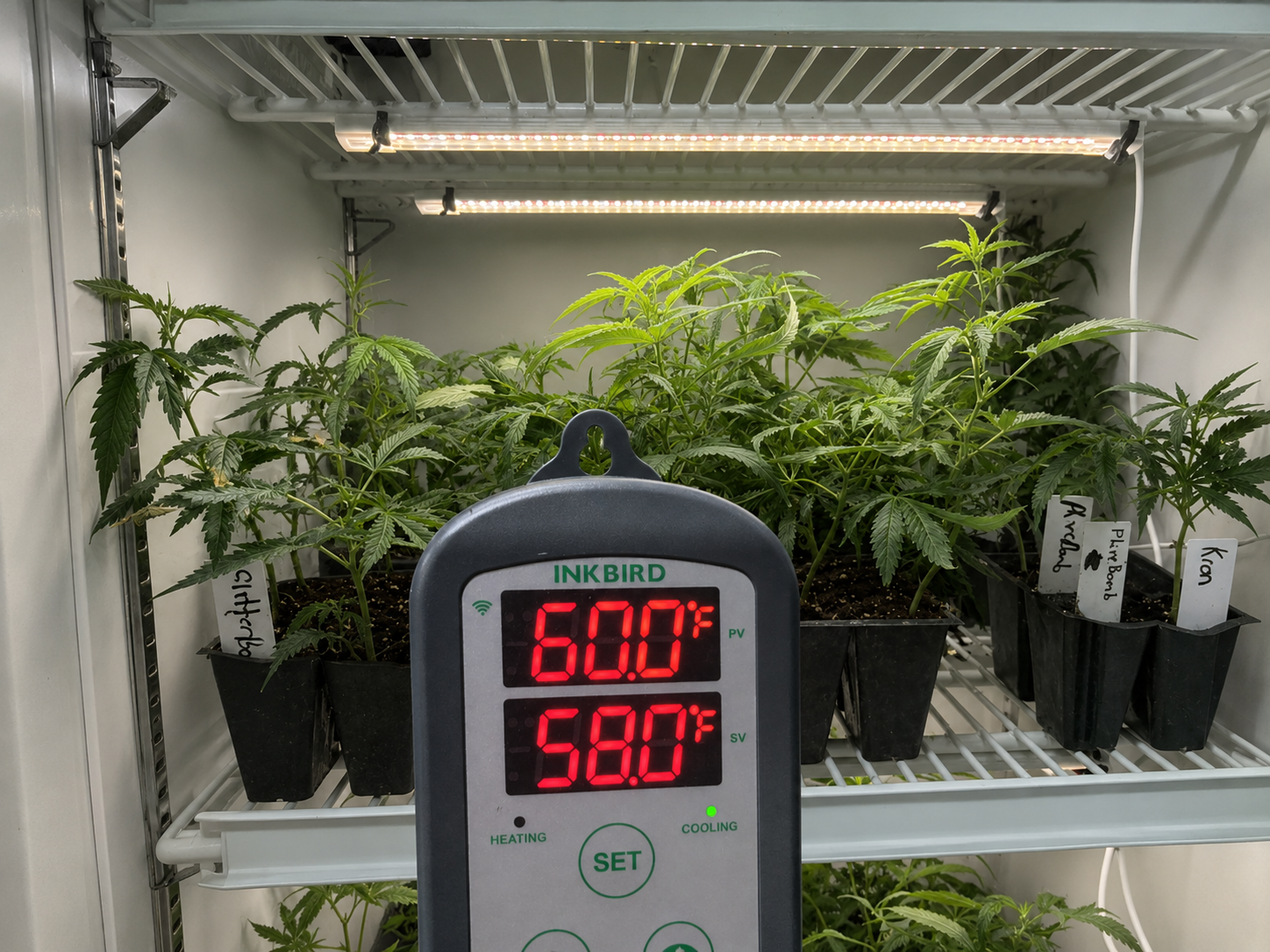
Pictured here are PhireBomb, Krontagious, Black Magic, Garlic Juice, Glitterbomb, Shanenanagens, Blue Dream, and Grape Gas.
These aren’t ordinary clones sitting in a refrigerator. They are healthy, fully rooted plants being maintained under a carefully controlled slow-growth storage program.
I use this method to dramatically reduce their growth rate while keeping the roots, leaves, and growing points alive. I call it controlled dormancy, although technically, the plants are still alive, breathing, and photosynthesizing at a very low rate.
WHY I STORE CLONES THIS WAY
Holding genetics as full-sized mother plants requires considerable space, lighting, water, nutrients, labor, and pest management. Mothers can become oversized, root-bound, stressed, or infected—and losing one can mean losing the entire genetic line.
Slow-growth clone storage gives me another option.
The benefits include:
- Preserving valuable and difficult-to-replace genetics
- Maintaining backup copies of important cultivars
- Using substantially less space than full-sized mothers
- Reducing water, fertilizer, lighting, and labor requirements
- Preventing clones from becoming oversized before they are needed
- Synchronizing plant inventory with production schedules
- Keeping many cultivars available without maintaining a massive mother room
- Allowing genetics to be restarted when demand or planting space becomes available
This is especially valuable for a breeder or nursery holding a diverse genetic library. Every square foot devoted to an oversized mother is space that cannot be used for propagation or production.
MY STORAGE PARAMETERS
The controller pictured shows an actual temperature of 60°F with a 58°F setpoint. This small operating range slows metabolism considerably without pushing the plants into the more dangerous temperatures associated with severe chilling injury.
My working targets for established, fully rooted clones are:
Temperature: 58–62°F
Controller setpoint: Approximately 58°F
Light intensity: 15–25 PPFD at canopy level
Light schedule: 18 hours on and 6 hours off
Relative humidity: Approximately 65–75%
Target VPD: Roughly 0.4–0.6 kPa
Air movement: Very gentle circulation with no strong fan blowing directly on the plants
Root-zone pH: Approximately 5.8–6.2 in soilless media
Feed strength: Minimal—approximately 0.4–0.8 EC only when the plants actually require nutrition
The goal is not to encourage new growth. The goal is to provide enough light, moisture, oxygen, and nutrition to maintain the plant without driving it forward.
ONLY HEALTHY, ROOTED PLANTS GO INTO STORAGE
I only store clones that are:
- Fully rooted throughout the plug
- Properly labeled and documented
- Free from visible pests and disease
- Not freshly sprayed or heavily watered
- Free from weak, yellow, damaged, or dying tissue
- Stable in vegetative growth before entering storage
Cold temperatures do not cure pests, viruses, fungi, or root disease. Putting an unhealthy plant into storage can preserve the problem along with the genetics.
WATER MANAGEMENT IS CRITICAL
The most common mistake is overwatering.
At approximately 60°F and under very low light, plants use water extremely slowly. A plug that would normally dry in a day or two may remain wet much longer in storage.
I irrigate according to the actual weight and moisture of the plug—not according to a fixed calendar. The media should remain lightly moist and oxygenated, never saturated. There should be no standing water beneath the containers.
Cold, wet, oxygen-starved media creates ideal conditions for root decline, fungus gnats, Pythium, and other problems.
SANITATION AND MONITORING
I use a clean, dedicated storage chamber. I do not store fruit, vegetables, or decomposing plant material alongside the clones.
Every plant is labeled by cultivar, storage date, and position. I monitor:
- Current, minimum, and maximum temperatures
- Plug moisture and container weight
- Leaf color and posture
- Root color and odor
- Mold, condensation, pests, and damaged tissue
- Stretching or unexpected new growth
- Light intensity at different shelf positions
Plants are inspected daily, and their positions are rotated when necessary so every cultivar receives comparable light and airflow.
HOW LONG CAN THEY REMAIN STORED?
There is no single storage duration that is safe for every cultivar.
Long-term storage in this system means extending the holding window from days into weeks—and potentially longer after a particular cultivar has proven that it tolerates the conditions.
Each genetic line must earn its own storage window. I start conservatively, inspect regularly, and document how each cultivar responds. Some genetics tolerate cool storage extremely well, while others show discoloration, leaf damage, nutrient depletion, root decline, or loss of vigor much sooner.
I do not assume that PhireBomb will respond exactly like Blue Dream, or that Glitterbomb will behave exactly like Grape Gas. Genetics matter.
WAKING THE CLONES BACK UP
Removing a clone from storage is a controlled process—not an immediate jump into intense light and heat.
My recovery process is:
Move the plants into approximately 65–70°F conditions under gentle light.
Allow them to stabilize for 24–48 hours.
Gradually increase light intensity, temperature, airflow, and nutrition.
Confirm that the roots are healthy and actively using water.
Transplant only after the plants begin showing stable new growth.
Increase to normal vegetative conditions over several days.
Suddenly moving a cool, slow-growing clone into high PPFD, heavy feeding, warm temperatures, and strong airflow can create unnecessary shock.
THE BIGGER PICTURE
This is more than putting plants in a refrigerator.
It is controlled-environment genetic preservation using temperature, light, moisture, airflow, sanitation, and accurate recordkeeping. Done correctly, it reduces the cost and space required to maintain a large genetic library while keeping important cultivars available for future production and breeding.
The objective is simple: slow the plant down without letting it decline.
That balance is where the real skill comes in.







Growing & Genetics
NEW STRAIN… OR JUST A NEW NAME? How Marketing Is Blurring the Line Between Innovation and Imitation in the Cannabis Industry

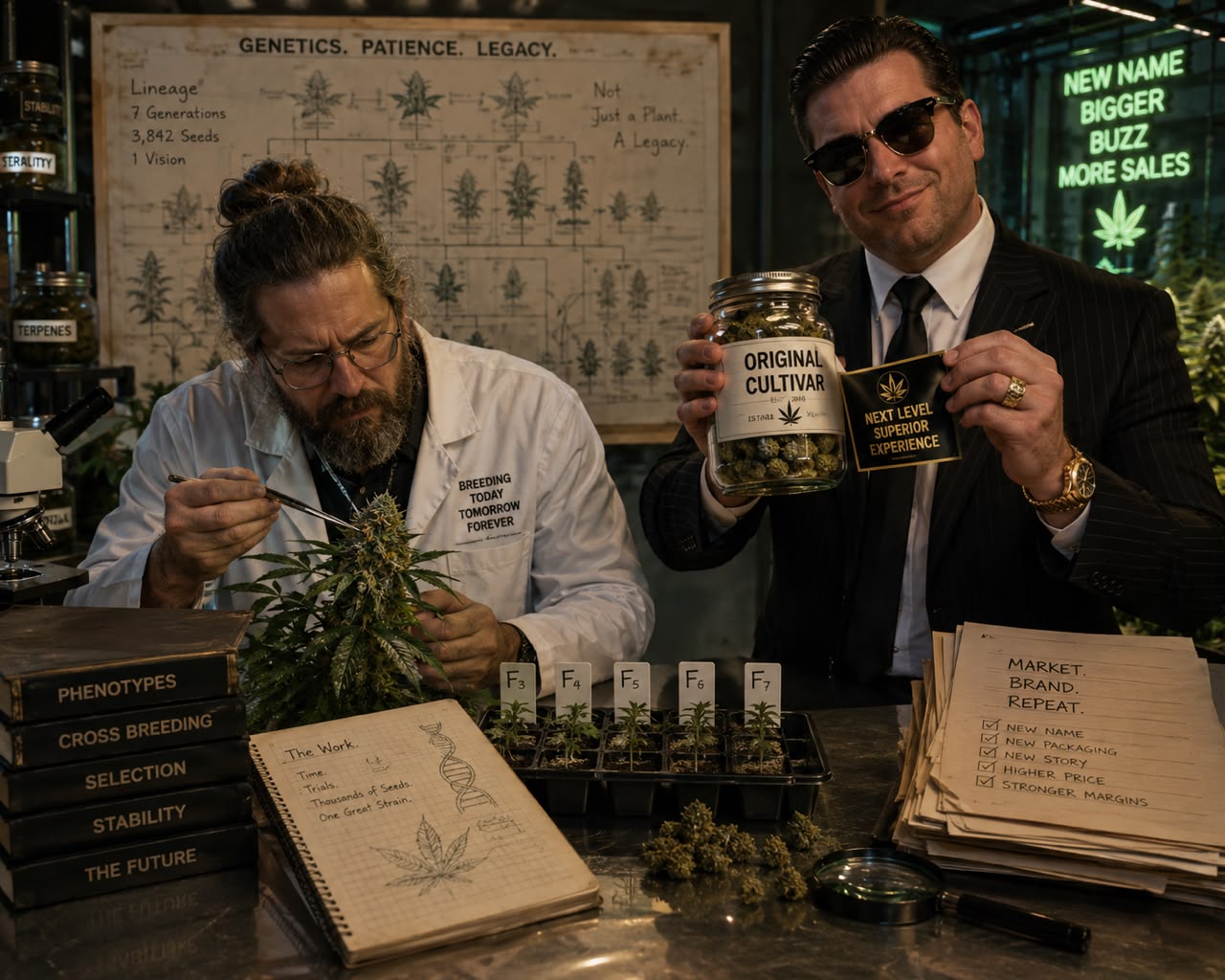
Walk into almost any dispensary today and you’ll be greeted by shelves filled with exciting new names. Every month there’s another “must-try” strain, another eye-catching package, another promise that you’re about to experience something revolutionary.
But before you reach for your wallet, ask yourself one simple question:
Am I looking at a truly new cannabis strain… or just an old favorite with a fresh name?
It’s a question that more cannabis consumers should be asking.
Because while cannabis genetics have advanced at an incredible pace over the last decade, so has the art of marketing. Unfortunately, the two are often confused.
The result?
Consumers believe they’re buying groundbreaking new genetics when, in some cases, they’re simply buying a familiar cultivar under a different name.
And that raises an important question:
Who deserves the credit—the breeder who spent years creating the genetics, or the marketer who gave them a catchier name?
⸻
The Real Engineers of Cannabis
Creating a genuinely new cannabis cultivar isn’t something that happens over a weekend.
It’s years of dedication.
Years of failures.
Years of experimenting.
A true cannabis breeder carefully selects exceptional male and female plants, collects pollen, performs controlled pollinations, grows hundreds—or sometimes thousands—of seedlings, evaluates each plant, and repeats that process over multiple generations until the desired traits become stable.
That’s not luck.
That’s science.
That’s horticulture.
That’s innovation.
These breeders are the engineers of the cannabis world. They aren’t simply growing plants—they’re building the future of cannabis one generation at a time.
Without them, there would be no modern classics to enjoy.
⸻
A New Name Doesn’t Always Mean New Genetics
Here’s where things become confusing.
Not every “new strain” is actually new.
Sometimes a grower discovers an exceptional phenotype—a unique expression—from an existing genetic line. That individual plant may become famous because it produces better flavor, stronger aromas, heavier resin production, or superior yields than its siblings.
There’s absolutely nothing wrong with celebrating an outstanding phenotype.
In fact, phenotype hunting is one of the most exciting parts of cannabis cultivation.
The problem begins when consumers are led to believe that a renamed phenotype is an entirely new genetic creation.
Those are two very different achievements.
One is discovering greatness.
The other is creating it.
⸻
The Name Game
One of the best-known examples is Blockberry and Super Boof.
The original cultivar was bred by Blockhead and named Blockberry. Later, an exceptional phenotype selected by Michigan grower Mobile Jay became widely known by the nickname Super Boof. Over time, the nickname became so popular that many consumers assumed it was an entirely new strain.
It wasn’t.
The genetics already existed.
The nickname became more famous than the original name.
That’s a fascinating piece of cannabis history—but it also shows how quickly confusion can spread throughout the marketplace.
The same thing happens elsewhere in the industry. Some cultivars are marketed under regional names, retailer-exclusive names, or house-brand names that differ from their original lineage. Sometimes it’s done simply to help customers recognize a particular cut. Other times, the marketing can leave consumers with the impression they’re purchasing something genetically new when they are not.
That’s why understanding lineage matters just as much as understanding THC percentages or terpene profiles.
⸻
Phenotype Hunting Isn’t Plant Breeding
Think about identical twins.
They share the same DNA, but each has their own unique appearance and personality.
Cannabis phenotypes work in a similar way.
A breeder creates the family.
The grower discovers which family member shines the brightest.
Finding that exceptional plant requires skill, patience, and experience.
But selecting the best expression isn’t the same thing as creating the genetic family in the first place.
Both roles deserve respect.
They simply deserve credit for different accomplishments.
⸻
Give Credit Where It’s Due
Cannabis culture has always been built on respect.
Respect for growers.
Respect for breeders.
Respect for genetics.
Imagine an architect spending years designing an incredible home.
Then imagine someone repainting the front door and introducing it as their own creation.
Most people would recognize the difference immediately.
Cannabis breeding deserves that same level of recognition.
Growing is a craft.
Cultivation is an art.
Marketing is a business.
Breeding is a discipline all its own.
When breeders don’t receive proper recognition for the genetics they’ve spent years creating, the entire industry loses a piece of its history.
⸻
How Consumers Can Protect Themselves
The next time you see a “brand-new” strain, don’t be afraid to ask a few questions.
Where did these genetics come from?
Who originally bred them?
What’s the lineage?
Is this a brand-new cross?
Or is it an outstanding phenotype of an existing cultivar?
Knowledge makes better consumers.
And informed consumers help reward the people who truly push cannabis genetics forward.
⸻
The Bottom Line
The cannabis industry doesn’t need fewer creative names.
It needs more transparency.
Celebrate the breeders who spend years creating tomorrow’s genetics.
Celebrate the growers who hunt extraordinary phenotypes.
Celebrate the cultivators who consistently produce exceptional flower.
Celebrate the retailers who educate consumers instead of simply chasing the next marketing trend.
Just don’t confuse a new label with new lineage.
Because in cannabis, names can change.
Packaging can change.
Logos can change.
Marketing certainly changes.
But genetics tell the real story.
And the next time someone tells you they’ve discovered the “hottest new strain on the market,” take one more look beneath the name.
You might just discover that what’s really new… is the label.


I DON’T WANT TO WASTE ANOTHER DAY: WHY I’M BUILDING MY LEGACY IN THE 518 CANNABIS COMMUNITY

THE BLACK MARKET GAMBLE: Can Playing by Some of the Rules Keep New York Cannabis Businesses Safe?

GOOD BURGER OR BAD TASTE? THE MOST CONTROVERSIAL STRAIN OF 2026 HAS SMOKERS DIVIDED!

She Didn’t Tiptoe In — OG Granny Blew the Door Off the Internet 💥🌿

Tokalotapot & Cannafae: The Couple That Made Weed Legal (Not Really, But It Feels Like It)

“Damn Sam”, The Man Who Kept the 518 Lit (and Safe) Before It Was Legal to Say “Lit”
-
 Cannabis Hall Of Fame9 months ago
She Didn’t Tiptoe In — OG Granny Blew the Door Off the Internet 💥🌿
-
 Cannabis Hall Of Fame1 year ago
Tokalotapot & Cannafae: The Couple That Made Weed Legal (Not Really, But It Feels Like It)
-
 Cannabis Hall Of Fame7 months ago
“Damn Sam”, The Man Who Kept the 518 Lit (and Safe) Before It Was Legal to Say “Lit”
-

 Cannabis Hall Of Fame1 year ago
Dope as Yola: From the Bottom to Cannabis Hall of Fame
-

 Community9 months ago
Empire State Cannabis Cup: An OG Strain Community Walkthrough
-

 Community1 year ago
🔥 HARVEST HYSTERIA: WHERE THE BUD AT, NEW YORK?!
-

 Community12 months ago
From Soil, Struggle, and Soul: Hudson Valley Green Wins Big at the Palenville Cannabis Cup”
-

 Community2 months ago
STONER MAMA NICOLE Breaking Stigma, One Laugh at a Time
GreeneDream
September 4, 2026 at 1:20 am
So much goes into everything – dog & appreciate the detail
GreeneDream
September 4, 2026 at 1:21 am
**dig