Industry
Stop Marrying Your Weed: Why the Fastest Money Is Usually the Smartest Money

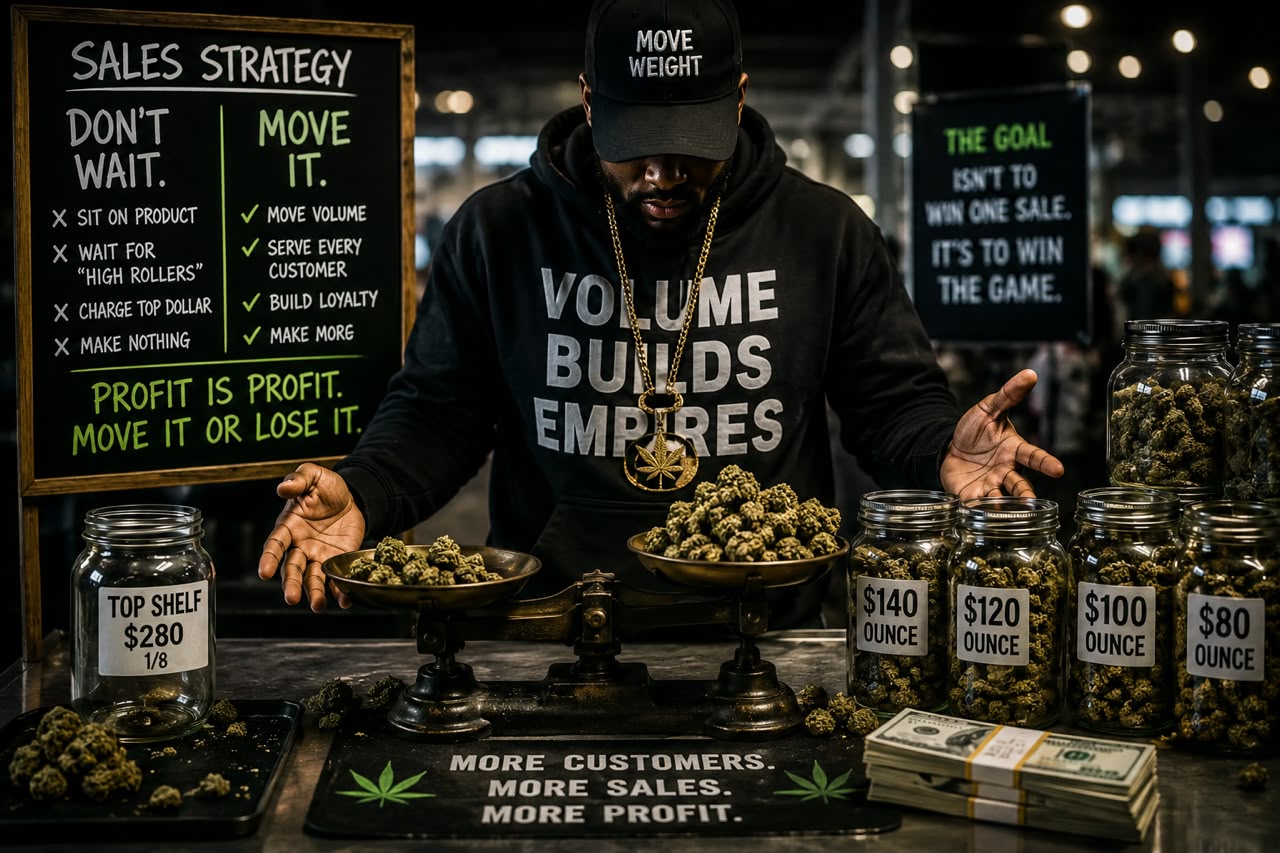
I’ve sold a lot of things in my life.
Windows.
Mortgages.
Cannabis.
I’ve sat through enough sales meetings, seminars, lectures, and motivational speeches to make a grown man start hearing the word “commission” in his sleep.
One thing I’ve learned is that sales is sales.
The product changes.
Human nature doesn’t.
And there’s one strategy I keep seeing in the cannabis industry that absolutely blows my mind.
The “I’m gonna sit on this forever and wait for a rich guy” strategy.
You know exactly what I’m talking about.
A vendor gets a decent batch. Maybe it’s even a great batch. They put a premium price on it and then spend the next three months staring at it like it’s the last jar of weed left on Earth.
Meanwhile, customers walk by.
Potential sales walk by.
Money walks by.
And the vendor proudly says:
“Nah, I’m waiting for the right customer.”
The right customer?
My brother in cannabis, the right customer just bought an ounce from the table next to you.
The $140 Ounce Problem
Let’s paint a picture.
You’re at an event.
The vendor beside you has ounces for $140.
Your flower is slightly better.
Not twice as good.
Not three times as good.
Slightly better.
But you’re charging double.
Now put yourself in the customer’s shoes.
Most people aren’t shopping for the absolute best flower in the building.
They’re shopping for the best value.
There’s a difference.
Now don’t get me wrong—there are absolutely people like me, OG Strain, who hunt for rare diamonds in the rough and happily pay extra for truly exceptional cannabis. Some consumers chase the best of the best no matter what the price tag says. But those customers are the exception, not the rule.
If they can get something that’s 90% as good for half the price, many of them will happily make that trade all day long.
And honestly?
Can you blame them?
The average consumer isn’t conducting a cannabis wine tasting with a monocle and a clipboard.
They’re trying to stretch their budget.
Profit Is Profit
Here’s where my sales background kicks in.
A lot of vendors focus on maximum profit per sale.
The smart ones focus on maximum profit overall.
Those are two very different things.
Let’s say you make $400 profit from one customer.
Great.
But what if you could have made $150 from four different customers during the same time period?
Now you’re at $600.
And you’ve moved product.
And you’ve built relationships.
And you’ve created repeat customers.
And you’ve generated referrals.
And you’ve freed up capital to buy more inventory.
The goal isn’t to win one transaction.
The goal is to win the game.
Cannabis Isn’t Fine Art
Some vendors treat cannabis like they’re auctioning off a rare painting.
They’re guarding jars like they’re museum exhibits.
Nobody touch it.
Nobody look at it.
Nobody breathe near it.
It’s special.
Meanwhile, the market keeps moving.
Here’s the reality.
Most flower is replaceable.
More is being grown every day.
More is being harvested every day.
More is being packaged every day.
Unless you’re sitting on something truly rare that won’t be available again for six months or longer, why are you acting like it’s the last cut on Earth?
Move it.
Replace it.
Move the next batch.
Replace that too.
Cannabis should move.
That’s what makes businesses grow.
The Rare Strain Exception
Now before somebody starts typing an angry comment, let’s be fair.
There are exceptions.
If you’ve got something genuinely rare.
A cut that’s difficult to find.
A limited release.
Something that won’t be available again anytime soon.
Then yes.
Holding your price can make sense.
Scarcity creates value.
But let’s be honest with ourselves.
Most of the flower people are sitting on isn’t rare.
It’s available.
It’s replaceable.
And if you can call your source tomorrow and get more, then you’re not protecting a treasure.
You’re delaying a sale.
Every Customer Isn’t the Same Customer
Another mistake I see is vendors treating pricing like it’s carved into stone tablets.
The cannabis market has never worked that way.
Every customer is different.
Some customers buy once.
Some buy weekly.
Some buy volume.
Some buy samples.
Some are loyal.
Some are shopping around.
Some vendors.
Some consumers.
Different relationships create different opportunities.
The smartest salespeople understand that flexibility closes deals.
The goal isn’t squeezing every dollar out of every person.
The goal is creating enough value that everyone wants to come back.
Because repeat customers are where the real money lives.
The Jar Doesn’t Get Better Sitting There
One of my favorite questions to ask is this:
How much money is that product making while it’s sitting on your shelf?
The answer is zero.
None.
Not a penny.
In fact, it’s costing you opportunity.
The longer inventory sits, the longer your money is trapped inside it.
That’s money that could have been reinvested into the next pickup.
The next strain.
The next opportunity.
The next customer.
A jar sitting on a shelf is basically a couch potato.
It isn’t working.
It’s just sitting there getting older.
The Biggest Players Understand This
Look around the industry.
The vendors moving serious volume aren’t usually the ones obsessed with squeezing every possible dollar from every sale.
They’re moving product.
Building relationships.
Creating repeat business.
Keeping inventory flowing.
Keeping customers happy.
Keeping money moving.
Momentum matters.
Volume matters.
Reputation matters.
A customer who feels they got a good deal often becomes a customer for years.
A customer who feels they’re getting squeezed usually becomes somebody else’s customer.
Final Hit
I’ve spent years in sales.
I’ve watched top performers in multiple industries.
And one lesson keeps showing up over and over again.
You can’t deposit inventory into your bank account.
You can only deposit sales.
If a product is replaceable, move it.
If a profit is available, take it.
If a customer wants to buy, sell to them.
Because the cannabis industry isn’t a museum.
It’s a business.
And the vendors who understand that usually aren’t sitting around waiting for the perfect customer.
They’re too busy counting the money from all the customers they already sold to.









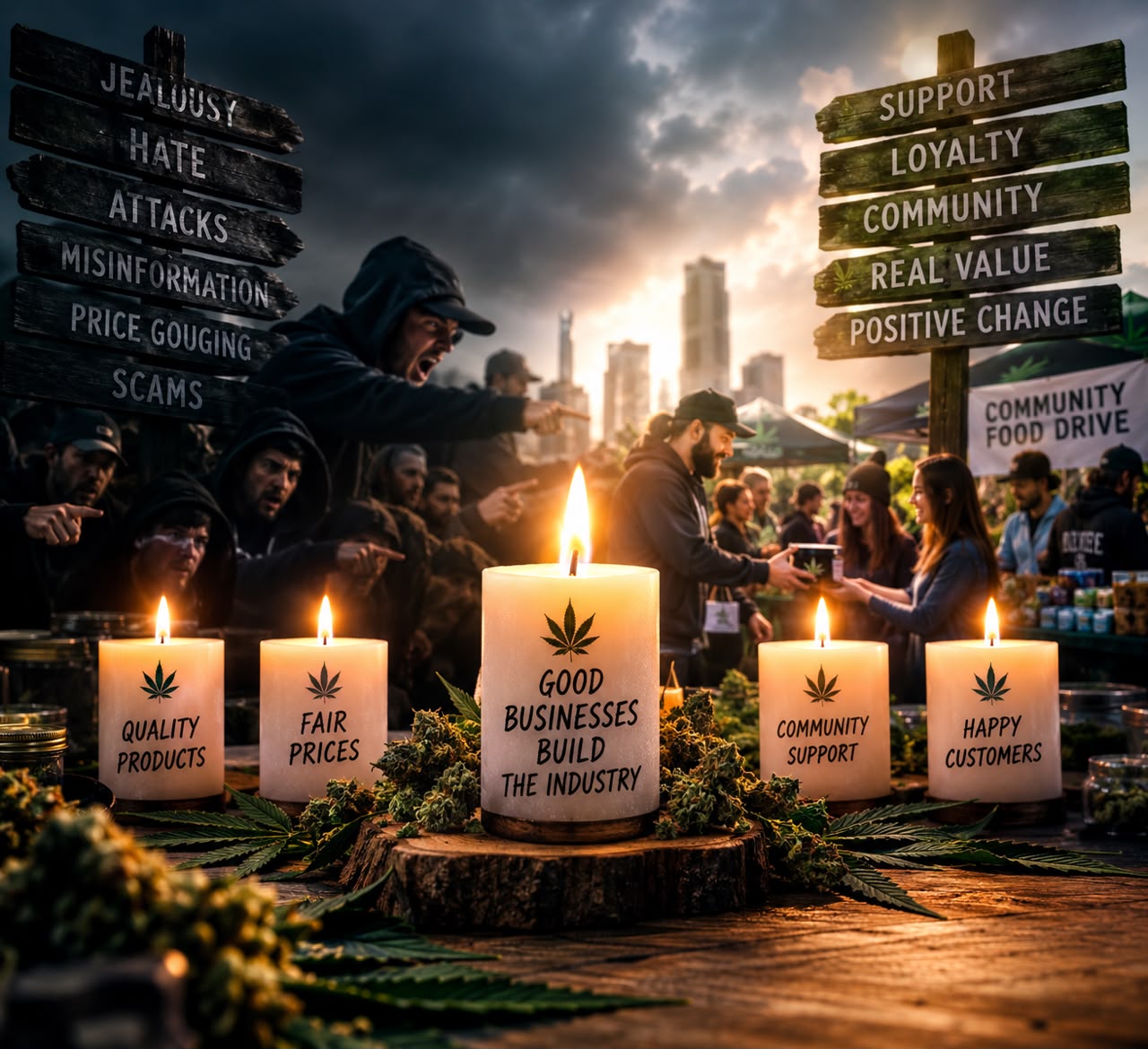
If you’re spending more time attacking your competition than improving your own business, maybe it’s time to look in the mirror.
Let’s get something straight. I’m tired of seeing good businesses attacked simply because they’re doing something right.
I spend my time highlighting companies, products, and people in the cannabis community who deserve recognition. I promote businesses that support their communities, treat customers right, offer quality products, and put effort into building something worthwhile.
But apparently, some people have a hard time understanding that promoting a company doesn’t make me affiliated with it, and it certainly doesn’t make me part of your personal beef with them.
I’m a reviewer. I’m here to cover the industry, not referee your rivalries. If I give a business positive coverage and you suddenly have a problem with me, perhaps you should ask yourself why you’re directing your frustration at the wrong person.
Now, let’s talk about the real issue.
MAYBE YOUR COMPETITION ISN’T THE PROBLEM
If another company is growing, attracting customers, and building a solid reputation, have you considered looking at what they’re doing right instead of trying to tear them down?
Maybe they’re offering fair prices. Maybe their products deliver what customers expect. Maybe they understand that treating people well is how you earn loyalty.
Maybe they’re giving out legitimate product samples, supporting food drives, raising money for charitable causes, and giving back to the community that supports them.
Meanwhile, if you’re charging significantly more for products that don’t live up to their claims, failing to build customer trust, and wondering why people are taking their business elsewhere, you might have found your answer.
Customers aren’t obligated to support your business just because you want them to. They have choices, and they’re going to spend their money where they feel appreciated and believe they’re getting value.
Customer loyalty is earned, not demanded.
And if your competitor is earning that loyalty by doing things better, that’s not a reason to attack them. It’s a reason to evaluate your own business.
COMPETITION SHOULD MAKE YOU BETTER, NOT BITTER
There’s nothing wrong with healthy competition. It pushes businesses to improve their products, reconsider their pricing, provide better service, and find new ways to connect with customers.
But there’s a difference between competing and trying to sabotage somebody else’s success.
If you believe another business is doing something unethical, bring forward credible evidence and address the issue professionally. Legitimate accountability matters. But attacking competitors out of jealousy, spreading unsupported accusations, or targeting people who recognize their accomplishments isn’t a business strategy. It’s a distraction from the work you should be doing yourself.
And let’s be honest: customers notice how businesses behave. A company that spends its time criticizing competitors can end up damaging its own reputation far more effectively than its competitors ever could.
Instead of asking, “How do I bring them down?” ask yourself, “What can I do to give customers a reason to choose me?”
That question might actually get you somewhere.
AND LEAVE ME OUT OF YOUR DRAMA
Let me make this personal for a moment.
When I recognize a company for doing something positive, I’m not declaring war on its competitors. I’m not automatically endorsing everything that company does, and I’m certainly not volunteering to become part of its business disputes.
I’m OG Strain. I review, I cover the industry, and I give credit where I believe it’s deserved.
If you’ve got a legitimate problem with another business, handle it with that business. Don’t drag me into your drama because you don’t like the attention somebody else is receiving.
I refuse to stop recognizing good people and good businesses simply because someone else might get jealous or offended.
BUILD YOUR OWN LEGACY
The cannabis community has enough challenges without businesses creating unnecessary divisions among themselves.
We need companies that stand behind their products, treat customers fairly, support their communities, and compete with integrity. We need business owners willing to learn from success rather than resent it.
So here’s my advice to the haters: If your prices aren’t competitive, reevaluate them. If your products aren’t meeting expectations, improve them. If your customers aren’t coming back, figure out why.
Stop blaming the business that’s doing it right while ignoring what you’re doing wrong.
You don’t build a successful company by blowing out somebody else’s candle. You build it by giving people a reason to appreciate the light coming from yours.
And if the only way you think you can succeed is by trying to tear down everyone around you, perhaps the problem isn’t your competition after all.
Maybe it’s time to fix your own business.
And while you’re at it, leave me out of your beef.
— OG Strain
The Plug’s Pages Magazine
Industry
THE BLACK MARKET GAMBLE: Can Playing by Some of the Rules Keep New York Cannabis Businesses Safe?

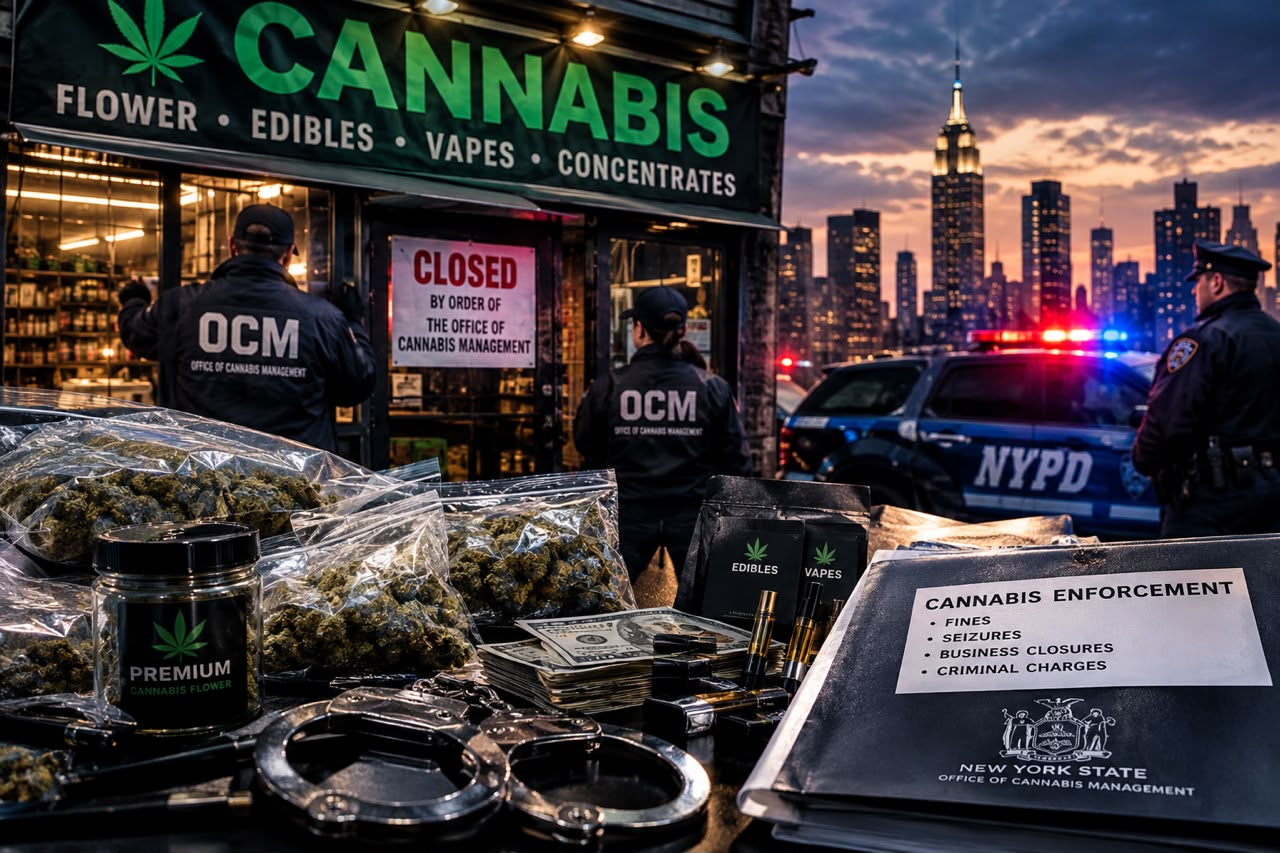
New York legalized recreational cannabis, but that doesn’t mean everybody selling it is operating legally. From pop-up vendors and cannabis events to unlicensed storefronts and businesses operating in regulatory gray areas, plenty of people are participating in an industry where the rules can be confusing—and the consequences of breaking them can be far more expensive than expected.
Some operators believe that if they sell quality products, label everything properly, avoid selling to minors, and follow as many safety rules as possible, they can reduce their chances of attracting unwanted attention from regulators. Others assume that getting caught simply means losing some inventory, paying a fine, and getting back to business.
But how much protection does following some of the rules actually provide? And what happens when the Office of Cannabis Management comes knocking?
Let’s break it down.
WHAT EXACTLY IS OCM?
The New York State Office of Cannabis Management, commonly known as OCM, regulates the state’s legal cannabis industry. It oversees licensing, compliance, product safety requirements, and enforcement against businesses operating outside the law.
Adults 21 and older can legally possess up to three ounces of cannabis flower and 24 grams of concentrated cannabis under New York law. However, the right to possess cannabis does not give someone the right to sell it commercially without the required authorization.
Having an LLC, a tax identification number, a business registration, or paperwork for a different cannabis-related activity does not automatically authorize commercial cannabis sales. A business may be legitimate in certain respects while still violating cannabis licensing requirements.
That distinction matters to pop-up vendors, event operators, smoke shops, brands, and anyone else selling cannabis products outside New York’s licensed system.
WHAT HAPPENS WHEN OCM COMES KNOCKING?
The consequences depend on the type of operation, the violations involved, the amount of product, and whether the operator continues selling after being ordered to stop.
Possible consequences include:
Fines: Civil penalties can reach thousands of dollars per day under applicable enforcement provisions.
Inventory seizures: Cannabis products may be confiscated.
Business closures: Certain unlicensed storefronts can be padlocked under the state’s enforcement procedures.
Major financial judgments: Operators who continue unlawful sales despite enforcement orders can face substantial penalties.
Criminal charges: Certain unlawful commercial cannabis sales can constitute criminal offenses.
New York Cannabis Law § 132 authorizes civil penalties of up to $10,000 for each day certain unlicensed commercial activity continues, plus additional penalties potentially tied to revenue or projected product revenue. Continued sales after an applicable cease order can expose an operator to penalties of up to $20,000 per day under that provision.
These are statutory maximums, not automatic fines imposed in every case. The actual outcome depends on the circumstances and applicable legal provisions.
A shutdown isn’t necessarily limited to two weeks, either. When the requirements for an emergency sealing order are met, a premises can be padlocked for an extended period.
REAL-WORLD ENFORCEMENT: THIS ISN’T JUST A WARNING
New York’s enforcement actions demonstrate that the consequences can go well beyond a small fine.
Brooklyn — January 2026
In an enforcement action announced by OCM on February 17, investigators recovered more than 220 pounds of cannabis flower, along with edibles, concentrates, and pre-rolls, at a Brooklyn location near a child-care center. The products had an estimated street value exceeding $1.4 million. The business received a notice of violation and was padlocked.
Previous major financial judgments
New York Attorney General Letitia James announced a $9.5 million judgment against the operator of the unlicensed Jaydega 7.0 dispensary in Ontario County. The judgment included penalties associated with continued unlawful sales after an order to stop.
In another case, the operator of seven unlicensed dispensaries associated with I’m Stuck and Weed Warehouse faced a $15.2 million judgment.
These were not ordinary first-offense cases. They involved commercial operations and serious enforcement proceedings. Nevertheless, they demonstrate the financial exposure that can arise when businesses continue operating unlawfully.
DOES FOLLOWING THE RULES HELP IF YOU’RE STILL UNLICENSED?
This is where things get interesting.
Imagine two operators. One sells products with no meaningful safety information, questionable packaging, and no reliable way to establish what’s actually inside them. The other takes product quality seriously, uses child-resistant packaging, provides accurate ingredient and potency information, and takes steps to protect consumers.
From a consumer-safety standpoint, the second operator is taking more responsible precautions.
But there is a major difference between reducing product-safety risks and complying with the law.
New York’s cannabis packaging and labeling regulations include requirements for licensed businesses involving potency, ingredients, warnings, packaging, and product documentation. The state also requires applicable cannabis products to undergo testing through permitted laboratories.
Simply putting a label on a product does not establish that it has been properly tested. Nor does a professional-looking package establish that the seller is authorized to distribute its contents.
Following some safety standards does not replace a required cannabis license.
An unlicensed business can still face enforcement even if its products appear well packaged, its customers are satisfied, and no one has reported a safety problem. Unpaid taxes and missing business authorization can create separate legal and financial exposure, depending on the circumstances.
Conversely, a licensed business can face penalties for failing to meet safety and labeling requirements. Licensing and product compliance are separate responsibilities.
IF YOU’RE OPERATING IN A GRAY AREA, WHAT SHOULD YOU DO?
There is no reliable checklist that guarantees an unlicensed cannabis business will avoid OCM enforcement. Rather than assuming that following selected rules makes an operation safe, operators should understand the legal status of their business and take steps to address any violations.
Here are the most meaningful precautions:
- Confirm what your paperwork actually authorizes. A business registration, event permit, or agreement with another company may not authorize cannabis sales. Verify the applicable license requirements with OCM or a qualified New York cannabis attorney.
- Take product safety seriously. Accurate labeling, appropriate packaging, reliable product documentation, and legitimate laboratory testing are important consumer-protection measures. They do not legalize unlicensed sales, but they address risks that can harm customers.
- Understand your tax obligations. Cannabis sales can involve state and local tax requirements. Operating outside the licensed system does not automatically eliminate tax obligations, and tax violations can create additional legal exposure.
- Do not ignore an enforcement order. Continuing prohibited sales after an official cease order can significantly increase potential civil penalties and lead to further legal action.
- Explore a lawful route forward. If your current operation is not authorized, seek legal advice about whether your activities can be brought into compliance, whether an appropriate license is available, and what obligations must be addressed before resuming sales.
The goal isn’t to make an unlawful business harder to find. It’s to understand the risks, protect consumers, and determine whether the operation can legally continue.
COULD YOU ACTUALLY GO TO JAIL?
Yes, in certain circumstances—but an OCM inspection or civil violation does not automatically mean jail time.
New York Penal Law § 222.50 makes certain unlawful commercial cannabis sales a Class A misdemeanor. For example, knowingly and unlawfully selling more than three ounces of cannabis or more than 24 grams of concentrated cannabis can qualify as criminal sale of cannabis in the third degree. The statute also covers certain unlawful sales to people under 21.
A Class A misdemeanor carries a maximum potential jail sentence of one year. More serious quantities or circumstances can lead to felony charges.
That doesn’t mean every pop-up vendor or small seller caught by OCM will be arrested. The facts, quantity, applicable offense, and evidence determine the outcome. Civil penalties, inventory seizures, and business closures are distinct from criminal prosecution.
But anyone who assumes that cannabis legalization eliminated criminal consequences for unlawful commercial sales should understand that it did not.
THE BOTTOM LINE: IS THE GAMBLE WORTH IT?
For some operators, the risk may seem manageable. They may believe that an occasional fine or loss of inventory is simply part of doing business. Others may decide that the possibility of losing their products, being locked out of their premises, facing a major financial judgment, or dealing with criminal charges makes the gamble unacceptable.
And there is no universal outcome. A small operation, a large storefront, a first inspection, and a business that repeatedly ignores enforcement orders are not interchangeable situations.
Following safety practices is responsible, but it isn’t a shield against licensing enforcement. Good packaging won’t replace a license, and a professional-looking business isn’t necessarily a legal one.
Maybe you believe getting busted is just part of the game. Maybe you think the potential profits justify the risk. Or maybe one enforcement action could take away everything you’ve worked to build.
So, is it worth it?
Is it worth risking your inventory, your business, your savings, and potentially your freedom for the chance to make money outside the licensed market? Or is getting caught even once a risk you simply can’t afford?
That’s a decision every operator has to make for themselves. But before taking that chance, make sure you understand what you’re actually risking.
This article is for general informational purposes and is not legal advice. Penalties depend on the applicable law and facts of each case.

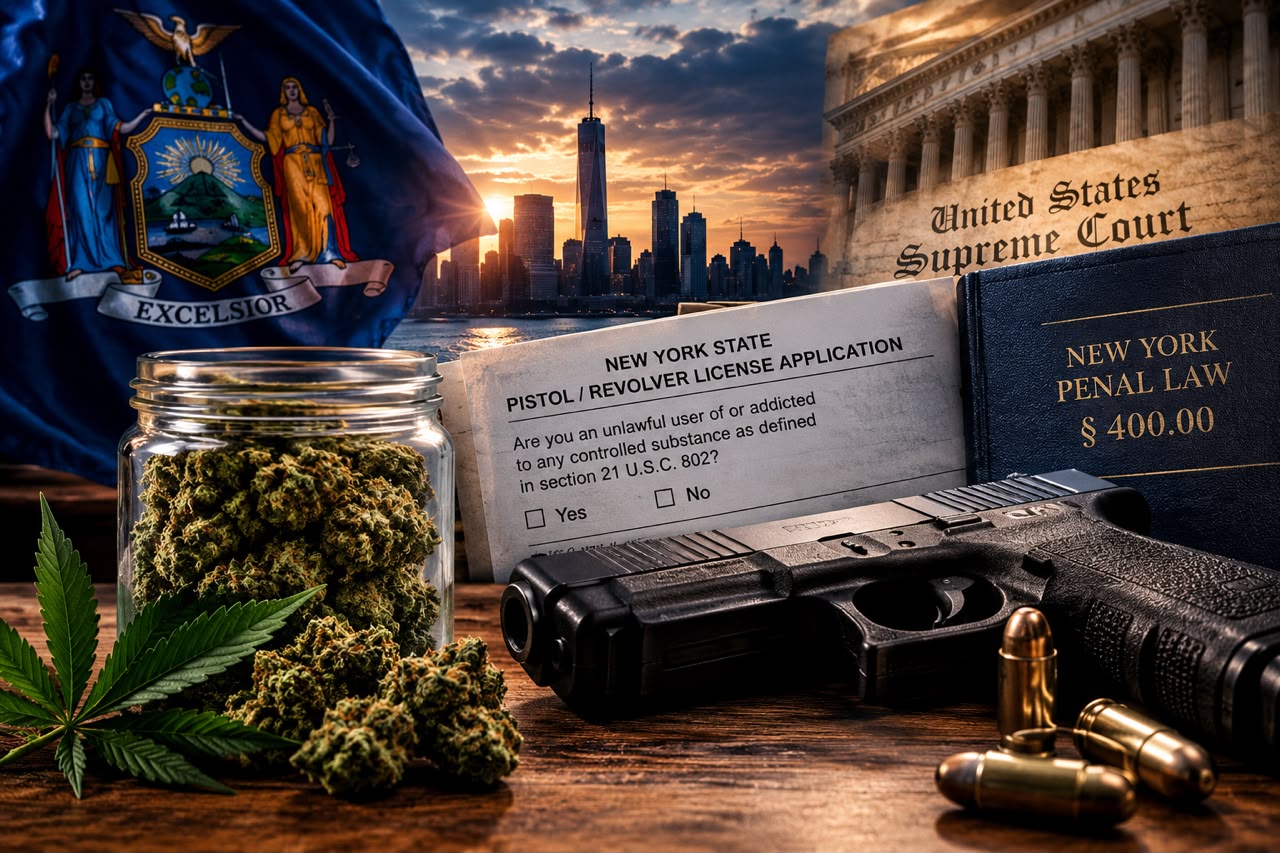
There are few things more frustrating than discovering that two laws can exist at the same time, point in completely different directions, and somehow both be important to you.
New York says cannabis is legal for adults 21 and older.
The Second Amendment protects the right to keep and bear arms.
And then there is the complicated world of federal controlled-substance and firearms law sitting right in the middle of those two rights.
But in June 2026, something happened that changed the conversation.
The United States Supreme Court decided United States v. Hemani, a case involving a Texas man who regularly used marijuana and possessed a firearm in his home. The federal government prosecuted him under 18 U.S.C. §922(g)(3), the federal law that generally prohibits an “unlawful user of or addicted to” a controlled substance from possessing a firearm.
The Supreme Court unanimously rejected the government’s attempt to prosecute Hemani based solely on his marijuana use, holding that the government’s application of the law to him violated the Second Amendment. The Court emphasized that the government had not shown that Hemani’s marijuana use made him dangerous or otherwise supplied the individualized justification necessary to disarm him.
That is a BIG deal.
But here’s where New York gets complicated.
Because Hemani did not simply declare that every marijuana consumer in America now automatically qualifies for every firearm license in every state.
And that distinction matters.
THE TEXAS CASE THAT CHANGED THE CONVERSATION
Ali Hemani lived in Texas and admitted that he used marijuana about every other day. Federal agents found marijuana and a firearm at his home during an investigation unrelated to the firearm charge.
The government later prosecuted him under §922(g)(3), relying on his marijuana use.
The Supreme Court’s question wasn’t whether marijuana was legal under Texas law.
It was whether the federal government could take away Hemani’s Second Amendment right and prosecute him merely because he regularly used marijuana, without additional evidence showing that his drug use made him dangerous.
The Court said no.
The decision was an as-applied decision, meaning the Court decided the constitutionality of the federal prohibition as it was applied to Hemani’s circumstances. The Court did not declare every possible application of §922(g)(3) unconstitutional. It specifically left questions involving addiction, present intoxication, other controlled substances, and individualized evidence of dangerousness unresolved.
That is why headlines saying “marijuana users can now own guns” can be misleading if they leave out the details.
The decision opened a door.
It did not erase every law standing behind that door.
SO WHAT ABOUT NEW YORK?
New York has its own pistol-licensing system.
Under New York Penal Law §400.00, an applicant cannot be issued or renewed a pistol license if the applicant is an “unlawful user of or addicted to any controlled substance” as defined by federal law. The statute also requires the licensing officer to investigate the application and make findings concerning the applicant’s eligibility and character.
And the current New York State pistol/revolver license application asks applicants directly:
“Are you an unlawful user of or addicted to any controlled substance as defined in section 21 U.S.C. 802?”
So New York has not simply removed marijuana from the firearm-license equation because cannabis became legal under New York law.
New York legalized adult-use cannabis for adults 21 and older, including possession and consumption within the limits established by state law.
But federal law has historically treated marijuana as a controlled substance.
That creates the collision:
New York cannabis law says lawful.
New York pistol law still uses federal controlled-substance terminology.
The Supreme Court has now said that the federal government cannot automatically disarm a marijuana user based solely on marijuana use in circumstances like Hemani’s.
Welcome to the legal gray area.
WHAT IF YOU USED TO SMOKE BUT DON’T ANYMORE?
This is one of the most important distinctions.
There is a huge difference between saying:
“I used marijuana years ago.”
and:
“I currently use marijuana.”
New York’s statutory disqualification is written in the present tense. It says an applicant must not “be” an unlawful user of or addicted to a controlled substance.
That means past marijuana use is not automatically the same thing as current unlawful use.
In fact, the current New York application asks the applicant whether they are an unlawful user or addicted—not simply whether they have ever consumed cannabis.
That doesn’t mean an applicant should hide past drug use.
Quite the opposite.
New York’s application separately asks applicants about arrests, charges and indictments, including matters that may be relevant to their background investigation.
And New York courts have repeatedly emphasized that applicants must provide truthful information and that licensing officers have substantial authority to investigate an applicant’s eligibility based on character.
So if somebody smoked marijuana years ago, stopped, and otherwise meets the requirements, past use by itself is not the same statutory condition as being a current unlawful user.
That is an important distinction.
WHAT IF YOU CURRENTLY USE CANNABIS IN NEW YORK?
This is where the answer becomes much less comfortable.
Under the literal language of New York Penal Law §400.00, a person who is an “unlawful user” of a controlled substance is disqualified from receiving a pistol license.
Because New York’s statute incorporates the federal controlled-substance definition, marijuana’s continued federal status matters.
That is why New York’s Office of Cannabis Management warned in 2026 that cannabis users should understand the continuing tension between state cannabis legalization and federal firearm rules. Its published guidance specifically described cannabis—including medical cannabis—as remaining federally illegal and warned that disclosure on firearm applications could have licensing consequences.
But then came Hemani.
And Hemani creates a serious constitutional question about whether New York—or anyone acting under federal law—can simply say:
“You use marijuana, therefore you are automatically too dangerous to possess a firearm.”
The Supreme Court rejected that kind of automatic conclusion in Hemani’s case.
The Court found that marijuana use alone, without additional evidence establishing the kind of danger that historically justified disarmament, was insufficient to support the federal prosecution against Hemani.
But—and this is the part people need to understand—the Supreme Court did not issue a ruling specifically ordering New York licensing officers to issue pistol permits to current marijuana users.
That question remains open.
NEW YORK VS. TEXAS: WHAT’S ACTUALLY DIFFERENT?
The biggest misconception is that Texas somehow received a special marijuana-and-guns exemption.
It didn’t.
Hemani happened to be a Texas resident.
The Supreme Court was deciding a federal constitutional question, not creating a Texas-only marijuana firearm law.
The federal constitutional holding therefore matters in New York too.
But New York has its own pistol-license statute and licensing process.
That’s the critical difference.
Think of it as two separate layers:
FEDERAL LAYER:
The Supreme Court has limited the government’s ability to use federal §922(g)(3) to automatically disarm a marijuana user solely because that person uses marijuana, at least under circumstances like Hemani’s.
NEW YORK LAYER:
New York Penal Law §400.00 still contains an eligibility requirement excluding an applicant who is an unlawful user of or addicted to a controlled substance.
Those two things now have to be reconciled.
And that reconciliation has not yet been definitively answered by the Supreme Court or, as of this writing, by a controlling New York appellate decision specifically holding that ordinary current marijuana use alone can no longer disqualify a New York pistol-permit applicant.
That is the legal question sitting on the table.
marijuana in the past but stopped
Past use alone is not the same as being a current unlawful user. It is not an automatic marijuana-based disqualification under the wording of §400.00.
You currently use cannabis in New York
New York’s statute still contains a controlled-substance disqualification, so current cannabis use can create a pistol-license eligibility problem.
You currently use cannabis and possess a firearm
Hemani significantly changed the federal constitutional analysis, but it did not automatically invalidate every state firearm restriction involving marijuana.
You are addicted to a controlled substance
Hemani expressly did not resolve the constitutionality of every application involving addiction.
There is additional evidence of dangerous conduct connected to drug use
That can present a materially different constitutional and licensing question from marijuana use alone.
You were denied a NY permit because of cannabis
The precise reason for the denial matters. A denial can potentially be challenged through the appropriate legal process, including judicial review under Article 78, depending on the circumstances.
The table is the short version.
The real story is much bigger.
IS THE BATTLE OVER?
No one should honestly tell New York cannabis consumers that the Supreme Court’s decision automatically solved the problem.
It didn’t.
But nobody should honestly tell them that the issue is hopeless, either.
The legal landscape has changed dramatically.
Before Hemani, the federal government had a much stronger argument that regular marijuana use alone could trigger §922(g)(3).
After Hemani, the Supreme Court has said that the government cannot simply assume that a marijuana user is dangerous and strip that person of firearm rights without the constitutionally required justification.
That creates an important foundation for future litigation, legislation and regulatory changes.
And that’s where the next chapter begins.
WHAT CAN PEOPLE DO NOW?
There are several lawful ways citizens can participate in the ongoing legal and policy debate.
First: know exactly what happened if a permit is denied.
A denial based on current cannabis use is different from a denial based on an undisclosed arrest, criminal conviction, false statement, or an independent finding concerning character or eligibility.
New York courts have recently emphasized that applicants must be truthful and that licensing officers have significant discretion in evaluating applications.
Second: talk to an attorney who understands both firearms law and cannabis law.
This is not an area where internet comments should replace individualized legal advice. The interaction between federal constitutional law, New York Penal Law §400.00 and local licensing procedures is complicated.
Third: watch the courts.
If a New York applicant is denied specifically because of marijuana use, that individual may have an opportunity to challenge the determination through the appropriate judicial process. New York law provides for judicial review of adverse licensing determinations, and recent cases demonstrate that firearm-license disputes continue to reach New York.
Fourth: watch Albany.
New York’s firearm laws are made and changed through legislation. Citizens can contact their state legislators, submit testimony, participate in public legislative processes and support or oppose proposed legislation according to their own views.
There are also national organizations on different sides of the Second Amendment and cannabis-law debate that are participating in litigation and public-policy discussions surrounding Hemani. The Supreme Court case itself attracted participation from organizations including the ACLU, NORML, the NRA and others.
And perhaps most importantly:
Pay attention to what the courts actually say—not just what social media says they said.
THE QUESTION NEW YORK HAS TO ANSWER
There is something almost surreal about the current situation.
New York can tell an adult:
“You are legally permitted under New York law to possess and consume cannabis.”
But its pistol-licensing statute still asks whether that same person is an unlawful user of a federally controlled substance.
Meanwhile, the Supreme Court has now said the federal government cannot automatically treat a marijuana user as someone who can be stripped of Second Amendment rights merely because that person uses marijuana.
That collision was inevitable.
Hemani didn’t finish the conversation.
It made the conversation impossible to ignore.
And now the question is no longer simply:
“Can a person smoke marijuana and own a gun?”
The more precise question is:
“Can the government constitutionally treat marijuana use, by itself, as sufficient evidence that an otherwise eligible person should lose the right to possess a firearm?”
The Supreme Court has already answered that question in one important federal context:
Not automatically.
But New York’s licensing system still contains language that creates a separate legal problem.
So for New Yorkers, the story isn’t finished.
The next chapter could come from the Legislature.
It could come from New York courts.
It could come from another federal case.
It could come from new regulations or guidance.
Or it could come from some combination of all of them.
For now, the most responsible conclusion is also the most intriguing one:
The Hemani decision changed the battlefield, but it did not declare the New York battle over.
For cannabis consumers who also care about their constitutional rights, that distinction matters.
Because when laws collide, knowing exactly where the law stands is the first step toward knowing where the law may go next.
- Seymour Buds


TEXAS JUST SENT A MESSAGE TO POLITICIANS: DON’T MESS WITH OUR CANNABIS! DID THE CANNABIS MOVEMENT JUST HELP TURN THE LONE STAR STATE BLUE?

RSO: Is Rick Simpson Oil Making a Comeback in the 518?

Trim Jail to Homemade THC Cookies: Don’t Throw Away Your Trim When You Can Turn It Into Something Delicious!

She Didn’t Tiptoe In — OG Granny Blew the Door Off the Internet 💥🌿

“Damn Sam”, The Man Who Kept the 518 Lit (and Safe) Before It Was Legal to Say “Lit”

Tokalotapot & Cannafae: The Couple That Made Weed Legal (Not Really, But It Feels Like It)
-
 Cannabis Hall Of Fame11 months ago
She Didn’t Tiptoe In — OG Granny Blew the Door Off the Internet 💥🌿
-
 Cannabis Hall Of Fame9 months ago
“Damn Sam”, The Man Who Kept the 518 Lit (and Safe) Before It Was Legal to Say “Lit”
-
 Cannabis Hall Of Fame1 year ago
Tokalotapot & Cannafae: The Couple That Made Weed Legal (Not Really, But It Feels Like It)
-

 Cannabis Hall Of Fame1 year ago
Dope as Yola: From the Bottom to Cannabis Hall of Fame
-

 Community10 months ago
Empire State Cannabis Cup: An OG Strain Community Walkthrough
-

 Community1 year ago
🔥 HARVEST HYSTERIA: WHERE THE BUD AT, NEW YORK?!
-

 Community1 year ago
From Soil, Struggle, and Soul: Hudson Valley Green Wins Big at the Palenville Cannabis Cup”
-

 Community3 months ago
STONER MAMA NICOLE Breaking Stigma, One Laugh at a Time