Products
Black Ash, White Ash, and the Great Cannabis Misunderstanding


If you’ve been around cannabis long enough, you’ve heard it.
Someone squints at the end of a joint like it’s a crystal ball and declares:
“Yo… this ash is black.”
And suddenly, the vibe changes.
Is the weed bad?
Was it grown wrong?
Is the universe out of alignment?
Relax. The ash is not judging you—and it’s definitely not snitching. But it is telling a story. Let’s talk about what black ash and white ash actually mean, without the myths, the bro-science, or the guy who swears his cousin’s uncle grows “perfect white-ash only” flower.
⸻
First Things First: Ash Is a Burn Result, Not a Moral Score
Ash color has nothing to do with whether cannabis is “good” or “bad” in a moral or hype sense. It’s about combustion—how completely the plant material is burning.
Think of it like a campfire.
A clean, hot fire leaves pale ash.
A smoldering, damp one leaves dark residue.
Cannabis works the same way.
⸻
What Black Ash Is Really Telling You
Black or dark gray ash usually means incomplete combustion. In plain English: the weed didn’t fully burn.
Here’s why that can happen:
• Moisture: Buds that weren’t cured long enough still hold water. Fire doesn’t love water.
• Excess nutrients: Salts left in the plant from feeding can interfere with a clean burn.
• Poor airflow: Overpacked bowls, tight joints, or clogged filters choke the flame.
• Low burn temperature: Weak lighting or uneven ignition causes partial combustion.
Black ash doesn’t automatically mean “trash weed.”
It does often mean a harsher smoke, darker flavor, and more relighting than you signed up for.
If your joint keeps going out like it’s tired—that’s black ash behavior.
⸻
What White Ash Is Actually Saying
White or very light gray ash usually means complete combustion. Everything burned the way it was supposed to.
This is often the result of:
• Proper curing: Moisture levels dialed in just right
• Balanced nutrients: No excess salts hanging around
• Good airflow: Loose rolls, well-packed bowls
• Even burn temperature: Clean ignition, steady flame
White ash is why people say a joint “smokes clean.”
It’s smoother, more consistent, and usually easier on the lungs.
But—and this part matters—
⸻
White Ash Does NOT Mean Stronger Weed
Let me say it louder for the folks in the back:
ASH COLOR ≠ POTENCY
THC lives in trichomes, not in ash.
You can have face-melting flower that burns dark.
You can have mid-level bud that burns snow-white.
Ash tells you about how the weed burns, not how high you’ll get.
Anyone telling you otherwise probably also believes tapping the grinder three times improves flavor. (It doesn’t. But they’ll still do it.)
⸻
How to Improve Ash (Without Being a Grower)
You don’t need a grow room or a lab coat to get a better burn. Try this:
• Let sticky bud air out for a few minutes after grinding
• Roll joints a little looser than you think
• Don’t overpack bowls—give fire room to breathe
• Light evenly, not like you’re trying to cauterize it
Sometimes the ash improves instantly.
Sometimes the weed just is what it is.
That’s life.
⸻
So… Should You Care?
Yes—but not obsessively.
Ash color is one piece of the puzzle, not the whole picture. Flavor, smoothness, effect, and how you feel afterward matter far more than whether the ash looks like chalk or charcoal.
If it tastes good, smokes smooth, and does what you want it to do—congratulations. You’re winning.
⸻
Final Thought from Seymour Buds
Black ash isn’t a crime.
White ash isn’t a trophy.
And the best weed in the room is still the one that brings good vibes, good conversation, and a moment of peace.
Now stop staring at the joint and pass it already.








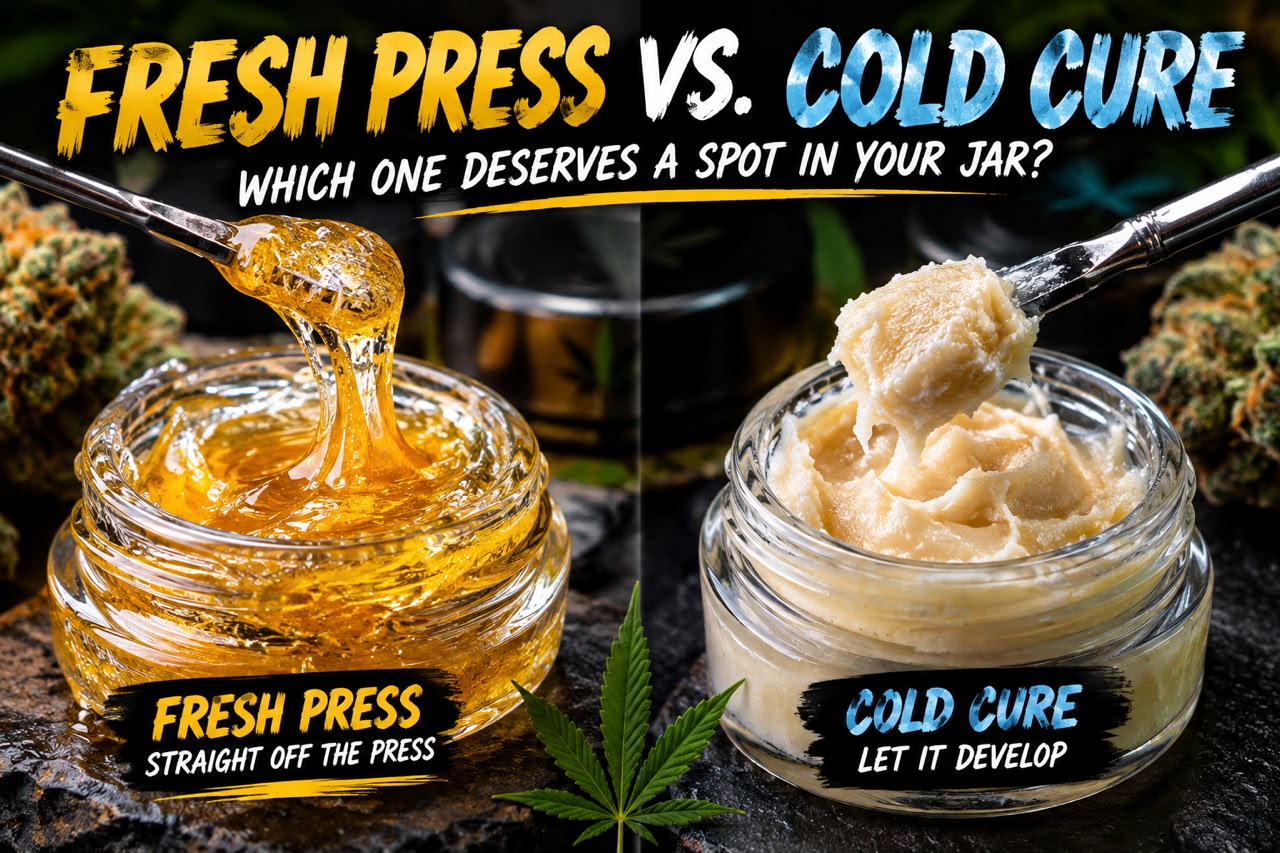
Two types of rosin. One press. Two completely different experiences.
If you’ve ever opened a jar of rosin and thought, “What the hell is this beautiful, sticky mess?” you may have just met fresh press.
And if you’ve opened another jar and found something creamy, scoopable and almost frosting-like, you’re probably looking at cold cure.
So what’s the difference?
Believe it or not, they can start as the exact same rosin.
The difference is what happens after it comes off the press.
FRESH PRESS: STRAIGHT OFF THE PRESS
Fresh press is essentially rosin in its freshly pressed state. Once the rosin is extracted through the press, it’s collected and packaged without intentionally putting it through a curing process.
The result can be glossy, translucent, sticky, oily or almost glass-like depending on the material and processing.
And while it can look absolutely beautiful, fresh press can be a pain in the ass to handle.
Bernie from Buddah Brothers, a CrisXotics vendor, put it perfectly:
“I hate fresh press. It’s a pain in the ass to work and most people end up losing half of it on their dab tool”
As OG Strain, I can’t argue with the man’s experience.
Sometimes fresh press doesn’t go onto your dab tool.
It goes wherever the fuck it wants.
But fresh press has its advantages. Because it hasn’t gone through a curing process, some people prefer the immediate, bright flavor and aroma of the freshly pressed product.
For the concentrate enthusiast who wants to experience rosin as close to its freshly pressed state as possible, that’s a major attraction.
COLD CURE: GIVE THAT ROSIN SOME TIME
Cold cure starts with the same basic rosin, but instead of immediately selling it as fresh press, the producer allows it to cure under controlled conditions.
During that time, the rosin’s physical structure changes.
The glossy, sticky material can develop into the creamy, badder-like consistency most people associate with cold cure.
And that’s where cold cure really separates itself.
It’s easier to work with.
You can usually scoop it, portion it and load your dab without needing a degree in concentrate engineering.
The texture can also make it easier to consistently control your dab size, which is something a lot of consumers appreciate.
FLAVOR: TWO DIFFERENT EXPERIENCES
This isn’t as simple as saying one tastes better.
Fresh press can provide a very immediate expression of the rosin, while curing can change how the aroma, flavor and texture are perceived.
Some people love that fresh, bright character.
Others prefer the fuller, more developed experience they associate with cured rosin.
That’s personal preference—and that’s where this debate gets interesting.
STORAGE: THIS IS WHERE THE TRADE-OFFS BEGIN
Fresh press generally needs careful storage to maintain its original state. Heat can quickly change its texture, so keeping it sealed, cool and protected from light is important.
Cold cure has already gone through a controlled transformation, but that doesn’t mean you can throw it on the dashboard of your car and expect it to be happy.
Depending on the producer’s process, cold-cure rosin may be stored under refrigerated or controlled cool conditions to help preserve its desired texture and terpene profile.
So while cold cure may be easier to use, maintaining it properly can require more attention.
Basically:
Fresh press can be harder to handle.
Cold cure can require more maintenance.
Pick your battle.
SO WHICH ONE IS BETTER?
Here’s the answer nobody wants to hear:
Neither one is automatically better.
Fresh press has legitimate advantages. It gives consumers the opportunity to experience rosin in its freshly pressed form, and some people specifically prefer its texture, aroma and flavor.
Cold cure has advantages too. It’s generally easier to handle, easier to portion, and its creamy consistency makes it much more user-friendly.
Personally?
OG Strain is taking the cold cure.
Not because fresh press is bad.
I’ve had fresh press that was absolutely fire.
I just prefer the combination of texture, flavor, workability and overall experience that a properly made cold cure gives me.
There’s something satisfying about opening a jar and seeing that beautiful creamy rosin sitting there waiting for you instead of watching half your dab stretch across the jar like a piece of mozzarella cheese.
THE BOTTOM LINE
Fresh press and cold cure aren’t enemies.
They’re two different ways of experiencing solventless rosin.
Fresh press is the “straight off the press” experience.
Cold cure is the “let’s give this thing some time to develop” experience.
And ultimately, the quality of the starting material and the skill of the producer matter more than whichever label is printed on the jar.
So try both.
See what your palate prefers.
See what your dab tool prefers.
And if your dab tool starts losing half the gram to the side of the jar…
Maybe Bernie was onto something.
- OG Strain
Products
WHY YOU SHOULD KEEP YOUR COLD CURE ROSIN COLD: Because Your Refrigerator Is Doing More Work Than You Think

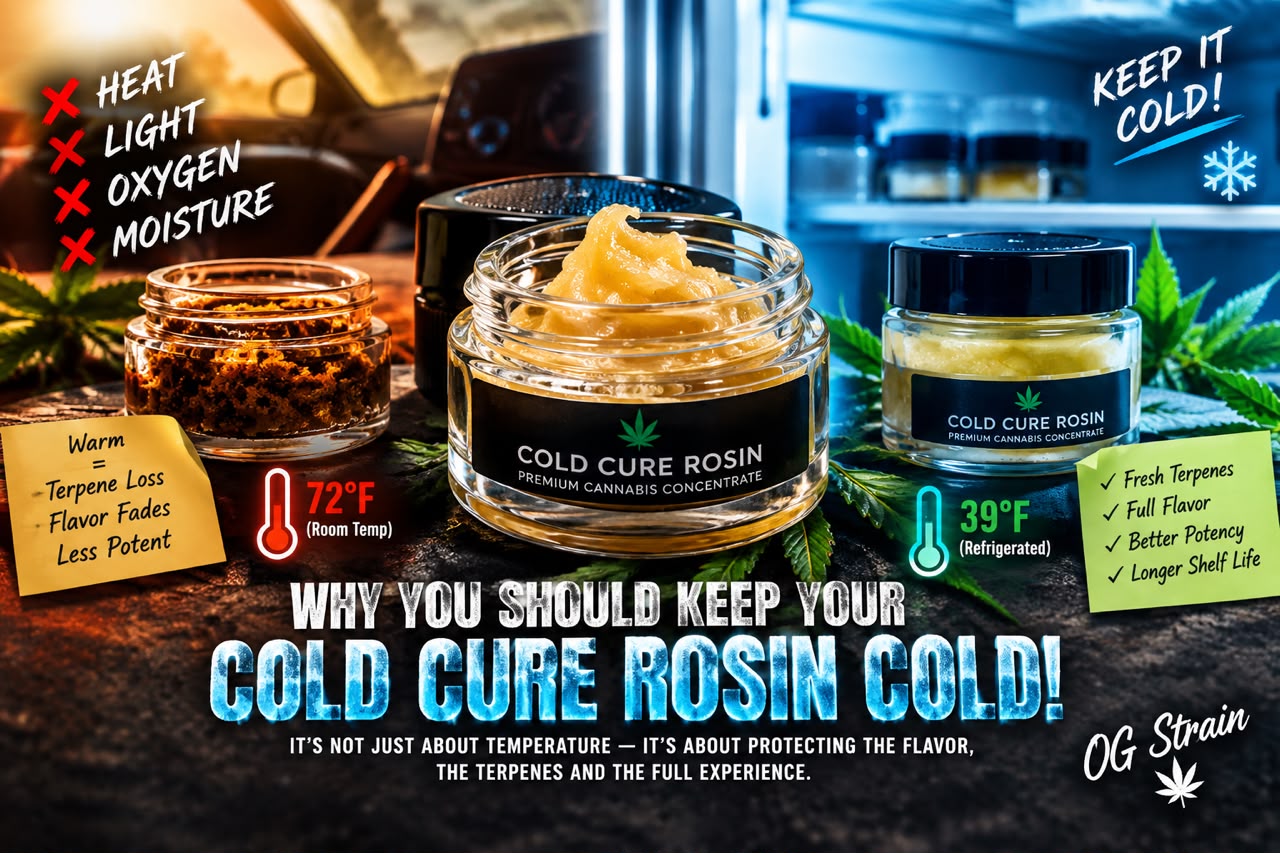
If you just spent good money on a beautiful jar of cold cure rosin, congratulations—you now own one of the most deliciously demanding substances in the cannabis world.
That little jar sitting on your table might look like a tiny container of happiness, but chemically speaking, it is more like a high-maintenance celebrity.
It doesn’t want to sit in your hot car.
It doesn’t want to bake on your desk.
It definitely doesn’t want to spend six hours next to your PlayStation while you’re deciding which game you’re going to play.
Cold cure rosin wants to be cold, dark, sealed and respected.
And there’s actually some science behind that.
WHAT EXACTLY IS HAPPENING INSIDE THAT JAR?
Cold cure rosin is a solventless cannabis concentrate. Depending on how it’s produced and cured, it can retain a significant amount of the volatile compounds responsible for its aroma and flavor—particularly terpenes.
Those terpenes are a huge part of what makes one jar smell like lemon, another smell like gasoline, another smell like berries, and another smell like somebody parked a skunk inside a garlic factory.
But here’s the catch:
The same compounds that make great rosin smell and taste incredible are also sensitive to heat, oxygen, light and time.
As temperatures rise, volatile compounds can evaporate more readily. Exposure to oxygen can promote oxidation. Light can accelerate chemical changes. And repeated warming and cooling can affect the texture and overall stability of the concentrate.
So when somebody says, “It’s just rosin. It’ll be fine on the counter,” OG Strain has a question:
Fine for what?
Fine as in still technically cannabis?
Probably.
Fine as in exactly like the beautiful jar you bought when it was fresh?
That’s a completely different question.
YOUR ROSIN DOESN’T NECESSARILY DIE—IT AGES
Here’s where things get interesting.
Improper storage doesn’t necessarily turn your rosin into toxic sludge overnight. Cannabis concentrates don’t suddenly wake up one morning and announce, “Well, today’s the day I become garbage.”
The changes are generally gradual.
The aroma can become less pronounced.
The flavor can become flatter.
The color can change.
The texture can change.
The terpene profile can shift.
And the overall experience can become less expressive than it was when the jar was fresh.
Scientific research on cannabis storage has shown that temperature, light, oxygen and time can all influence the stability of cannabinoids and terpenes. Research comparing storage temperatures has found that room-temperature storage can produce substantially more chemical change than colder conditions, while refrigeration around 4°C/39°F was among the more favorable conditions examined for preserving cannabis compounds.
In other words, your refrigerator isn’t just keeping your milk from becoming a science experiment.
It can help slow the chemistry happening inside your cannabis products, too.
THE FOUR HORSEMEN OF ROSIN DESTRUCTION
If OG Strain had to name the four biggest enemies of a beautiful jar of cold cure, they’d be:
HEAT.
LIGHT.
OXYGEN.
MOISTURE.
Heat can encourage terpene evaporation and accelerate chemical reactions.
Light can contribute to photochemical degradation.
Oxygen can contribute to oxidation.
And moisture is something you absolutely don’t want sneaking into your concentrate.
That’s why the ideal storage strategy is basically:
KEEP IT COLD.
KEEP IT DARK.
KEEP IT SEALED.
KEEP IT DRY.
It’s not complicated.
But apparently, neither was putting your phone on silent during a movie, and somehow we’re still struggling with that one.
WHAT HAPPENS WHEN YOU LEAVE COLD CURE ROSIN WARM?
Imagine opening a brand-new jar.
You get that first blast of aroma.
You look at the texture.
You scoop a little out.
The flavor is loud.
The terpenes are expressive.
Everything is working together.
Now imagine leaving that same jar sitting at room temperature for extended periods—especially in a warm environment.
Over time, you’re creating conditions that can encourage evaporation and chemical changes.
The most noticeable casualty may not even be potency.
It may be flavor.
That’s important because THC percentage doesn’t tell the entire story of a concentrate.
A jar can still test extremely high in cannabinoids while losing some of the aromatic character that made the particular extract special.
You can have plenty of horsepower left in the engine while somebody stole the stereo.
And if you bought premium cold cure because you wanted the full flavor experience, that’s a problem.
WHY DOES THE JAR SOMETIMES GET DARKER?
Ever notice rosin changing color?
Color changes can happen for several reasons, and color alone isn’t a perfect freshness meter.
But oxidation and other chemical changes can contribute to darkening over time, particularly in areas receiving greater exposure to oxygen.
Think about the top of the jar.
That’s where the concentrate meets the air inside the container.
Every time you open the jar, you introduce fresh air.
Every time you leave the lid loose, you’re giving oxygen another invitation.
And if your jar is only half full, there’s more air space above the concentrate.
Your rosin doesn’t need a personal assistant.
It needs you to close the damn jar.
BUT WAIT—DON’T YOU HAVE TO LET IT WARM UP?
Yes.
And this is one of the most important parts of proper storage.
If you pull cold rosin directly from the refrigerator or freezer and immediately crack the jar open in a warm room, you’re potentially creating another problem:
condensation.
Warm, humid air can meet the cold surface of the container and create moisture.
That’s why a better approach is to allow the sealed container to come back toward room temperature before opening it.
The simple rule is:
Cold jar? Keep it closed until it warms up.
Don’t open the refrigerator door, grab your jar, pop the lid and start digging around while the concentrate is still ice-cold.
Give it time.
Your rosin has waited this long.
It can wait another few minutes.
REFRIGERATOR OR FREEZER?
Here’s where people sometimes get carried away.
Colder isn’t automatically better for every situation.
For routine storage of cold cure/live rosin, refrigeration is a practical way to keep the product cool and slow degradation without constantly subjecting it to extreme temperature changes.
Freezing can make sense for longer-term storage, but it requires more care because condensation and repeated freeze/thaw cycles can create problems.
And there’s another important point:
Don’t constantly move your rosin from refrigerator to freezer to countertop and back again.
Temperature stability matters.
Your rosin doesn’t need to experience all four seasons every time you want a dab.
WHAT ABOUT THE TERPENES?
This is where keeping rosin cold really starts making sense.
Terpenes are volatile compounds, meaning many can evaporate relatively easily compared with less volatile components.
Some are particularly sensitive to environmental conditions.
That incredible citrus smell from a terpene-rich jar isn’t something you should assume will remain exactly the same forever.
Heat, oxygen and light can all contribute to changes in the terpene profile.
And once those compounds start disappearing or changing, the flavor can become less vibrant.
The lemon gets quieter.
The fruit becomes less obvious.
The gas doesn’t hit quite as hard.
The garlic doesn’t announce itself from three rooms away anymore.
Suddenly your $90 jar is acting like it has a day job.
SO WHAT’S THE BEST WAY TO STORE IT?
If you’re serious about preserving your cold cure, keep the formula simple:
- KEEP IT REFRIGERATED FOR ROUTINE STORAGE.
A refrigerator provides a cool environment that can slow many of the chemical processes associated with degradation.
- KEEP IT IN THE DARK.
Don’t leave the jar sitting in direct sunlight or underneath a bright window.
- KEEP THE CONTAINER SEALED.
Every time you open the jar, you’re introducing fresh air.
Open it when you’re using it—not because you’re bored and want to smell it for the seventeenth time.
Although OG Strain understands that temptation.
- AVOID HEAT.
Don’t leave your rosin in a hot vehicle, next to a heater, on a sunny windowsill or anywhere else that feels like the inside of Satan’s mailbox.
- AVOID MOISTURE.
Don’t introduce water into your concentrate, and be especially careful about condensation when taking cold rosin out of storage.
- LIMIT TEMPERATURE SWINGS.
Consistency is your friend.
Constantly going from cold to warm and back again isn’t the kind of workout your rosin asked for.
THE BOTTOM LINE
Premium cold cure rosin isn’t just expensive because somebody put cannabis in a jar and gave it a fancy name.
A lot goes into producing high-quality solventless extracts, and the final product contains a complex mixture of cannabinoids, terpenes and other compounds that can change during storage.
Once that jar is in your hands, you’re part of the preservation process.
The grower did their job.
The hash maker did their job.
The person who pressed, cured and packaged it did their job.
Now it’s your turn.
You don’t need a laboratory.
You don’t need a nitrogen-filled vault.
You don’t need to build a cryogenic bunker underneath your house.
You basically need a good refrigerator, a properly sealed container, some common sense and enough discipline not to leave your rosin sitting in the cup holder while you run into Walmart.
Keep it cold.
Keep it dark.
Keep it sealed.
Keep it dry.
Because when you’re dealing with premium cold cure rosin, proper storage isn’t just about keeping it from going bad.
It’s about giving that jar the best chance of staying the way the maker intended it to be.
And that’s the whole point.
If you paid for the cold cure, you might as well keep the damn thing cold.
- OG Strain

There are a lot of reasons I love cold cure rosin, but let me make one thing clear right from the jump: these are my reasons. I’m not here to tell you why everybody should love it. I’m telling you why, after decades of enjoying cannabis, cold cure rosin has become one of my favorite ways to experience it.
Let’s start with the obvious one: potency.
Cold cure gets me where I’m trying to go. At this point, I’ll be the first to admit that my tolerance is probably too damn high for straight flower to always get the job done by itself. Flower still has its place in my world, but when I’m looking for that extra punch, cold cure rosin absolutely brings the horsepower.
But potency is only the beginning.
THE SMELL WILL WALK INTO THE ROOM BEFORE YOU DO
Have you ever opened a jar of cold cure rosin and suddenly realized you’ve accidentally invited the entire room into the experience?
You crack that jar and BOOM—your nose knows.
I’m talking about creamy, cold terpenes coming out of that jar so loud that you don’t even need to put your nose anywhere near it. If you’re standing next to the guy holding the jar, congratulations—you’re already participating.
Sometimes it seems like anybody within five square feet is going to know exactly what just got opened.
That smell is part of the experience for me. Before I even take a dab, I’m already enjoying the product.
And then comes my favorite part:
The taste.
I DON’T JUST SMOKE CANNABIS. I TASTE IT.
I absolutely smoke for taste.
Give me a strain that tastes incredible and I can fall in love with it even if it isn’t the most potent thing on the planet. There’s something special about experiencing all those different strains through their individual flavors and aromas.
Cold cure rosin takes that experience to another level for me because of its terpene-rich character. When you get a really flavorful batch, those terpenes can make every hit feel like a completely different experience.
Put that cold cure into a good rig, keep the temperature low—I personally like staying at 500°F or below—and suddenly you’re not just getting high.
You’re tasting the cannabis.
You’re picking up those loud, distinctive flavors. You’re experiencing the differences between strains. One might hit your palate with citrus, another with gas, another with sweetness, another with that funky flavor that makes you stop and say, “What the hell was THAT?”
That’s what makes trying different cold cure strains so damn fun.
THE ONLY PART I DON’T LOVE? THE PRICE.
Now we have arrived at the elephant in the dispensary.
The price.
Cold cure rosin can be expensive. When you’re looking at $40-plus for a gram, the price starts getting serious enough that your wallet may need its own therapy session.
And when you start doing the math by the gram, you realize you’re talking about prices that can get uncomfortably close to what people associate with some very expensive illegal drugs.
That’s one of the strangest parts of the whole cannabis market to me: something that can be purchased legally in a dispensary can still cost enough per gram to make you stare at the receipt like, “Damn… did I just buy cannabis or a small piece of Manhattan?”
Then again, look at a one-gram vape selling for around $50 at a dispensary. Suddenly that expensive gram of cold cure doesn’t seem quite as crazy.
Still, I hope the future brings the price down.
As extraction technology improves and producers figure out ways to make these processes more efficient and consistent, I’d love to see premium cold cure become more affordable. Because if the quality stays where it is while the price drops?
Now we’re talking.
WHY I KEEP COMING BACK
I love using my e-rig for cold cure. There’s something about loading that little bit of rosin, finding that sweet low-temperature setting, and taking your time with it.
And I even like putting a little cold cure on my joint paper before I roll up. It adds another dimension to the experience and turns an ordinary joint into something a little more special.
If money were no object, I’d probably love to have an ounce of top-shelf rosin sitting around every month.
An ounce is only a little under a gram a day.
Sounds reasonable, right?
Until you realize a high-quality ounce could potentially run close to a thousand dollars.
Suddenly my mathematical argument has been completely defeated by my bank account.
I love cold cure rosin, but I can’t justify spending a grand every month just to keep my smoking supply stocked. At that price, the rosin might need to start paying rent.
THE BOTTOM LINE
For me, cold cure rosin is about the potency, the smell and the taste.
It’s the way that jar announces itself the second you open it. It’s the way the aroma can fill the space around you before the dab ever touches the rig. It’s the flavor that makes you slow down and actually appreciate what you’re experiencing. It’s the excitement of trying another strain and wondering what new combination of aromas and flavors is waiting inside that next jar.
And yes, it can be expensive as hell.
But take away the price, and there’s very little about cold cure rosin that I don’t love.
I love the smell.
I love the taste.
I love the potency.
I love experimenting with different strains.
I love sitting down with my e-rig and experiencing what that little jar has to offer.
That’s why I love cold cure rosin.
Not because it’s everybody’s favorite.
Not because everybody needs to smoke it.
But because for OG Strain, after all these years of experiencing cannabis in just about every way imaginable, cold cure gives me something I’m always looking for:
A damn good cannabis experience—and one I can actually taste, smell and feel from the first moment that jar gets opened to the last hit.


MOLD WAR: HOW NEW YORK OUTDOOR GROWERS CAN FIGHT BACK BEFORE THE HARVEST IS LOST

FRESH PRESS VS. COLD CURE: WHICH ONE DESERVES A SPOT IN YOUR JAR?

CANNA MAFIA FAMILY: WHERE EVERYBODY GETS A SEAT AT THE TABLE

She Didn’t Tiptoe In — OG Granny Blew the Door Off the Internet 💥🌿

Tokalotapot & Cannafae: The Couple That Made Weed Legal (Not Really, But It Feels Like It)

“Damn Sam”, The Man Who Kept the 518 Lit (and Safe) Before It Was Legal to Say “Lit”
-
 Cannabis Hall Of Fame9 months ago
She Didn’t Tiptoe In — OG Granny Blew the Door Off the Internet 💥🌿
-
 Cannabis Hall Of Fame12 months ago
Tokalotapot & Cannafae: The Couple That Made Weed Legal (Not Really, But It Feels Like It)
-
 Cannabis Hall Of Fame6 months ago
“Damn Sam”, The Man Who Kept the 518 Lit (and Safe) Before It Was Legal to Say “Lit”
-

 Cannabis Hall Of Fame1 year ago
Dope as Yola: From the Bottom to Cannabis Hall of Fame
-

 Community8 months ago
Empire State Cannabis Cup: An OG Strain Community Walkthrough
-

 Community12 months ago
🔥 HARVEST HYSTERIA: WHERE THE BUD AT, NEW YORK?!
-

 Community11 months ago
From Soil, Struggle, and Soul: Hudson Valley Green Wins Big at the Palenville Cannabis Cup”
-

 Humor1 year ago
OG Strain: The 518’s True Connoisseur Bringing Cannabis Reviews and Comedy Gold to YouTube