Products
Grove Bags vs. Jars: Which One Really Cures Cannabis Better?


By Herb Greenstein — Senior Contributor, The Plug’s Pages Magazine
Curing used to mean one thing: trim, dry, tuck your flower into a pantry of mason jars, and burp the jars like clockwork until the gods of terpenes smiled upon you. But 2024–2025 brought a new player into the ring: purpose-built curing bags — Grove Bags being the most talked-about brand. Growers are polarized, forums are loud, and marketing is loudest of all. Time to cut through the noise.
Short answer up front: If you want ease, consistency, and a “set it and forget it” cure — Grove Bags are the modern choice. If you want maximum long-term stability and full manual control, jars still have the edge. The smart middle ground — and what many pros are doing — is to use Grove Bags for curing, then transfer to jars for long-term storage.
⸻
What Grove Bags actually do (and why growers are hyped)
Grove Bags and similar “TerpLoc” curing bags are engineered to create a microclimate around the flowers: they moderate relative humidity, allow controlled off-gassing, and are designed to eliminate the need to burp. For growers with large harvests or limited time, that’s a game-changer — no dozens of jars to fill, no daily poking and prodding. Grove’s own FAQ and multiple hands-on writeups say these bags cure to consumption without burping and can extend shelf life when used properly.
Hands-on forum reports back this up: growers consistently praise the bags for being “fool-proof” and very low maintenance, especially for large or outdoor harvests where jar logistics become a nightmare. Many people report very good terpene preservation and a ready-to-smoke product straight out of the bag.
⸻
Where mason jars still matter
Mason jars aren’t obsolete. Jars give the grower complete manual control: you monitor hygrometers, add Boveda or other RH packs, and “burp” to manage moisture and off-gassing. For long-term storage — months to years — sealed glass with a humidity pack still appears to preserve aroma and potency better for many growers. Several experienced cultivators report that cured flower placed into jars after an initial cure has a longer shelf life and maintains quality better than bag-only workflows.
Jars also give you auditability: pop the lid, read a hygrometer, and know exactly what’s happening inside. If you’re a small grower who enjoys hands-on craft curing, jars remain an excellent option.
⸻
Common real-world workflows growers actually use
The community trend in 2024–2025 is pragmatic: Grove Bags for primary/initial cure, then transfer the finished product into glass for storage. This hybrid approach combines the ease of bags (fast, passive curing with minimal risk of trapping excessive moisture) with the long-term stability and archival qualities of jars. Multiple community threads and grow blogs describe precisely this workflow as their go-to method.
A few practical notes practitioners emphasize:
• Don’t seal anything that’s too wet — proper initial drying (targeting ~55–62% bud moisture) matters regardless of container.
• Use appropriately sized bags; overcrowding reduces performance.
• For long storage, move to dark glass jars with humidity packs after the cure is complete.
⸻
Where Grove Bags can disappoint
Not every test is glowing. Some growers report that once opened and left in less controlled environments, bag-cured flower can dry out faster than jar-cured batches. A few testers also reported subtle differences in aroma profile (subjective) after long storage. There have also been durability complaints about zippers and about some low-end bags not matching manufacturer claims; the market has imitators and variable quality. If you’re curing large volumes for long storage without follow-up jarging, be cautious.
⸻
The verdict — which is “better”?
“Better” depends on your goals.
• For busy growers (large harvests, outdoor runs, limited time): Grove Bags are better. They reduce labor and produce consistent, ready-to-smoke results.
• For small, craft growers focused on long-term preservation and total control: Mason jars (with hygrometers and RH packs) remain the gold standard.
• Best practice for most people: Cure in Grove Bags, then jar for storage. This hybrid workflow is widely used and recommended by experienced cultivators.
⸻
Final takeaways for growers (quick checklist)
• Dry properly before sealing (aim ~55–62% moisture).
• Use Grove Bags for passive, low-maintenance curing. Great for bulk or busy operations.
• Transfer to glass + RH packs for long-term storage.
• Monitor a few test bags/jars with hygrometers to dial your process in.
⸻
As with every “best” method in cannabis cultivation, the final answer is part science and part preference. Grove Bags have shifted the conversation by delivering consistent, low-effort curing that many growers now prefer — but jars still hold their spot for craft control and aging. My advice: try both on a small scale, see what your nose and your stash prefer, and then scale the process that gives your flowers the flavor and shelf life you want.
— Herb Greenstein, The Plug’s Pages Magazine
⸻
Sources & further reading
Grove Bags FAQ; GroveBags.com.
HappyHydro — Grove Bags vs Mason Jars (comparison).
THCFarmer & community threads on workflows and hybrid cure→store approaches.
KureBags / curing bag manufacturer reviews and industry perspective (2025).
Multiple grower reports and Reddit/ILGM threads describing hands-on experiences with Grove Bags.









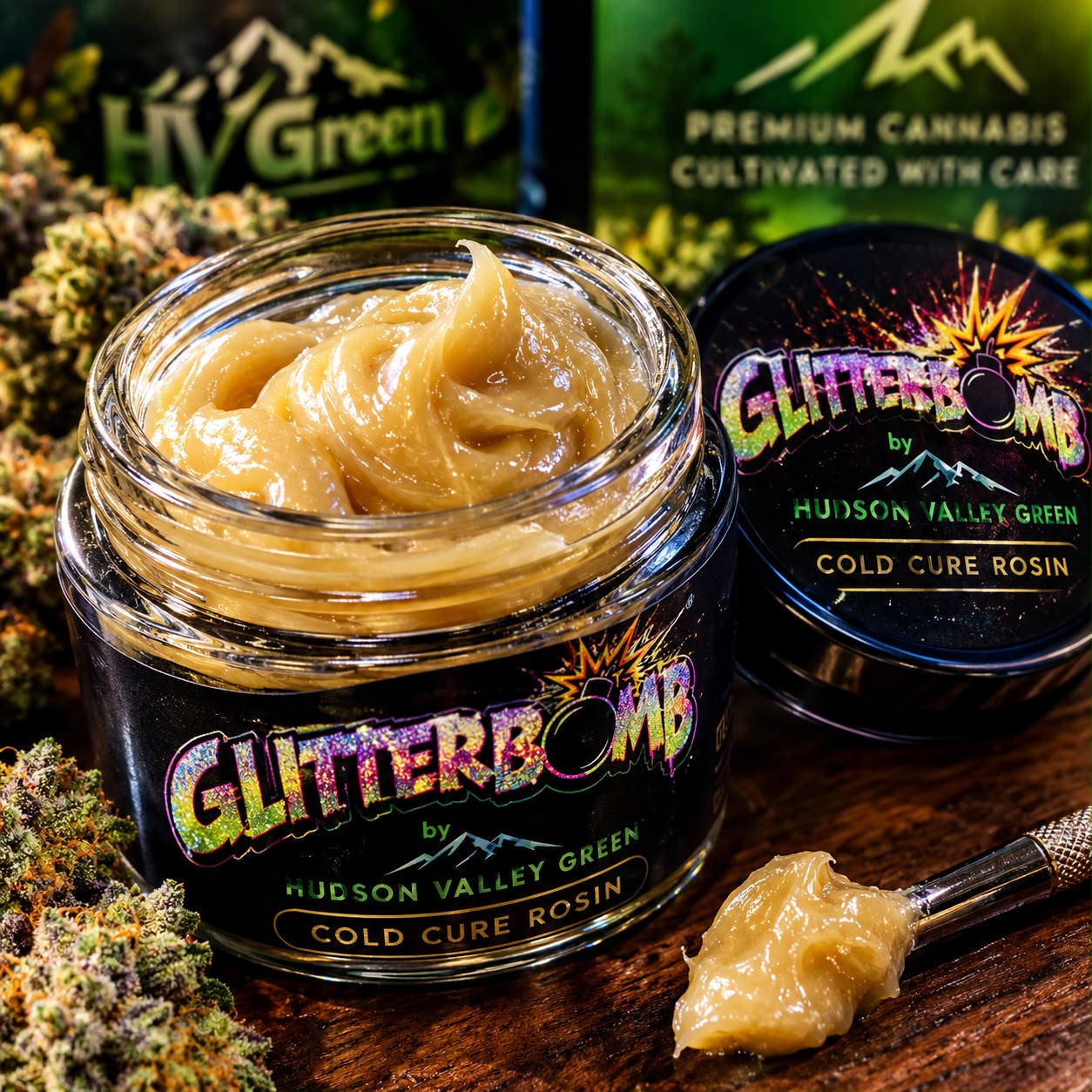
Six jars went into the OG Strain laboratory. One came out wearing the championship belt.
Let me tell you something about Hudson Valley Green’s cold cure rosin: this stuff is fresh.
I recently made another trip to Hudson Valley Green and came home with six different cold cure rosin strains. And because apparently I enjoy making difficult decisions for myself, I decided to rank all six from my least favorite to my favorite.
Now before anybody reads too far into that last sentence, let me make something crystal clear:
My least favorite was still top-shelf rosin.
This isn’t one of those reviews where I have to find something nice to say about five jars while secretly wondering what happened to the sixth. Every one of these jars showed me that Hudson Valley Green knows what they’re doing with solventless. The freshness, moisture, texture, aroma and terpene expression were all there.
But I’m OG Strain. I’m not here to hand out participation trophies.
I’m here to tell you which ones made my taste buds stand up and say, “HOLY SHIT, WHAT IS THAT?”
And lately, I’ve been chasing a very particular kind of flavor: loud, funky, sharp, unusual flavors that grab you right on the side of the tongue and don’t politely leave.
So let’s rank them.
⸻
#6 — RUBBERBAND MIMOSA
The one that just wasn’t my cup of tea
I’m going to start with the one I liked the least, and I’m not going to dance around it.
Rubberband Mimosa wasn’t my favorite.
And that’s strictly a matter of personal preference.
The quality? Absolutely there.
The rosin? Top shelf.
The flavor? That’s where OG Strain and Rubberband Mimosa had an irreconcilable difference of opinion.
This one had a strong, potent flavor that struck me as having a distinctly wine-like character. It was bold, it was noticeable, and it definitely wasn’t lacking in personality. In fact, I’m sure there are plenty of people who would absolutely love this profile.
I just wasn’t one of them.
And that’s an important distinction when you’re reviewing cannabis: not liking a particular flavor doesn’t mean the product isn’t good.
If you put a low-quality jar next to this one, I’m still reaching for the Hudson Valley Green every single time.
Rubberband Mimosa simply landed at the bottom of my personal flavor ranking.
OG Strain verdict: Excellent-quality cold cure. Strong, distinctive flavor. Just not my favorite flavor profile.
⸻
#5 — RAINBOW BELTS
A flavorful rosin with plenty to say
Rainbow Belts brought a completely different personality to the lineup.
The rosin in my jar had a noticeably more saucy consistency compared with some of the chunkier cold cures in this group. But don’t let that fool you into thinking it was lacking anything.
Quite the opposite.
This stuff was loaded with flavor and aroma.
Rainbow Belts is generally known for a sweet, fruity, candy-like profile, and that certainly fits the kind of experience I got from this jar. The nose was strong, the flavor was sweet and fruity, and the terpene expression was immediately noticeable.
This was the kind of cold cure where you open the jar and your nose knows there’s something serious happening before you even take a dab.
And the effects were enjoyable and satisfying.
Would I buy it again?
Absolutely.
But this is where ranking six excellent jars gets difficult. Sometimes a strain can be really damn good and still end up toward the bottom simply because the competition is brutal.
Rainbow Belts didn’t disappoint me.
It just had to compete.
OG Strain verdict: Sweet, fruity, aromatic and terp-heavy. A very solid cold cure that brings plenty of personality to the table.
⸻
#3 TIE — RAINBOW SHERB
The fruit-forward contender
Rainbow Sherb earns a spot in a tie for third, and honestly, I almost feel bad putting it this low.
This is another strain where the flavor profile leans heavily toward the fruit-and-sweet side. Published strain profiles commonly describe Rainbow Sherbet as fruity, sweet and tropical, with notes that can include berry, orange and apricot.
My experience with the Hudson Valley Green cold cure was exactly why this jar deserves respect: flavor, aroma and effects were all there.
It was another one of those jars where the freshness was immediately apparent. The rosin had that moist, creamy, alive-looking quality that makes you wonder if somebody forgot to tell the jar it was supposed to sit around for a while before I got my hands on it.
Rainbow Sherb delivered a flavorful, enjoyable experience and is absolutely something I’d buy again.
But here’s the problem:
There were six jars in this competition.
And when everything on the table is bringing its A-game, somebody has to be third.
OG Strain verdict: Fruity, sweet, terp-rich and seriously enjoyable. Easily good enough to be somebody else’s number one.
⸻
#3 TIE — GARLIC ICE CREAM CAKE
Savory meets dessert
Tied for third with Rainbow Sherb is Garlic Ice Cream Cake.
And this one proves exactly why I love reviewing cannabis.
Because on paper, garlic + ice cream cake sounds like somebody accidentally dropped dinner into the dessert menu.
But in cannabis?
It can work.
Garlic Ice Cream is commonly associated with garlic-forward genetics crossed with creamy dessert lines, producing the kind of savory-meets-sweet profile that makes the strain particularly interesting for flavor chasers.
And that’s exactly why this one belongs in the top half of this ranking.
It brought a completely different personality to the lineup. Instead of simply screaming fruit or sweetness, it had that deeper savory, creamy character that makes you stop for a second and analyze what your taste buds are actually experiencing.
The effects were solid, the quality was undeniable, and the jar absolutely earned another purchase.
Honestly, if I had never tried the other two jars that were still sitting ahead of it, I’d probably be sitting here telling you that Garlic Ice Cream Cake was the greatest thing since sliced bread.
But I had six jars.
And I had to rank them.
OG Strain verdict: Savory, creamy, funky and seriously good. Another strain that could easily be somebody else’s number one.
⸻
#2 — CRASH GLOW
The one that nearly stole everything
Now we’re getting serious.
Crash Glow was not far behind my number-one pick at all.
This one grabbed me because of that sharp, unique flavor I can’t get enough of lately.
And there’s something about that type of flavor that keeps bringing me back. It’s not simply sweet. It’s not just fruity. There’s a sharper, funkier quality that makes the flavor memorable.
Something that hits you right on the side of the tongue.
That’s my kind of rosin.
Published profiles for Crash Glow describe a complex combination of fruity, citrus, creamy, doughy, savory and gassy characteristics, which helps explain why this cultivar can have such a layered personality.
But no online strain description can completely explain what comes out of an individual jar.
And this jar from Hudson Valley Green?
It was loud.
The aroma was powerful. The flavor was distinctive. The cold cure itself was fresh, moist and creamy, with the kind of texture that makes it obvious you’re dealing with quality solventless.
The effects were just as impressive.
Crash Glow absolutely delivered.
And here’s where things get interesting:
It came damn close to taking the whole damn thing.
OG Strain verdict: Loud, complex, funky and memorable. A serious contender that came within striking distance of the top spot.
⸻
🏆 #1 — GLITTERBOMB
ROSIN STRAIN OF THE MONTH
The one that took the whole damn cake
Ladies and gentlemen…
We have a winner.
Out of all six Hudson Valley Green cold cure rosin strains I tried from this run, Glitterbomb stood above the rest.
This stuff is LOUD.
Not regular loud.
Not “Yeah, I can smell it.”
I’m talking open-the-jar-and-the-room-knows-about-it loud.
And then you taste it.
HOLY SHIT.
The flavor is so unique and so powerful that I honestly struggled to come up with a comparison that didn’t sound ridiculous.
Then I finally figured it out:
It cuts into your taste buds like extra-sharp cheddar cheese.
Now, before somebody starts thinking OG Strain has discovered cannabis-infused macaroni and cheese, I’m not saying Glitterbomb tastes like cheese.
I’m talking about the sensation.
That sharpness.
That punch.
That way a really aged, intensely flavored cheese can hit your tongue and immediately announce itself.
That’s what this rosin does.
Glitterbomb doesn’t whisper.
It doesn’t politely introduce itself.
It kicks open the door, walks into your mouth, and starts rearranging the furniture.
Glitter Bomb is commonly associated with a Grape Gas and OGKB Blueberry Headband lineage, with public strain profiles describing combinations of grape, blueberry, berry, gas, citrus and earthy notes.
But here’s the thing:
None of that tells you what this particular jar from Hudson Valley Green tasted like to me.
And that’s why the personal experience matters.
The Hudson Valley Green Glitterbomb was loud, funky, flavorful and incredibly potent-feeling.
The effects were insane.
The flavor kept pulling me back.
And that sharp, unusual character is exactly what I’ve been looking for in rosin lately.
This is the kind of concentrate where you take a hit and immediately think:
“Yep. That’s different.”
That’s what separates memorable cannabis from cannabis that is simply good.
And Glitterbomb was memorable.
Very memorable.
⸻
THE FINAL OG STRAIN SCORECARD
After working my way through all six jars, here’s where they landed:
🥇 #1 — Glitterbomb
🏆 ROSIN STRAIN OF THE MONTH
🥈 #2 — Crash Glow
🔥 A damn-near champion
🥉 #3 — Rainbow Sherb
🍬 Fruity, sweet and seriously solid
🥉 #3 — Garlic Ice Cream Cake
🧄🍦 Savory, creamy and funky
#5 — Rainbow Belts
🌈 Sweet, fruity and terp-heavy
#6 — Rubberband Mimosa
🍷 Quality was there; the wine-like flavor just wasn’t for me
⸻
THE BOTTOM LINE
Here’s what I really want people to take away from this ranking:
This isn’t a list of good rosin versus bad rosin.
This is a list of six good jars competing against each other.
Even the strain I liked the least was still clearly high-quality cold cure rosin. My ranking is based on my personal preference for flavor, aroma, texture and effects, not a declaration that one strain is objectively better than another.
And Hudson Valley Green absolutely gets my OG Strain approval for the quality of this cold cure lineup.
The rosin was fresh.
The consistency was moist and creamy.
The aromas were loud.
The terpene expression was there.
And most importantly, these jars actually had personality.
That’s what I’m chasing.
I don’t want every jar to taste exactly the same.
Give me the funky stuff.
Give me the sharp stuff.
Give me something that makes me stop mid-sesh and say, “What the hell am I tasting right now?”
That’s what Glitterbomb did.
That’s what made this particular run so damn enjoyable.
I’ve also seen the flower from Hudson Valley Green, and what I saw looked damn good. But lately, I’ve been deep in my cold cure rosin era, so that’s what we’re talking about today.
Six jars.
Six personalities.
One champion.
And for this run, according to OG Strain…
GLITTERBOMB IS THE COLD CURE ROSIN STRAIN OF THE MONTH.
Hudson Valley Green brought the fire. OG Strain just had to figure out which fire burned the brightest.
Why Your Dab Tool Might Be Scratching Up Your Favorite Rig!
Let’s talk about something every concentrate enthusiast has probably used, cursed at, or thrown back into a drawer at least once: the dab tool. More specifically, we’re talking about the battle between the traditional metal dab tool and the modern electric hot knife. Both are designed to help you handle your precious concentrates, but after spending time using both, OG Strain has a few thoughts about what these tools get right, what they get wrong, and what manufacturers might be overlooking.
Because here’s the million-dollar question: If these products are designed for people who dab, why does it sometimes feel like the people designing them have never actually taken a dab in their lives? 😂
THE TRADITIONAL DAB TOOL: OLD SCHOOL FOR A REASON
There’s something to be said for keeping things simple. A traditional metal dab tool doesn’t need a battery, a charging cable, or a button that lights up like a Christmas tree. It’s a straightforward piece of metal that gets the job done, and sometimes the old-school approach is still the way to go.
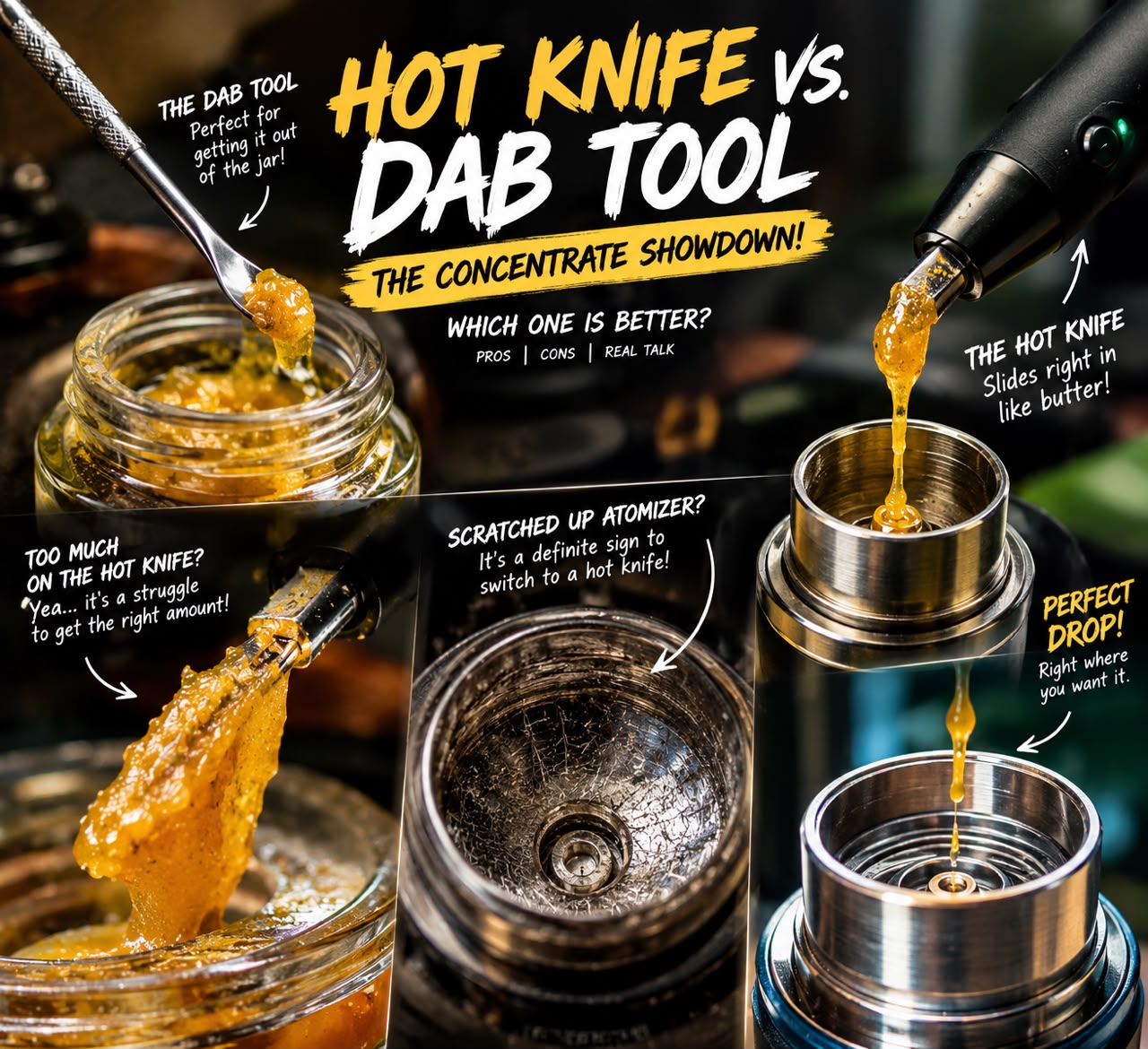
One of the biggest advantages of a traditional dab tool is the tip. Many feature a rounded, spoon-shaped end that makes scooping concentrates out of a jar relatively easy. When you’re working with sticky, delicious cold-cure rosin, that rounded tip gives you the control you need to collect the amount you’re looking for without fighting with your equipment.
For me, this is where the traditional dab tool really shines. Getting rosin out of the jar is easy, convenient, and precise. I can maneuver the tool around the container, work with the consistency of the concentrate, and pick up what I need without feeling like I’m performing surgery with a butter knife.
But just because something works well for one part of the process doesn’t mean it’s perfect for everything.
THE PROBLEM WITH TRADITIONAL METAL TOOLS
Here’s where things get interesting. Once you’ve collected your concentrate, the next challenge is getting it into your atomizer without making a mess or damaging your equipment.
With a traditional dab tool, many people scrape the concentrate against the edge of the atomizer to get it off the tool. Then comes the fun part: flipping the tool around, using the other end to push or scrape the concentrate down into the chamber, and hoping you don’t accidentally turn your expensive atomizer into a scratched-up science experiment.
Over time, repeatedly scraping metal against the inside of an atomizer can leave visible marks and potentially damage certain chamber surfaces, depending on the material and how aggressively you’re scraping. Nobody wants to spend good money on a quality rig only to have the inside looking like somebody tried to excavate it with a miniature pickaxe.
And let’s be honest: when you’re handling sticky rosin, getting every last bit off a metal tool can become a frustrating little wrestling match. The concentrate sticks to the tool, you try to scrape it off, it stretches like melted cheese, and suddenly you’re spending more time fighting with your dab than enjoying it.
That’s where the hot knife enters the conversation.
ENTER THE HOT KNIFE: THE ELECTRIC SOLUTION
The hot knife is one of those inventions that makes you wonder why somebody didn’t think of it sooner. Instead of relying entirely on scraping, you press a button, the heating element warms the blade, and the concentrate releases much more easily.
When it comes to loading an atomizer, this thing can be a game changer.
With my hot knife, I can position the concentrate over the atomizer, activate the heating function, and watch the rosin slide off the blade like butter. Instead of scraping the concentrate against the edge of the chamber and then trying to push it into place with the other end of a metal tool, the concentrate releases right where I want it.
Less scraping. Less wrestling. Less mess.
And potentially fewer scratches on the inside of your atomizer.
For anyone who’s looked inside their chamber and wondered whether they’ve been dabbing concentrates or sharpening tools in there, this is worth paying attention to.
The hot knife makes transferring sticky concentrates much easier, especially when you’re working with cold-cure rosin that wants to cling to absolutely everything except the exact spot where you want it.
However, before we crown the hot knife champion of the concentrate world, there’s one little problem we need to discuss.
THE HOT KNIFE’S BIGGEST FLAW: WHO DESIGNED THIS THING?
Here’s my biggest complaint about the hot knife, and it’s something I can’t stop thinking about.
WHY IS THE BLADE SO SHORT?
Seriously, folks. Have you ever tried scooping cold-cure rosin out of a jar with one of these things?
My hot knife screws into a standard 510-threaded battery, which means the battery section is considerably thicker than the blade itself. That makes maneuvering inside a jar more difficult, particularly when you’re trying to reach concentrate along the sides or near the bottom.
Then there’s the blade. It’s short, narrow, and not shaped anything like the traditional rounded spoon tip that works so well for scooping concentrate out of a jar.
Instead of smoothly collecting the amount I want, I sometimes find myself struggling to get the right amount onto the blade in the first place. The design that makes transferring concentrate into an atomizer so convenient can make collecting it from the jar unnecessarily frustrating.
And that’s what gets me.
The hot knife solves one problem beautifully, only to create another problem that seems completely avoidable.
It’s like buying a sports car with an amazing engine but discovering the driver’s seat doesn’t move far enough back. You’ve got something impressive, but somebody overlooked an important part of the actual experience.
I can’t help wondering whether product designers are spending enough time using these tools in real-world situations. Have they tried loading thick, sticky rosin out of a small jar? Have they struggled to collect the right amount without getting the battery housing in the way? Have they sat there wondering why the blade couldn’t be just a little longer?
Because I sure have!
THE PERFECT HOT KNIFE: WHAT OG STRAIN WANTS TO SEE
Now, imagine combining the best features of both tools.
Take the longer reach and rounded, spoon-shaped tip of a traditional metal dab tool. Give it a heating element and the convenient push-button functionality of an electric hot knife. Make the blade long enough to maneuver comfortably inside a concentrate jar, and design the handle so it doesn’t constantly interfere with collecting the product.
Now we’re talking!
The goal wouldn’t simply be to make the blade longer for the sake of making it longer. It would be to create a heated tool that can comfortably reach into a jar, collect concentrates with precision, and then release them cleanly into an atomizer without requiring all that scraping and pushing.
Of course, the heating element, blade material, electrical connections, and overall dimensions would need to be engineered properly. A longer blade would need to heat effectively and remain practical to use. But the basic concept seems worth exploring.
Why should dabbers have to choose between a tool that’s great for collecting concentrate and a tool that’s great for transferring it?
Why not design one that does both?
I haven’t personally come across a hot knife with the longer, rounded, spoon-shaped design I’m describing, but that doesn’t mean one doesn’t exist. If somebody has found a product like this, I’d genuinely love to hear about it.
Manufacturers, consider this an invitation to surprise me!
TRADITIONAL DAB TOOL VS. HOT KNIFE: WHICH ONE WINS?
Here’s the thing: I don’t believe either tool completely replaces the other. At least, not with the designs I’m currently using.
The traditional metal dab tool remains my preference for getting cold-cure rosin out of the jar. Its shape, maneuverability, and ability to collect the concentrate make that part of the process easier.
The hot knife, on the other hand, gets my vote when it’s time to transfer that concentrate into the atomizer. The heated blade makes releasing the rosin easier and reduces the need to scrape metal against the chamber.
So, rather than picking one winner, I’m choosing to use both tools for what they do best.
Here’s my personal breakdown:
Traditional Metal Dab Tool
Pros: Excellent for scooping concentrates out of jars, simple design, no batteries required, reusable, and easy to maneuver with the right tip.
Cons: Concentrates can stick to the tool, transferring product can get messy, and scraping metal against an atomizer may scratch or damage certain surfaces.
Electric Hot Knife
Pros: Makes transferring sticky concentrates easier, helps release rosin into the atomizer, reduces the need for scraping, and can help minimize mess during loading.
Cons: Short blades can make collecting concentrate from jars difficult, battery housings can get in the way, and the device requires charging or a compatible power source.
One important note: Not all atomizers have the same interior materials, and not every scratch necessarily means you’ve damaged the chamber. Always follow the manufacturer’s cleaning and loading recommendations, and avoid using metal tools aggressively against delicate surfaces. Hot knives also have heated tips, so handle them carefully and allow them to cool as directed.
FINAL THOUGHTS: THE FUTURE OF DAB TOOLS
The concentrate market continues to evolve, and it’s exciting to see manufacturers developing products that make the experience cleaner, easier, and more convenient. Hot knives are a great example of how a relatively simple idea can solve a genuine problem for concentrate enthusiasts.
But there’s still room for improvement.
For now, OG Strain is sticking with both tools. I’ll keep using my traditional metal dab tool to collect that cold-cure goodness from the jar, and I’ll keep reaching for my hot knife when it’s time to get that concentrate into the atomizer.
But I’m still waiting for somebody to build the best of both worlds: a hot knife with a longer, properly shaped blade that makes collecting and transferring concentrate equally convenient.
Until then, we’re working with what we’ve got.
And remember, folks, the goal is to enjoy your concentrates, not spend half your session fighting with a tool that looks like it was designed by somebody who’s never seen a jar of rosin!
NOW IT’S YOUR TURN!
I want to hear from the concentrate community. Are you team traditional dab tool, team hot knife, or are you like me and use both? Have you discovered a hot knife with a longer, rounded tip that actually works well for collecting concentrate out of a jar?
Drop your experiences, recommendations, and favorite tools in the comments. Let’s hear what works, what doesn’t, and what manufacturers should be working on next.
Because if somebody out there has already invented the perfect hot knife, OG Strain wants to know about it!
Stay lifted, stay informed, and keep those dabs delicious!
— OG Strain
So you want to try dabbing.
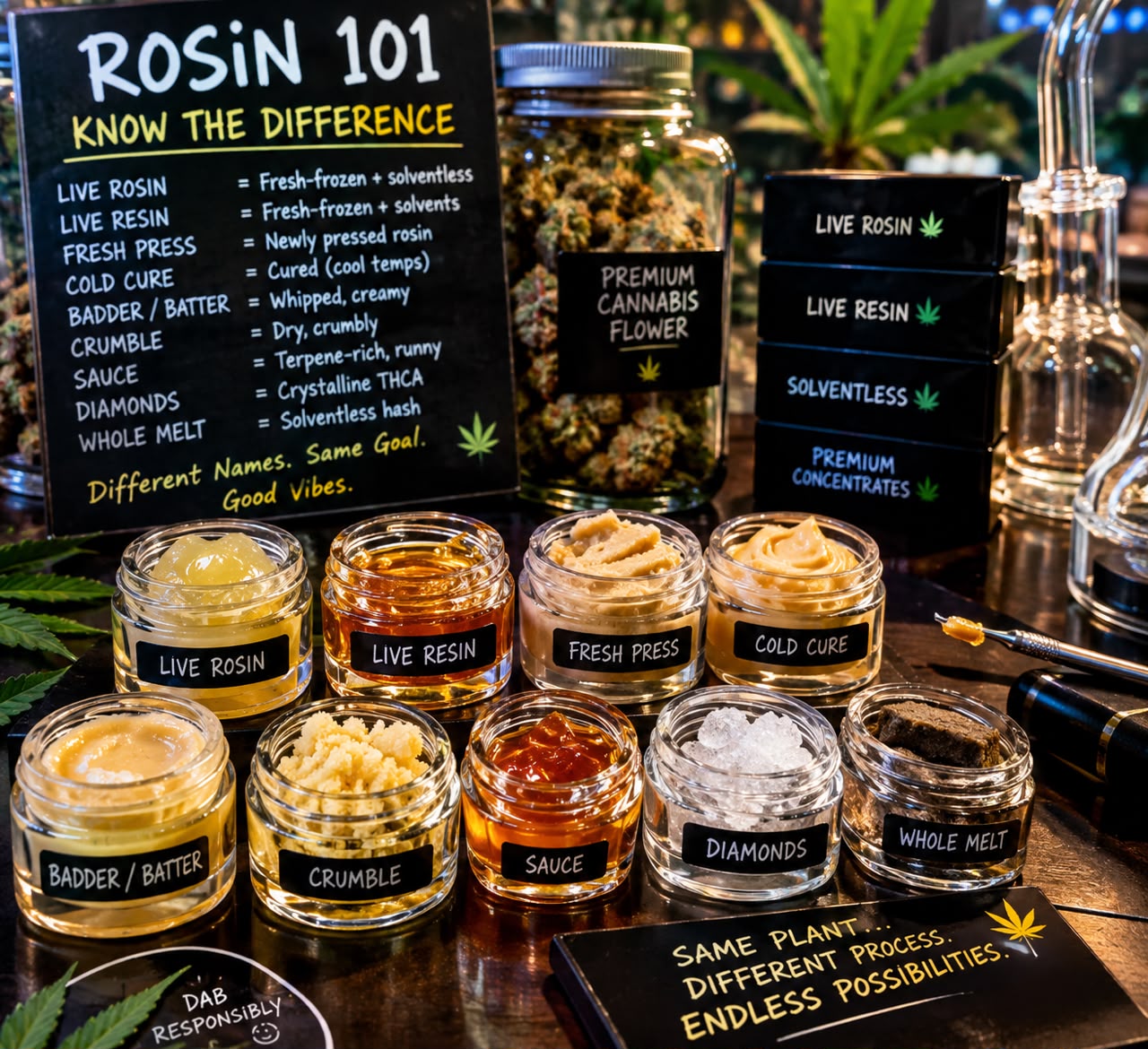
You walk into a dispensary, look at the concentrates, and suddenly you’re staring at a refrigerator full of little jars labeled Live Rosin, Fresh Press, Cold Cure, Badder, Sauce, Diamonds, Whole Melt, Live Resin…
And you’re thinking, “I just wanted to get high. Why does this look like I’m shopping for a new transmission?”
That’s exactly why I’m writing this.
If you’re new to concentrates, the terminology can be intimidating as hell. So let’s break down the basics without making you need a chemistry degree—or a cannabis dictionary.
FIRST THINGS FIRST: ROSIN VS. RESIN
These two words sound almost identical, but they’re not the same thing.
Rosin is a solventless concentrate. Instead of using chemical solvents to extract the cannabinoids and terpenes, rosin is produced using heat and pressure. When it’s made from fresh-frozen cannabis, you’ll commonly see it called live rosin.
Resin, including live resin, is generally made using solvents to extract the compounds from the plant. Live resin also starts with fresh-frozen cannabis, which helps preserve more of the plant’s volatile compounds.
The simple way to remember it:
Rosin = solventless.
Resin = solvent-based extraction.
That one little distinction can save a beginner from standing at the counter looking like they just got handed a calculus exam.
WHAT DOES “LIVE” MEAN?
When you see Live Rosin or Live Resin, the word live usually refers to the cannabis being fresh-frozen soon after harvest instead of being traditionally dried and cured before extraction.
Why does that matter?
Freezing the plant right after harvest helps preserve compounds that can be lost during drying and curing, particularly volatile terpenes.
So if you see Live Rosin, think:
Fresh-frozen cannabis → solventless extraction → rosin.
See Live Resin?
Fresh-frozen cannabis → solvent extraction → resin.
If the word live isn’t on the label, that doesn’t automatically mean the product is bad. It simply tells you that a different starting material or production process was used.
NOW LET’S TALK ABOUT THAT JAR
Once you understand resin versus rosin, the next confusing part is all those words describing the consistency and processing.
FRESH PRESS:
Fresh press rosin is rosin that hasn’t been extensively worked or cured after pressing. It can have a glossy, sticky, almost glassy appearance and can be very flavorful. It can also be a little more challenging to handle because it may be extremely sticky and sensitive to temperature.
COLD CURE:
Cold-cure rosin is allowed to undergo a controlled curing process, generally at cool temperatures. This can change the texture and make it easier to handle. You’ll often see a creamy, buttery, badder-like consistency.
If you’re brand new to rosin, cold cure can be a much less intimidating place to start because you’re not necessarily wrestling with a jar of cannabis glue.
BADDER / BATTER:
These terms generally describe a whipped or worked concentrate with a soft, creamy consistency. Think somewhere between frosting and peanut butter—although I strongly recommend keeping your rosin away from your toast.
CRUMBLE:
Crumble is a dry, crumbly concentrate that breaks apart easily. It generally contains less moisture and has a different texture from the sticky, creamy consistency many people associate with rosin.
SAUCE:
Sauce is a terpene-rich, often runny or syrupy concentrate. It can contain a mixture of cannabinoids and terpene-rich components and is commonly associated with a strong aroma and flavor.
DIAMONDS:
Diamonds are highly crystalline formations of THCA. They can appear like little crystals or rocks in the concentrate. Sometimes you’ll see diamonds by themselves; other products combine them with sauce.
WHOLE MELT:
Whole melt generally refers to high-quality, solventless hash that can melt cleanly when heated. You’ll often see different grades of melt, and the term is commonly associated with hash made from separated trichomes.
And here’s an important beginner tip:
The name describing the texture doesn’t automatically tell you the quality.
A jar being called “badder,” “sauce,” “diamonds,” or “cold cure” doesn’t magically make it good—or bad. These terms primarily tell you something about the product’s form, processing, or composition.
SO WHAT SHOULD A BEGINNER ACTUALLY LOOK FOR?
Don’t just stare at the biggest THC number on the label.
Look at the producer, extraction method, cannabinoid information, terpene information when available, testing information, production date, and storage recommendations.
Pay attention to whether you’re buying rosin or resin, whether it’s live or made from cured material, and what consistency you’re actually looking for.
If flavor and aroma are important to you, terpene information can be especially useful.
And remember: THC percentage isn’t the entire story.
Two concentrates with similar THC numbers can smell, taste, feel, and perform completely differently.
THE OG STRAIN CHEAT SHEET
Here’s the beginner version to remember:
LIVE ROSIN = fresh-frozen cannabis + solventless extraction.
LIVE RESIN = fresh-frozen cannabis + solvent extraction.
FRESH PRESS = newly pressed rosin with little or no curing.
COLD CURE = rosin that has been cured under controlled cool conditions, often producing a creamy texture.
BADDER/BATTER = soft, whipped, creamy consistency.
CRUMBLE = dry, crumbly consistency.
SAUCE = terpene-rich, often runny consistency.
DIAMONDS = crystalline THCA formations.
WHOLE MELT = solventless hash known for melting cleanly when heated.
Once you know those words, walking up to the concentrate case doesn’t feel quite so much like walking into a foreign country where everybody speaks fluent Cannabis.
And that’s the whole point of this article.
You don’t have to be a concentrate expert before you try your first dab. You just need to understand what you’re looking at.
Read the label. Know what you’re buying. Ask questions. Start low, take your time, and let the experience teach you what you like.
Because when it comes to cannabis, you don’t have to know everything—you just have to know enough to make an informed choice.
- OG Strain


I DON’T WANT TO WASTE ANOTHER DAY: WHY I’M BUILDING MY LEGACY IN THE 518 CANNABIS COMMUNITY

THE BLACK MARKET GAMBLE: Can Playing by Some of the Rules Keep New York Cannabis Businesses Safe?

GOOD BURGER OR BAD TASTE? THE MOST CONTROVERSIAL STRAIN OF 2026 HAS SMOKERS DIVIDED!

She Didn’t Tiptoe In — OG Granny Blew the Door Off the Internet 💥🌿

Tokalotapot & Cannafae: The Couple That Made Weed Legal (Not Really, But It Feels Like It)

“Damn Sam”, The Man Who Kept the 518 Lit (and Safe) Before It Was Legal to Say “Lit”
-
 Cannabis Hall Of Fame10 months ago
She Didn’t Tiptoe In — OG Granny Blew the Door Off the Internet 💥🌿
-
 Cannabis Hall Of Fame1 year ago
Tokalotapot & Cannafae: The Couple That Made Weed Legal (Not Really, But It Feels Like It)
-
 Cannabis Hall Of Fame7 months ago
“Damn Sam”, The Man Who Kept the 518 Lit (and Safe) Before It Was Legal to Say “Lit”
-

 Cannabis Hall Of Fame1 year ago
Dope as Yola: From the Bottom to Cannabis Hall of Fame
-

 Community9 months ago
Empire State Cannabis Cup: An OG Strain Community Walkthrough
-

 Community1 year ago
🔥 HARVEST HYSTERIA: WHERE THE BUD AT, NEW YORK?!
-

 Community12 months ago
From Soil, Struggle, and Soul: Hudson Valley Green Wins Big at the Palenville Cannabis Cup”
-

 Community2 months ago
STONER MAMA NICOLE Breaking Stigma, One Laugh at a Time