Products
Grove Bags vs. Jars: Which One Really Cures Cannabis Better?


By Herb Greenstein — Senior Contributor, The Plug’s Pages Magazine
Curing used to mean one thing: trim, dry, tuck your flower into a pantry of mason jars, and burp the jars like clockwork until the gods of terpenes smiled upon you. But 2024–2025 brought a new player into the ring: purpose-built curing bags — Grove Bags being the most talked-about brand. Growers are polarized, forums are loud, and marketing is loudest of all. Time to cut through the noise.
Short answer up front: If you want ease, consistency, and a “set it and forget it” cure — Grove Bags are the modern choice. If you want maximum long-term stability and full manual control, jars still have the edge. The smart middle ground — and what many pros are doing — is to use Grove Bags for curing, then transfer to jars for long-term storage.
⸻
What Grove Bags actually do (and why growers are hyped)
Grove Bags and similar “TerpLoc” curing bags are engineered to create a microclimate around the flowers: they moderate relative humidity, allow controlled off-gassing, and are designed to eliminate the need to burp. For growers with large harvests or limited time, that’s a game-changer — no dozens of jars to fill, no daily poking and prodding. Grove’s own FAQ and multiple hands-on writeups say these bags cure to consumption without burping and can extend shelf life when used properly.
Hands-on forum reports back this up: growers consistently praise the bags for being “fool-proof” and very low maintenance, especially for large or outdoor harvests where jar logistics become a nightmare. Many people report very good terpene preservation and a ready-to-smoke product straight out of the bag.
⸻
Where mason jars still matter
Mason jars aren’t obsolete. Jars give the grower complete manual control: you monitor hygrometers, add Boveda or other RH packs, and “burp” to manage moisture and off-gassing. For long-term storage — months to years — sealed glass with a humidity pack still appears to preserve aroma and potency better for many growers. Several experienced cultivators report that cured flower placed into jars after an initial cure has a longer shelf life and maintains quality better than bag-only workflows.
Jars also give you auditability: pop the lid, read a hygrometer, and know exactly what’s happening inside. If you’re a small grower who enjoys hands-on craft curing, jars remain an excellent option.
⸻
Common real-world workflows growers actually use
The community trend in 2024–2025 is pragmatic: Grove Bags for primary/initial cure, then transfer the finished product into glass for storage. This hybrid approach combines the ease of bags (fast, passive curing with minimal risk of trapping excessive moisture) with the long-term stability and archival qualities of jars. Multiple community threads and grow blogs describe precisely this workflow as their go-to method.
A few practical notes practitioners emphasize:
• Don’t seal anything that’s too wet — proper initial drying (targeting ~55–62% bud moisture) matters regardless of container.
• Use appropriately sized bags; overcrowding reduces performance.
• For long storage, move to dark glass jars with humidity packs after the cure is complete.
⸻
Where Grove Bags can disappoint
Not every test is glowing. Some growers report that once opened and left in less controlled environments, bag-cured flower can dry out faster than jar-cured batches. A few testers also reported subtle differences in aroma profile (subjective) after long storage. There have also been durability complaints about zippers and about some low-end bags not matching manufacturer claims; the market has imitators and variable quality. If you’re curing large volumes for long storage without follow-up jarging, be cautious.
⸻
The verdict — which is “better”?
“Better” depends on your goals.
• For busy growers (large harvests, outdoor runs, limited time): Grove Bags are better. They reduce labor and produce consistent, ready-to-smoke results.
• For small, craft growers focused on long-term preservation and total control: Mason jars (with hygrometers and RH packs) remain the gold standard.
• Best practice for most people: Cure in Grove Bags, then jar for storage. This hybrid workflow is widely used and recommended by experienced cultivators.
⸻
Final takeaways for growers (quick checklist)
• Dry properly before sealing (aim ~55–62% moisture).
• Use Grove Bags for passive, low-maintenance curing. Great for bulk or busy operations.
• Transfer to glass + RH packs for long-term storage.
• Monitor a few test bags/jars with hygrometers to dial your process in.
⸻
As with every “best” method in cannabis cultivation, the final answer is part science and part preference. Grove Bags have shifted the conversation by delivering consistent, low-effort curing that many growers now prefer — but jars still hold their spot for craft control and aging. My advice: try both on a small scale, see what your nose and your stash prefer, and then scale the process that gives your flowers the flavor and shelf life you want.
— Herb Greenstein, The Plug’s Pages Magazine
⸻
Sources & further reading
Grove Bags FAQ; GroveBags.com.
HappyHydro — Grove Bags vs Mason Jars (comparison).
THCFarmer & community threads on workflows and hybrid cure→store approaches.
KureBags / curing bag manufacturer reviews and industry perspective (2025).
Multiple grower reports and Reddit/ILGM threads describing hands-on experiences with Grove Bags.


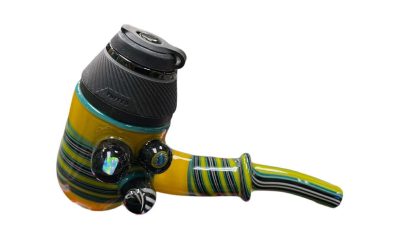





A Puffco Proxy Review — by Seymour Buds Tiny device. Big clouds. Bigger feelings. Read on, roll one up, and let’s see if $250 gets you to flavor town or just a fancy paperweight.
Lede Puffco’s Proxy promises pro-level dabbing in a portable, modular package — a dry-dab rig that looks like it wandered off a design-studio mood board and straight into your pocket. It lists for $250 on Puffco’s site (they also offer build-your-own and color options).
⸻
What people are saying (real users, real baked takes)
Across Reddit threads, first-hand reviews, and vape-site write-ups, the loudest applause centers on flavor, portability, and modularity. Many users report terpene-forward, smooth hits that hold their own against larger desktop rigs — especially on lower temp settings where flavors bloom. Fans praise the clean design and the ability to swap glass/attachments to suit sessions on-the-go.
But it’s not all daisies and dab pearls. Common gripes: the price (some users felt $250+ was steep for a portable), occasional connection/fit quirks between chamber and base, and the inevitable social-media takes comparing it to the Peak Pro — some say the Proxy is close, but not quite Peak-tier for home-heads.
⸻
The highs (what folks love)
• Flavor first — excellent terpene clarity on low-mid temps; flavorful hits that justify the concentrate.
• Portable but pro-minded — modular glass and accessory ecosystem makes the Proxy useful for travel or desktop-adjacent sessions.
• Fast heat & control — preset temps plus app control let you chase subtle or cloudier hits depending on mood.
⸻
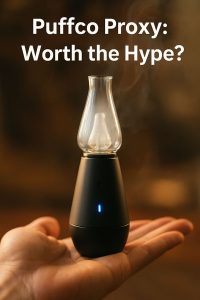
The lows (what people complain about)
• Price sticker shock — $250 isn’t small potatoes in the dab pen world; some users prefer saving for a Peak/Pro if mostly home-use.
• Connection & fit issues — a few reports of chamber/base alignment problems or flashing errors that usually fix with cleaning/re-seating.
• Not a complete Peak Pro replacement — while close, some connoisseurs feel the Proxy sacrifices a hair of performance for portability.
⸻
Does it waste concentrate?
Short answer: No — not if you use it right. Users report the Proxy clears about 80–90% of a small dose on good hits; adding a 3mm pearl or using appropriately small dabs improves efficiency and reduces leftover puddles. But leaving large globs sitting in the chamber between sessions is discouraged — it can puddle, gunk, and reduce efficiency. Puffco and veterans recommend dosing small and cleaning regularly for best yield.
⸻
How much of a pain is cleaning?
Expectation: moderate maintenance, doable. Puffco’s official guidance is standard dab-device hygiene — swab lightly after sessions, and deep-soak the chamber/glass in 90%+ isopropyl alcohol every so often (Puffco recommends deep cleaning on a battery cycle or whenever residue builds). Don’t soak the electronics/base; instead carefully swab the contacts. Community guides and videos make the whole process easy — but if you hate ISO & q-tips, prepare to put on gloves and cry a little.
⸻
Verdict — is $250 worth it?
If you value portable flavor, modular attachments, and an intuitive, pocketable environment for concentrates — yes, the Proxy is worth considering. It’s a strong bridge between functional travel rig and flavor-first device. If you primarily dab at home and already own a Peak/Peak Pro, the Proxy may feel like a luxury “also-rig” rather than a necessary upgrade. In short: worth it for mobile connoisseurs; optional for desktop-only dabbers.
⸻
Quick buyer’s checklist (so you don’t buy regret)
• Want portable, flavorful dabs?
• Hate cleaning? moderate cleaning required.
• On a tight budget? $250 might sting — shop sales.
• Waste worries? dose small + use pearls to maximize yield.
⸻
Final puff (the Seymour Buds seal of giggly approval)
The Puffco Proxy is like that friend who shows up to the party in a tailored blazer and a joint tucked behind their ear — classy, a little extra, and definitely ready to impress. If you want tasty, convenient dabs away from the kitchen torch and don’t mind spending on tech that makes your concentrates sing, the Proxy is a top-tier road trip companion. If you’re strictly a living-room dab aristocrat, maybe keep the Peak on the throne and let the Proxy be your weekend valet. Either way — respect the concentrate, clean your chamber, and always—always—share a puff with a friend (or at least laugh at them while they cough).

By Seymour Buds, Senior Writer at The Plug’s Pages
In a world where glass breaks, metal burns, and silicone just feels wrong, one man from Portland decided to take things back to nature — literally. Meet William Adams, better known in the cannabis community as “Sticks Stoned.” He’s not just a pipe maker — he’s a wood whisperer with sawdust in his beard and creativity in his blood.
For the past three years, Sticks has been handcrafting one-of-a-kind wooden pipes that look like something straight out of a stoner’s fairytale. He doesn’t start with factory molds or assembly lines — he starts with trees. “I cut down a tree, slice it into pieces, and see what it wants to become,” says Adams. “The wood kinda talks to me — I just flow as I create.”
His favorite medium? Apple wood — sweet, smooth, and durable enough to handle whatever you’re smoking. Each piece takes about 20 to 40 minutes from start to finish, and he does it all by hand. Well — almost all. It’s a family affair: William cuts and shapes, his son sands, and his wife adds the artistic touches. It’s like the Norman Rockwell version of a cannabis company — wholesome, hardworking, and powered by pure passion.
And here’s what sets Sticks Stoned Pipes apart — they don’t break. Ever drop a $60 glass pipe and feel your heart sink into your shoes? Yeah, that doesn’t happen with these. These things are the pickup trucks of the pipe world — tough, reliable, and built to last.
His business name, “Sticks and Stoned,” is as straightforward as it is clever. He literally makes pipes from sticks and decorates them with stones. Genius. And if you think that’s all, he even makes stainless steel pusher rods to keep your pipe clean — because nothing ruins a sesh faster than a clogged bowl.
You can find his handcrafted masterpieces in six marijuana shops, one tobacco shop, one head shop, and five convenience stores around the Portland area. That’s not bad for a guy who almost lost a finger on a table saw but refused to quit. “Got stitched up and went right back to making pipes,” he laughs. That’s blue-collar dedication — and exactly the kind of story we at The Plug’s Pages love to share.

His favorite creation? A sleek piece with a long bamboo stem, the perfect blend of elegance and old-school chill.
Everywhere he goes, people can’t help but smile when they see his work. “Every store I walk into for the first time, people light up,” he says. “They’re excited.”
And so are we.
At The Plug’s Pages, we don’t promote junk, gimmicks, or cookie-cutter gear. We spotlight the real craftsmen — the innovators shaping cannabis culture from the ground up. And trust us: Sticks Stoned Pipes are the real deal. So next time you’re shopping for a new piece, skip the fragile glass and go for something that feels alive — something that was once rooted in the earth and reborn through fire and craftsmanship.
Because when it comes to quality, William Adams doesn’t just make pipes.
He makes legends.
Link: www.sticksandstoned.square.site/?sfnsn=mo

By Seymour Buds
You roll into the dispensary. Glass jars lined up like a candy shop for grown-ups. You’re holding an eighth, maybe you spent top-dollar for it, and you ask yourself: “Am I getting what I paid for?” You don’t want the fluff. You want the fire. You want the kind of bud that makes you lean back, mouth open, thinking: Yep. That’s worth it.
Here’s your unofficial certificate of quality—the Seymour Buds checklist—for ensuring every nug in the jar is earning its keep.
⸻
- The Smell Test
Open the jar. Inhale. Does it reach out and grab you by the nostrils?
Good weed smells bold. Fruity, gassy, piney, skunky, citrusy—whatever the terpene profile, it must announce itself.
If it smells like a barn, old hay, or nothing at all? That’s a red flag. Lack of aroma often means poor curing or age.
Smell hints at the terpenes, and terpenes hint at effect (yes you heard that). So when you sniff, ask: “Does this smell like something I want to pay for?”
And for your internal “plugs pages” grade: anything that hits “wow” in the nose gets bonus points.
⸻
- The Visual Inspection
You know you’re close when the jar glows under the light. The sparkle of crystals. The greens, the purples, the orange hairs.
What to look for:
• Color – Rich green tones (sometimes with purple or blue hues, depending on strain) and bright pistils (orange/red hairs) = good. Dull brown, overly pale, or gray = weak.
• Trichomes – The “diamonds” of the bud. Those little mushroom-shaped crystal glands that carry cannabinoids and terpenes. The more frosty and abundant, the better.
• Structure & Trim – A top shelf eighth should not be filled with stems, shake, or scraps. The buds should be well-formed, trimmed (preferably hand-trimmed), not full of leaf.
• Bud size – Big enough to justify your spending: you mentioned “one to maybe three buds tops” for a premium eighth—solid standard. If you open a jar and it’s all tiny bits, that’s a scale tip in your wallet’s favor but not your experience’s.
⸻
- The Touch & Break Test
Now you handle it. Gently. Because you don’t want to crush the beauty when you’re shopping.
Here’s what to feel for:
• It should feel sticky/tacky to the touch—resin should still be alive. If it feels dry as dust, you’re losing the potency and flavor.
• The bud should be firm and dense, but not rock-hard or too spongy. Too soft = undercured/too moist (risk of mold); too brittle = overdried, losing terpenes.
• When you break it open (you love that Styrofoam-crack feel) you should see the inner structure: good density, minimal stems, lots of resin on the inside too.
• Check for any seeds, weird discoloration or mold spots. If you see white fuzz, grey powder, or overt browning—walk away.
⸻
- The Curing & Moisture Factor
This is often overlooked by many in the “just grab it and go” mindset, but curing is everything.
If a piece of bud:
• Was harvested too early → trichomes are underdeveloped → weaker effect.
• Was dried/cured incorrectly → terpenes volatile, moisture too high → risk of mold; or too low → stale flavor.
So yes, your “bud should crack like styrofoam” meter is on point. That means it still has spring and resin. Not crumbling into dust, not squishy and wet.
When you uncap the jar: does the bud break nicely? Does it grip your fingers a bit? That’s the cured-right sign.
⸻
- The Price & Batch Awareness
You pay top dollar—so expect top tier. But price alone isn’t everything. Quality matters more than sticker.
Here are some cues:
• Is the strain rare, limited batch or from a known craft grower? These often carry premium pricing.
• Does the dispensary provide lab results/COAs for contaminants, terpene/cannabinoid profile? If yes, you get more trust. (Yes—this falls under knowledge is power)
• Compare: if an eighth costs “top shelf price,” open the jar and check if all the above (smell, structure, trim, feel) align with that premium. If not—your wallet deserves better.
⸻
- Ask Questions & Use Your Budtender
As OG Strain always says: talk to the plugs. You’re in a dispensary? Use your voice.
Good questions to ask:
• “When was this harvested?”
• “How was this cured?”
• “Do you have the terpene/cannabinoid report?”
• “Who’s the grower/what’s the batch size?”
• “Trim — hand or machine?”
A budtender who shrugs and says “just trust it” might be red-flag city.
⸻
- Your Personal Feel & Effect (Yes: It Matters)
All the sparkle, smell, trim and density in the world won’t matter if the high doesn’t match your need.
Are you buying this for flavor? For potency? For relief (hello pain relief)? So, keep in mind:
• Terpene profiles tie into effect (e.g., limonene for uplift, myrcene for relaxation) so smell + effect = big combo.
• If you’re paying premium, expect consistency in effect—not some “meh” session.
⸻
- In Summary: Your Seymour Buds Quick Checklist
Before you drop the bills, run this in your mind:
• Smell: Does it hit you? Loud, clean, distinctive.
• Appearance: Frosty crystals, vibrant colors, minimal stems/leaves.
• Touch: Sticky-resin feel, dense but not rock-hard, cracking nicely.
• Trim: Big buds, minimal shake, no seeds.
• Price vs quality: Does it align? Are you getting top tier for your top dollar?
• Lab info: If available, check it.
• Effect: Does it seem like it will deliver what you need?
If all these pass—congratulations. You’re holding something worth your money. If some fail—maybe downgrade expectations or walk.
⸻
So next time you open that jar and you’re eyeing that eighth, lean in, take that first sniff, break off that first nug, and ask: “Is this saying what I paid for it?” If yes — light it up. If no — keep walking, because you deserve that “worth it” moment.
Your wallet. Your high. Your choice.
Stay sharp. Smoke smart. And may your stash always sparkle.
— Seymour Buds


Why New York Needs a Cannabis-Infused Restaurant — And Why the First Chef to Build It Could Become a Billionaire

THE REAL DIFFERENCE BETWEEN A GOOD DISPENSARY & A BAD ONE

The Highs and Lows of the Puffco Proxy

Tokalotapot & Cannafae: The Couple That Made Weed Legal (Not Really, But It Feels Like It)

OG Strain: The 518’s True Connoisseur Bringing Cannabis Reviews and Comedy Gold to YouTube

From Soil, Struggle, and Soul: Hudson Valley Green Wins Big at the Palenville Cannabis Cup”
-
 Cannabis Hall Of Fame2 months ago
Tokalotapot & Cannafae: The Couple That Made Weed Legal (Not Really, But It Feels Like It)
-
 Humor3 months ago
OG Strain: The 518’s True Connoisseur Bringing Cannabis Reviews and Comedy Gold to YouTube
-
 Community1 month ago
From Soil, Struggle, and Soul: Hudson Valley Green Wins Big at the Palenville Cannabis Cup”
-

 Community2 months ago
🔥 HARVEST HYSTERIA: WHERE THE BUD AT, NEW YORK?!
-

 Cannabis Hall Of Fame3 months ago
From High School Dropout To So Paid Promo Tour Jake Strain
-

 Lifestyle2 months ago
🌧 Frost, Rain & Fire Buds: Seymour Buds’ Survival Guide for Northeast Growers
-

 Community3 months ago
Trump, Weed, and America: What Reclassification Really Means
-

 Industry2 months ago
Don’t Pull Too Early: The Frost Is Boss in Upstate NY